PipeNex | Midstream Operations Technology
IoT Software for Midstream Operations
IoT software connects field observations with operational applications. In midstream operations, it helps organize data from pipeline instrumentation, compressor stations, pump stations, meters, remote terminal units, and other connected assets.
Explore IoT SoftwareIoT software connects field observations with operational applications. In midstream operations, it helps organize data from pipeline instrumentation, compressor stations, pump stations, meters, remote terminal units, and other connected assets. The software manages incoming device data, preserves the context needed to interpret it, and makes events and measurements available to operations personnel and authorized enterprise systems.
The value is not simply collecting more readings. A useful IoT implementation must associate each observation with the correct asset, retain its event time and engineering units, identify data-quality problems, and handle delayed or repeated messages without creating misleading operational records. These functions support a consistent view of pipeline and station conditions across field locations and control-room workflows.
PipeNex focuses on Physical AI and Artificial Intelligence of Things (AIoT) for midstream operations. IoT software is an enabling technology within that scope. Specific device compatibility, protocol support, system connectors, hosting arrangements, and production readiness must be established for each project rather than assumed.
How IoT Software Fits into Midstream Operations
Midstream assets are geographically distributed and operate across different site conditions, communications links, equipment generations, and operating responsibilities. A pipeline segment may be monitored through pressure and flow instruments connected to a remote terminal unit, while a compressor station may contribute equipment status, vibration, temperature, and operating events. Metering facilities and terminals may produce additional measurement and custody-related records.
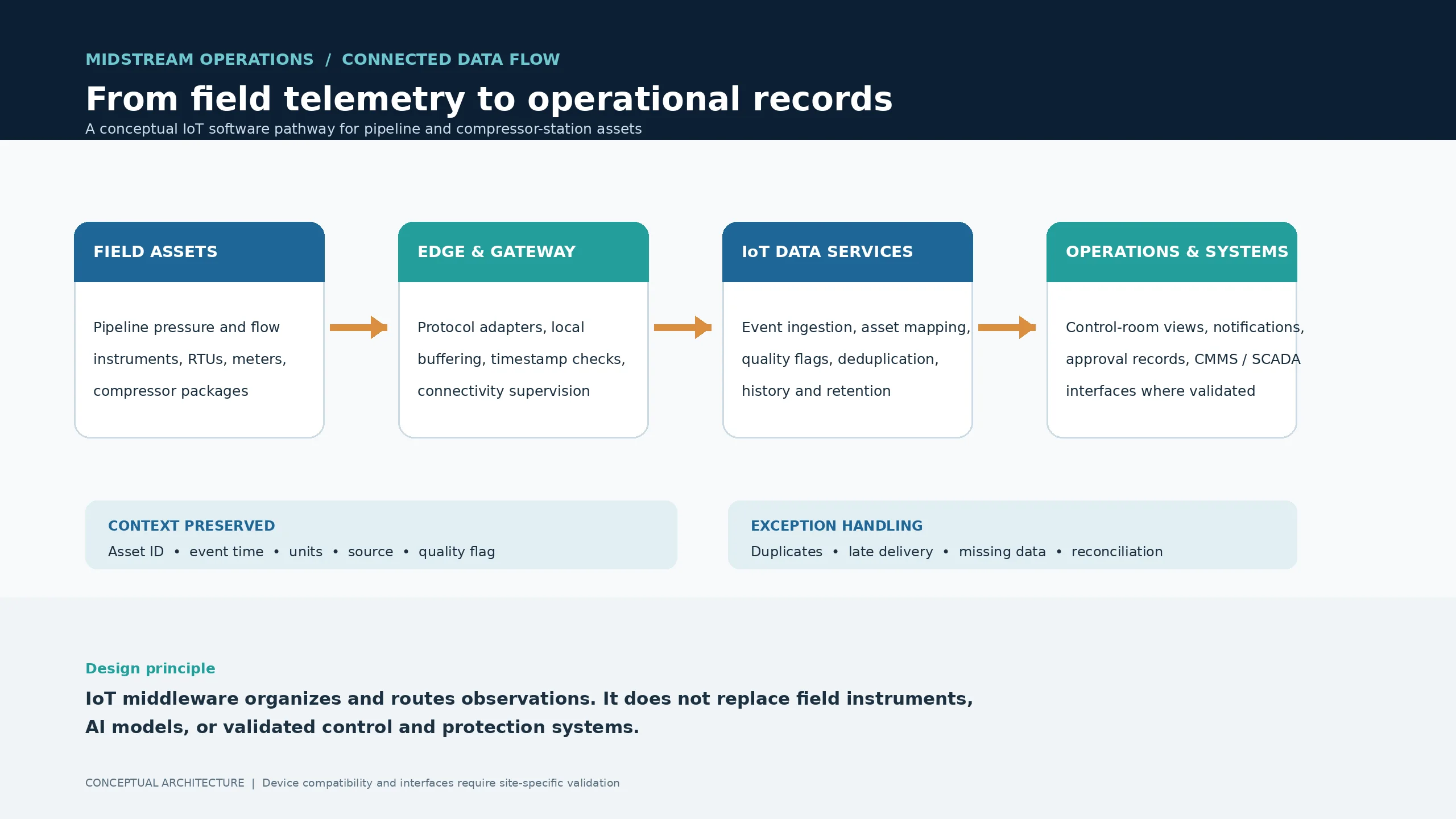
IoT middleware provides the software path between those field observations and the applications that use them. It can receive device messages, normalize their structure, associate them with asset records, apply data-quality checks, and route approved information to dashboards, historians, maintenance workflows, or other enterprise applications. The specific interfaces depend on the equipment, control-system boundaries, data ownership, and site architecture.
IoT software should remain distinct from three neighboring components:
Physical devices and instrumentation create the observations. Sensors, meters, transmitters, remote terminal units, and gateways remain responsible for physical measurement or communications at the field level.
AI software and analytics interpret data to identify patterns, estimate conditions, or support decisions. These functions are covered separately in the AI software and analytics discussion.
Control and protection systems perform validated equipment control and protective functions. An IoT dashboard, notification, or workflow request is not itself authorization to change a pipeline or compressor operating state.
This separation helps define responsibility when data is missing, a message is delayed, an alert is reviewed, or a proposed action requires approval.
Device Data Ingestion and Asset Association
An IoT data path begins with device adapters and event capture. Adapters translate supported device or gateway messages into a consistent internal representation. Before a message becomes an operational record, the receiving service should check its source, asset association, event timestamp, ingestion timestamp, measurement name, engineering unit, and data-quality status.
For midstream operations, asset association is especially important. A pressure value without a reliable pipeline segment, station, meter, or equipment identifier can be difficult to interpret and may be routed to the wrong workflow. Asset identifiers should map to an approved asset register or master-data source. Public examples should use fictional identifiers rather than genuine facility or equipment IDs.
Timestamp handling should distinguish when a measurement or event occurred from when the software received it. The system should retain the source time, ingestion time, and applicable time-zone convention. Where field devices use different clocks or communications paths, the ingestion process should identify clock drift, missing timestamps, and out-of-order delivery rather than silently treating receipt time as event time.
Device adapters and protocol choices are implementation options until tested against the actual device firmware, gateway configuration, network conditions, and site security requirements. A protocol name alone does not establish compatibility.
Device Lifecycle Management
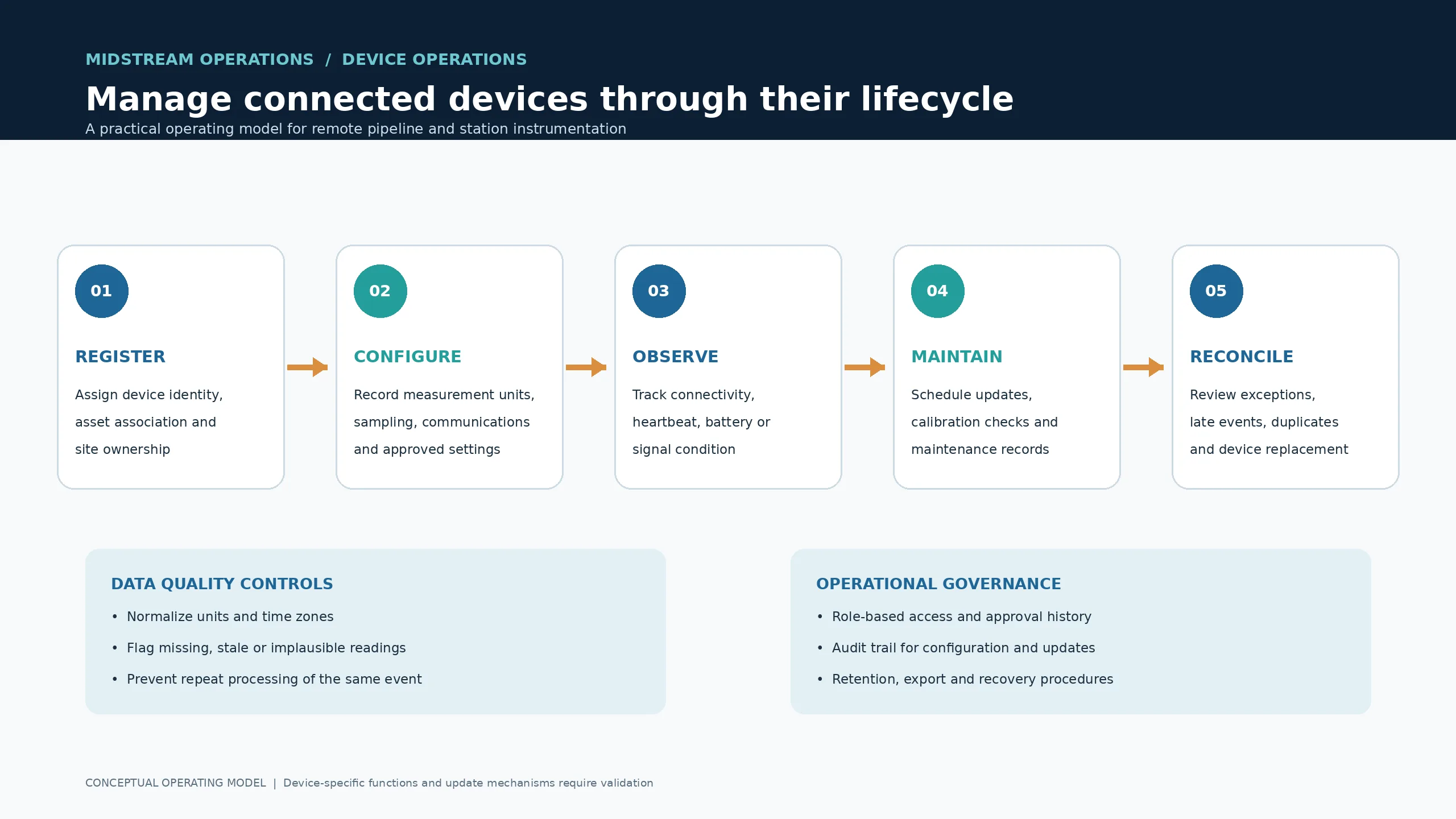
Connected devices need operational records throughout their service life. An onboarding process should register the device, assign its identity, associate it with the correct asset and site, record its owner, and document the data it is expected to provide. Configuration records should capture relevant measurement units, sampling expectations, communication settings, and approved changes.
Ongoing device-health monitoring can help identify loss of connectivity, missing heartbeats, abnormal reporting intervals, low battery status where applicable, or repeated communication errors. These indicators should be treated as device and data-path health information, not automatically as proof that the underlying pipeline or rotating equipment has changed condition.
Lifecycle records should also cover firmware or software updates where supported, configuration revisions, calibration references supplied by the responsible instrument owner, maintenance events, device replacement, and decommissioning. Update methods and maintenance responsibilities vary by device and must be confirmed during engineering review. Changes should be controlled, attributable, and recoverable.
Data Services, Quality, and Event Integrity
IoT data services preserve useful operational history and prepare observations for downstream use. Typical functions include time-series storage, event history, filtering, quality flags, duplicate detection, retention controls, and controlled data export. The appropriate storage and retention design depends on measurement frequency, operational purpose, regulatory and company requirements, and the systems that own the authoritative record.
Quality controls should distinguish valid measurements from missing, stale, out-of-range, estimated, or otherwise questionable values. Units must be explicit and consistent. A pressure measurement, for example, should not be interpreted without its unit and the identity of the measurement point. Filtering should not erase the original observation or hide why a value was excluded.
Duplicate handling is also essential. Gateways and networks may retry delivery after an interruption, so the same event can arrive more than once. The software should use a stable event identifier or another documented deduplication rule to prevent the same event from being counted or processed repeatedly. This is commonly described as idempotent processing: receiving the same event again does not create a second operational effect.
Delayed delivery requires a defined recovery process. The system should preserve the original event time, record the later ingestion time, identify out-of-order events, and reconcile the history without rewriting the sequence as if every message arrived on time. Buffering and replay behavior should be tested under realistic network interruptions.
Illustrative IoT Event Record
The following record is synthetic and uses fictional identifiers. It illustrates the context that should accompany a measurement; it is not a live PipeNex device record or evidence of a deployed connector.
| Field | Illustrative value |
|---|---|
| event_id | EVT-DEMO-00481 |
| asset_id | PIPE-SEG-DEMO-07 |
| event_time | 2026-10-21T14:32:10Z |
| ingestion_time | 2026-10-21T14:32:18Z |
| measurement | line_pressure |
| value / unit | 6.85 MPa |
| source_type | remote_terminal_unit |
| quality_flag | valid |
| dataset_label | synthetic_example |
The event time and ingestion time are both retained so an eight-second delivery delay remains visible. The asset identifier is fictional, the unit is explicit, and the quality flag communicates the result of the ingestion checks. A production data contract would also define required fields, allowed values, clock policy, duplicate rules, retention, access controls, and error handling.
Operational Dashboards, Notifications, and Audit Records
Operational views should help control-room personnel, measurement specialists, instrumentation technicians, and maintenance teams understand the status and history of connected assets. Depending on the approved use case, dashboards may present current telemetry, recent events, device-health indicators, data gaps, and exception queues. Views should make stale or questionable information visible rather than displaying it as current without qualification.
Notifications should be tied to a defined operational purpose, routing rule, and responsible role. A notification may direct a user to review a data gap, confirm an asset association, investigate a device-health issue, or follow an established maintenance process. Alert thresholds and escalation rules require site-specific review to avoid unnecessary notifications or missed exceptions.
Role-based permissions should determine who can view, acknowledge, annotate, approve, export, or change configuration. Where a workflow requires approval, the software should retain the request, reviewer, decision, timestamp, and any resulting work record. Audit trails should capture relevant configuration changes, access events, data corrections, and administrative actions.
Dashboards and notifications support situational awareness; they do not replace operating procedures, alarm management, independent protective systems, or the authority of designated personnel.
Integration with Midstream and Enterprise Systems
IoT software often sits between field data sources and systems that maintain operational, maintenance, measurement, or business records. Potential integration points may include supervisory control and data acquisition (SCADA) environments, computerized maintenance management systems (CMMS), enterprise resource planning (ERP) systems, historians, and asset-management applications. The appropriate connection depends on system ownership, approved interfaces, cybersecurity controls, and the operational purpose of the data exchange.
An integration design should define the source and destination of each data element, the authoritative owner of the asset identifier, event mapping, units, timestamp conventions, synchronization frequency, acknowledgment behavior, and handling of rejected records. It should also document what happens when a receiving system is unavailable, a message is malformed, or the same event is delivered more than once.
Middleware should not be described as an AI model or as a field device. It transports, validates, transforms, stores, and routes data according to defined rules. AI models may consume prepared records and return assessments or recommendations through a separate interface. Physical control remains subject to the validated control architecture, operating authority, and protective functions.
For deployment planning, teams should decide which functions need to operate locally during a communications interruption and which can depend on a remote server or cloud service. Local buffering, retry behavior, data recovery, monitoring, backups, and support ownership should be included in acceptance testing. Edge, customer-managed server, private-hosted, and cloud arrangements are options to evaluate, not a statement that every arrangement is currently offered.
Device Lifecycle, Governance, and Recovery
A reliable IoT implementation is maintained as an operational system, not treated as a one-time device connection. The operating model should assign responsibility for device registration, asset mapping, configuration approval, firmware or software maintenance, calibration records, access administration, retention, and incident response. Responsibilities may be divided among operations, instrumentation and controls, information technology, cybersecurity, and system integrators.
Recovery tests should cover communications loss, gateway restart, delayed message replay, duplicate delivery, clock mismatch, rejected records, device replacement, and restoration from backup. Acceptance criteria should state which data can be recovered, how gaps are identified, how event ordering is reconciled, and who approves corrections. A successful connection test alone does not establish reliable performance during a prolonged outage or across all field conditions.
Implementation and Evaluation Considerations
A project should begin with a bounded operational workflow and a defined set of assets. The team should document the devices and data sources involved, measurement purpose, expected event frequency, site connectivity, asset master-data ownership, user roles, and destination systems. This establishes the system boundary before selecting adapters, storage, dashboards, or deployment locations.
A pilot should test representative operating conditions rather than only a successful message path. Include normal reporting, missing observations, duplicate messages, delayed delivery, out-of-order events, device-health exceptions, and communications interruption. Evaluate event completeness, correct asset association, duplicate-processing rate, data-gap visibility, recovery behavior, reconciliation effort, and maintenance burden.
The implementation record should distinguish verified functions from proposed interfaces and untested assumptions. Device compatibility, protocol support, enterprise connectors, deployment options, and security controls should be documented with their validation status. No performance result should be published without a defined test scope, measurement method, and evidence package.
Related Technology and Architecture Resources
Identification Engine
Sensing Engine
System Integration and Deployment
System Integration Guide
Edge, Cloud, and Server Deployment
Technology and Integration
Implementation Status and Editorial Notes
This page explains IoT software functions and implementation considerations for midstream operations. It does not claim that PipeNex currently supports every named device, protocol, connector, hosting model, or integration. Confirm specific capabilities, supported interfaces, security controls, deployment options, and product maturity with the technical owner before publication.
The two visuals are original conceptual technical illustrations, not photographs of PipeNex equipment or customer deployments. They are intended to explain the data path and lifecycle workflow. If the final design requires stock photography of actual industrial personnel, select and license suitable midstream images separately and replace or supplement these conceptual visuals after rights review.
Next Step
Discuss your midstream IoT requirements with PipeNex. A useful technical review can define the target assets, field data sources, integration boundaries, device lifecycle responsibilities, connectivity constraints, and acceptance tests for a proposed workflow.
Contact PipeNex