
PipeNex | Midstream Operations Research
Cybersecurity, Physical Security, and Trusted Industrial AI Research for Midstream Operations
Explore cybersecurity, physical security, privacy, and resilience research for Physical AI and AIoT in midstream operations.
Explore the ResearchConnected industrial systems depend on trustworthy observations and authorized actions. Research for midstream operations examines how to protect devices, AI, command paths, mobile platforms, and physical assets while maintaining essential pipeline, compressor station, metering, and gas processing operations.
Why security research matters in midstream operations
Midstream operators rely on geographically distributed pipelines, compressor stations, pump stations, custody-transfer and metering facilities, gas processing plants, storage sites, and remote valve locations. Supervisory control and data acquisition (SCADA) systems, programmable logic controllers (PLCs), remote terminal units (RTUs), flow computers, industrial gateways, sensors, and communications links connect these assets to control rooms and operational applications.
That connectivity supports remote monitoring, alarm handling, maintenance coordination, and selected control functions. It also creates dependencies that must be understood across operational technology (OT), information technology (IT), field communications, physical access, and third-party support. A compromised account, manipulated measurement, unauthorized configuration change, or disrupted communications path can affect the integrity of operational information and the availability of essential workflows.
Physical AI and Artificial Intelligence of Things (AIoT) add further questions. Identification and sensing functions depend on the integrity of device identity and field observations. AI-supported decisions depend on trustworthy data, controlled model and software changes, and clear limits on what an AI agent may request. Physical action requires authenticated authority, bounded commands, independent safeguards where applicable, and evidence that the equipment reached the intended state.
PipeNex’s research direction considers these concerns as connected but distinct disciplines. Cybersecurity protects digital systems and information flows. Physical security addresses people, facilities, equipment, and access to critical locations. Privacy governs the collection and use of information about workers and site activity. Equipment safety remains a separate engineering responsibility. Security testing does not replace process-safety analysis, functional-safety validation, regulatory review, or site-specific engineering approval.
Research priorities for secure and trusted operations
Device identity, onboarding, and lifecycle management
Research can examine how field sensors, gateways, RTUs, PLCs, flow computers, cameras, and mobile inspection devices are identified, enrolled, configured, monitored, updated, and retired. Candidate methods include device inventories, certificate-based identity where appropriate, controlled provisioning, configuration baselines, ownership records, and revocation procedures. The work should account for legacy devices that cannot support modern authentication directly and may require compensating controls at gateways or network boundaries.
Network segmentation and restricted remote access
Pipeline control environments often include control centers, operations networks, remote compressor and pump stations, field telemetry, engineering workstations, historians, and vendor support paths. Research questions include how to define security zones and conduits, restrict traffic to operational need, separate enterprise and control functions, and provide time-limited, monitored remote access. Candidate methods include segmented architectures, hardened jump hosts, multifactor authentication, session recording, approval workflows, and passive network monitoring. Any design must preserve required control communications and safe operating procedures.
Sensor integrity and spoofing resistance
AIoT applications depend on field measurements and status observations. Research can assess how manipulated, replayed, stale, missing, or incorrectly associated signals affect pressure, flow, temperature, vibration, valve-position, equipment-status, and environmental interpretations. Candidate methods include cross-checking related measurements, plausibility constraints, time synchronization checks, source authentication where supported, sensor-health indicators, and explicit quality flags. The evaluation should distinguish an abnormal physical condition from a compromised or unreliable observation.
Secure AI agents and command authorization
An AI-supported workflow should not inherit unrestricted authority from the account or service through which it operates. Research can examine constrained tool access, least-privilege permissions, task-specific authorization, human approval, command allowlists, operating envelopes, rate limits, expiry of approvals, and independent validation of command targets. Tests should include stale process state, incorrect asset identity, denied authority, duplicate requests, partial execution, and loss of communications. A recommendation or work-order request must remain distinct from a command that changes physical equipment state.
Model, data, and software supply-chain integrity
Industrial AI depends on data pipelines, model artifacts, firmware, device configurations, libraries, deployment packages, and update services. Research questions include how to establish provenance, verify package integrity, control signing keys, record model and dataset versions, detect unauthorized changes, and roll back a faulty or compromised release. Candidate methods may include signed artifacts, controlled build and release processes, software bills of materials, protected repositories, reproducible evaluation records, and staged deployment. The page does not claim that any particular mechanism is currently implemented by PipeNex.
Physical access, perimeter, and asset security
Security extends beyond network boundaries to pipeline control centers, compressor stations, metering skids, valve sites, tank farms, gas processing facilities, communications shelters, and equipment enclosures. Research can examine how access-control records, visitor procedures, tamper indications, surveillance events, field inspection records, and asset identity can be correlated for review. The objective is to improve the quality and timeliness of security-relevant information without treating a camera alert or access event as proof of malicious activity.
Privacy in industrial sensing and workforce analytics
Cameras, access-control systems, location technologies, wearable devices, and operational logs may capture information about employees, contractors, and visitors. Research should define the operational purpose, minimum necessary data, role-based access, retention period, permitted use, and review process for each data source. Workforce analytics should not be treated as a substitute for direct safety supervision or a basis for unsupported judgments about an individual. Privacy, labor, and applicable legal requirements must be reviewed before any field data is used.
Incident containment, recovery, and verified restart
A cyber incident can require coordinated decisions across cybersecurity, control-room operations, instrumentation and controls, field operations, safety, and emergency response teams. Research can examine isolation of affected devices or network segments, preservation of evidence, safe fallback procedures, restoration from known-good configurations, staged reconnection, and independent confirmation of process conditions before restart. Recovery should be evaluated as an operational workflow, not only as restoration of IT services.
Mobile-platform perception and localization security
Where inspection robots, remotely operated vehicles, or other mobile platforms are relevant to a defined midstream task, research can examine manipulation of camera, ranging, positioning, map, and localization inputs. Candidate methods include consistency checks across sensors, map-version control, route constraints, operator supervision, safe-stop behavior, and isolation of a compromised fleet member. These topics should be included only when a specific asset inspection or facility workflow justifies them.
Secure teleoperation, fleet isolation, and cryptographic agility
Remote inspection and teleoperation introduce dependencies on operator identity, command freshness, communication integrity, device state, and recovery from interrupted sessions. Research can assess authenticated sessions, replay protection, bounded control authority, session expiry, safe communication-loss behavior, and controlled software updates. For fleets, tests may examine isolation of a compromised member and the integrity of shared maps or task data. Cryptographic agility and post-quantum migration can be studied as longer-term planning topics, including performance, interoperability, device constraints, and staged replacement requirements.
Research questions and candidate methods
The program can organize investigation around a small number of practical questions:
- Can a field device or gateway be reliably identified throughout onboarding, maintenance, ownership changes, and retirement?
- Can network segmentation and remote-access controls reduce unauthorized pathways without degrading essential telemetry or approved control tasks?
- Can manipulated, replayed, delayed, or misattributed sensor observations be detected before they influence an operational decision?
- Can an AI agent be restricted to approved data, tools, assets, and command types, with authorization renewed when task conditions change?
- Can operators trace a model output or command proposal to its input data, model version, software release, user or service identity, and approval record?
- Can physical access events and digital security events be correlated while respecting workforce privacy and access restrictions?
- Can a response team isolate a compromised component, recover trusted configurations, and verify physical process conditions before restoring normal operations?
Candidate methods include threat modeling for defined pipeline and facility workflows; asset and data-flow inventories; security-zone analysis; controlled adversarial testing; passive network observation; identity and authorization testing; signed configuration and software verification; and tabletop or hardware-in-the-loop exercises. Method selection should follow the operational question and the constraints of the test environment.
Proposed demonstration: isolated midstream security testbed
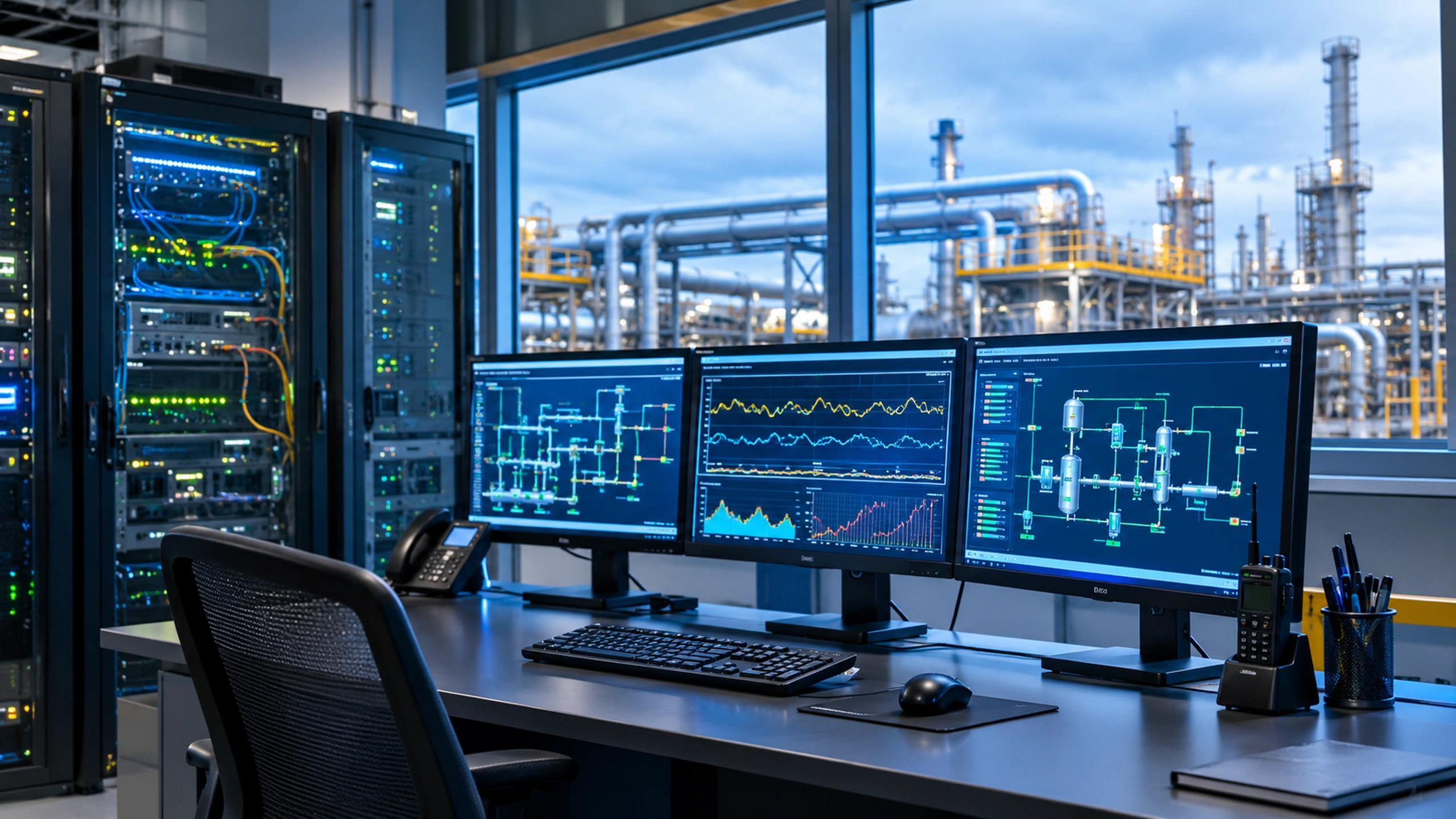
A proposed demonstration would use an isolated, authorized testbed representing a midstream control environment. The model could include a simulated control center, an OT network segment, a remote compressor-station gateway, representative PLC or RTU interfaces, simulated pressure and flow telemetry, a command gateway, and a controlled operator approval workflow. No live pipeline, production control network, or customer system would be connected.
The demonstration would establish a baseline configuration and then introduce controlled test conditions: an unknown or incorrectly enrolled device; an unauthorized remote-access attempt; a manipulated or replayed sensor observation; an expired or invalid command authorization; a compromised software or model update; delayed or lost communications; and a recovery scenario requiring restoration and verification.
The test would record the event source, asset identity, timestamp, security control under test, expected response, observed response, and operational effect. It would distinguish whether an event was blocked, detected, escalated, or missed. Where physical effects are represented only in simulation, the result must be labeled accordingly. A testbed result would not establish that a control is effective in every field installation or that a system is certified for operational use.
Evaluation measures
Evaluation should compare the candidate controls with a documented baseline under matched test conditions. Relevant measures include:
- Residual unauthorized-action success: unauthorized command attempts that result in an accepted or executed action, divided by the total unauthorized attempts in the defined test set.
- Detection delay: elapsed time between the defined start of a test event and its detection or escalation.
- False-alarm rate: security alerts that do not correspond to the defined test condition, reported against a stated observation period or event denominator.
- Legitimate-task degradation: change in completion rate, latency, availability, or operator workload for approved tasks when security controls are enabled.
- Recovery time: elapsed time from the defined incident trigger to restoration of the specified trusted operating state.
- Physical outcome verification: proportion of attempted eligible actions for which independent observations confirm the expected equipment or process state.
- Update and cryptographic resource cost: added processing time, memory, bandwidth, energy use, compatibility constraints, and maintenance effort associated with security changes.
Each measure needs a documented definition, unit, denominator, test duration, and acceptance criterion. Report adverse outcomes and cases where a control blocks a legitimate task. A low number of alerts does not by itself demonstrate security, and a successful command acknowledgment does not prove that the physical process reached the intended state.
Operational boundaries, limitations, and evidence status
Security controls must be evaluated against the realities of remote sites, intermittent communications, legacy control equipment, maintenance windows, vendor access, and the need to maintain safe operations. Active scanning or intrusive testing may be inappropriate for some operational devices. Testing should use passive methods or an isolated replica when active methods could affect availability or process behavior. Any field validation requires operator authorization, a reviewed test plan, defined rollback procedures, and coordination with control-room and site personnel.
This page describes a research direction and proposed methods. It does not claim a completed PipeNex cybersecurity product, a deployed security architecture, a customer pilot, measured field performance, regulatory compliance, or certification. No test results are reported here. Specific controls, integrations, supported devices, and implementation status must be confirmed before publication as product capabilities.
Research evidence should distinguish proposed investigation, an illustrative scenario, an executed simulation using synthetic data, a controlled bench or hardware test, a customer pilot, and an operational customer result. Synthetic data derived from private records still requires confidentiality and disclosure-risk review. Any simulation or testbed study should preserve its scenario specification, assumptions, data dictionary, code, configuration, test logs, calculated outputs, limitations, and review record.

Relationship to the PipeNex Physical AI and AIoT architecture
Security supports every stage of the Physical AI and AIoT architecture. Identification functions need trustworthy device and asset identity. Sensing functions need reliable measurements and clear data-quality indicators. AI decision functions need traceable inputs, controlled model versions, and explicit uncertainty handling. Physical action functions need authenticated command paths, bounded permissions, human authority where required, and independent outcome checks.
For the wider architecture, see the Physical AI and AIoT Engines Overview, AI Decision Engine, and Physical AI Action Engine. Implementation considerations are covered in IoT Software and System Integration and Deployment. Practical safeguards for buyers and implementation teams are addressed in the Cybersecurity and Physical Action Safeguards guide.
Research collaboration and next steps
The shared research initiative is attributed to Aperture Venture Studio, GAO RFID Inc., and GAO Tek Inc. The approved shared name, Aperture Physical AI Research Labs, should be used where applicable after confirming its current public description and relationship to PipeNex. Shared research does not imply a separate PipeNex research team, a completed PipeNex implementation, or a customer deployment. Company-specific activity, proposed demonstrations, and measured results should be identified separately.
The next step is to select one midstream workflow and define its assets, threat boundaries, data sources, command authority, baseline controls, test conditions, and acceptance measures. A focused discussion can determine whether the first evaluation should address remote access to a compressor station, integrity of pressure and flow telemetry, secure maintenance access, facility access-event correlation, or authorization of an AI-supported operational command.
Explore the PipeNex R&D hub for related research directions, including Verification, Human Oversight, and Emerging Connectivity, Distributed Intelligence, Robotics, and Autonomous Systems, and Industrial Knowledge, Learning, and Deployment. To discuss a midstream research question or a site-specific evaluation, contact PipeNex.
Discuss a midstream security research question
The next step is to select one midstream workflow and define its assets, threat boundaries, data sources, command authority, baseline controls, test conditions, and acceptance measures.
Contact PipeNex