
PipeNex | Midstream Operations Research
Verified AI Decisions and Physical Control Research for Midstream Operations
Explore research on constrained AI decisions, authorized pipeline equipment actions, and verified physical outcomes in midstream operations.
Explore the ResearchConnecting AI-supported decisions to pipeline and station equipment requires more than a correct recommendation. The operating context must be current, the requested action must fall within an approved scope, and the resulting physical state must be checked independently. PipeNex research examines how these requirements can be addressed in defined midstream workflows, including pipeline flow management, compressor and pump station operations, and remotely operated valve tasks.
The work focuses on the boundary between operational analysis and physical execution. It considers how industrial AI agents can use restricted command interfaces, how supervisory decisions can respect process limits, and how multi-step tasks should respond when conditions change or execution is incomplete. These are research questions and proposed evaluation areas, not claims that autonomous control is currently deployed by PipeNex.
Why verified control matters in midstream operations
Midstream systems move crude oil, natural gas, and related products through interconnected pipelines, terminals, storage facilities, compressor stations, and pump stations. Operating decisions depend on changing pressure, flow, temperature, equipment availability, line conditions, and maintenance constraints. A recommendation that ignores an operating mode, a stale instrument value, or a restricted asset state may be unsuitable even when its underlying analysis appears reasonable.
A decision-support system may help an operator review an abnormal pressure trend, compare pump or compressor operating options, or prioritize an inspection. A physical-control workflow adds a separate set of requirements: identify the correct asset, validate the requested command, confirm authority, use the designated control interface, and establish what actually happened. A command acknowledgment alone does not prove that a valve moved or that a process reached its intended state.
For this reason, the research boundary is supervisory decision-making and bounded action coordination. Existing safety instrumented functions, emergency shutdown systems, equipment interlocks, and validated low-level control loops retain their designated roles. AI-supported planning must not bypass or replace these protections.
Research questions and technical focus
Industrial AI agents with restricted equipment interfaces
Can an AI agent prepare a useful operational request while remaining limited to an explicit set of assets, commands, parameters, and time windows? Research questions include how permissions are represented, how requests are checked against current equipment state, and how the system prevents an agent from expanding its own authority. The command gateway, rather than the language model or planning agent alone, should enforce the approved scope.
Candidate methods include allow-listed command schemas, asset-specific permissions, parameter bounds, expiring approvals, precondition checks, and auditable request identifiers. Evaluation should include unauthorized requests, parameter substitution, replayed or duplicated commands, and attempts to act on an asset outside the assigned scope.
Adaptive supervisory control within process limits
Pipeline and station operations involve interacting constraints. Pressure and flow targets may depend on equipment curves, operating envelopes, pipeline conditions, product requirements, and available capacity. Research can examine whether optimization or adaptive supervisory methods can compare operating options while respecting constraints supplied by engineering and operations teams.
Candidate approaches include rule-based supervisory baselines, constrained optimization, model-predictive supervisory planning, and decision-support methods that present trade-offs to an operator. The research should distinguish supervisory recommendations from the regulatory control loops that maintain equipment and process variables. Any proposed operating limits must come from reviewed engineering documentation and site-specific approval, not from generic model assumptions.
Leak response and environmental intervention workflows
A midstream-relevant extension is the coordination of a response to a suspected leak or abnormal environmental condition. The research question is not whether an AI system can independently declare an incident or operate emergency equipment. It is how observations, alarm context, operator authority, approved response procedures, and subsequent measurements can be linked in a traceable workflow.
Candidate evaluation may examine whether the system preserves alarm priority, routes uncertain observations for review, records operator decisions, and verifies the status of any authorized follow-up task. Emergency response procedures and protective systems remain authoritative.
Multi-step planning under changing conditions
A station task may involve several dependent steps, such as checking equipment readiness, obtaining approval, issuing a bounded request, waiting for a response, and confirming the resulting state. Research will examine fresh-state checks, checkpoints, bounded retries, renewed authorization after material changes, and safe escalation when a task cannot be completed.
A planner should not blindly repeat a command after a timeout. It must first determine whether the equipment acted, partially acted, or remained unchanged. If the available observations cannot resolve that question, the task should remain unresolved and be referred to the responsible operator.
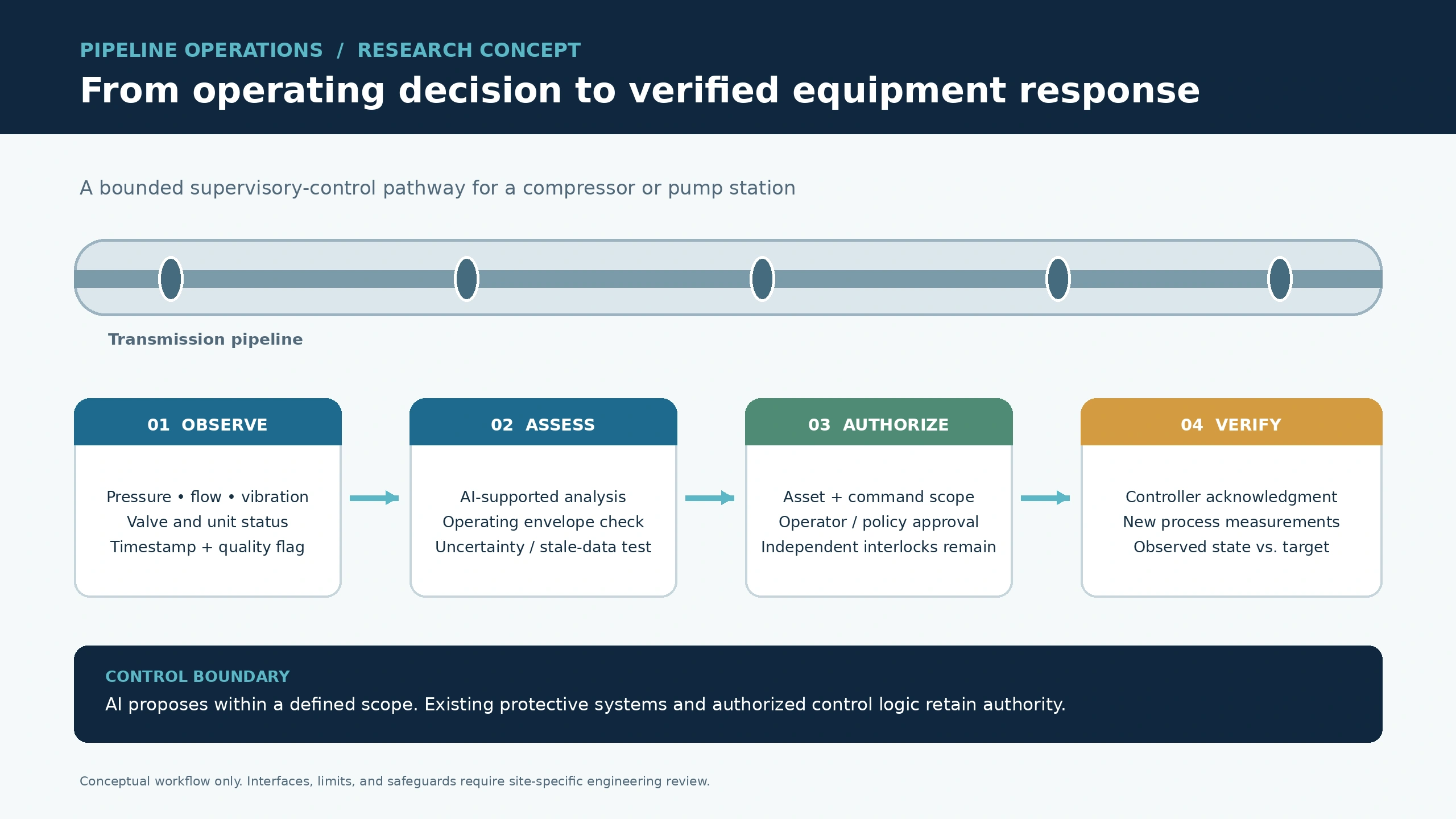
From operational decision to verified physical response
A proposed midstream control pathway separates observation, assessment, authorization, dispatch, and outcome verification. For example, a supervisory application might assess a pressure or flow condition at a compressor station and prepare a bounded request for operator review. The request would identify the target equipment, intended change, applicable limits, required preconditions, and expiry. Only an authorized command would pass to the designated interface.
Candidate methods, data, and integration requirements
A credible evaluation needs synchronized operational context rather than isolated sensor values. Candidate inputs include asset identifiers, timestamps, pressure and flow measurements, temperature, vibration where relevant, valve or unit status, operating mode, alarm state, maintenance restrictions, and the quality or freshness of each observation. Data availability and access must be confirmed for the selected facility.
The system boundary may include supervisory control and data acquisition (SCADA), programmable logic controllers (PLCs), remote terminal units (RTUs), historian records, equipment condition systems, and maintenance or work-management records. These are possible integration points, not verified PipeNex connectors or compatibility claims. Each project must document the actual interface, read or write permissions, update frequency, command semantics, timeout behavior, and responsible system owner.
Candidate data and platform requirements include:
- Time-aligned telemetry with units, quality flags, source identifiers, and operating-mode context.
- An asset register that binds each command and measurement to the correct pipeline segment, valve, pump, compressor, or station component.
- An approved command catalogue defining permitted operations, parameter ranges, preconditions, expiry, and required approval.
- Separate records for the decision proposal, authorization, command dispatch, controller acknowledgment, subsequent observations, and final outcome.
- Versioned models, rules, configuration, and audit records so an evaluation can be reproduced and reviewed.
The baseline should reflect a credible existing workflow, such as operator-led review using alarms, procedures, and current SCADA displays. A candidate method should be compared with that baseline under matched scenarios. The comparison should not assume that adding an AI planner improves an operation; it should establish where the method helps, where it abstains, and where it creates additional review work.
Proposed demonstration and evaluation
A suitable initial demonstration is a bounded equipment rig or a simulation of a remote valve or station task. The scenario should define one target asset, a limited set of permitted commands, explicit operating constraints, the required human approval, and an independent method for observing the resulting state. A simulation can test workflow logic and failure handling, but it cannot establish that a physical installation is safe, certified, or ready for deployment.
The demonstration should compare a fixed workflow with a candidate planner. It should include normal task completion as well as partial task completion, actuator failure, stale observations, delayed acknowledgment, communications loss, duplicate requests, and changed permissions. The test plan should retain the actual state separately from the observations available to the decision method so that evaluation does not accidentally expose hidden ground truth.
Evaluation measures
- Verified completion rate: eligible tasks with an independently confirmed target state divided by eligible tasks attempted, with exclusions stated.
- Unauthorized command rejection: prohibited or out-of-scope requests correctly blocked, alongside any unauthorized requests that pass the control boundary.
- Sequencing errors: tasks in which a required prerequisite, approval, or checkpoint is missed or executed out of order.
- Duplicate action rate: repeated physical requests for the same task where the repetition was not explicitly authorized.
- Constraint violations: attempted or completed actions that breach defined process, equipment, or task limits.
- Replanning time: elapsed time from a detected exception to a valid revised plan or escalation.
- Operator intervention: number and type of reviews, overrides, stops, and manual recoveries required.
- Outcome verification latency: time between command dispatch and independent confirmation or explicit unresolved status.
Report denominators, time windows, scenario coverage, run counts, and uncertainty. Separate routine operating scenarios from deliberately enriched fault cases. Report rejected commands and adverse outcomes alongside successful task completion. Do not use a favorable completion percentage as a substitute for evidence about rare but consequential failures.
Limitations, safeguards, and research status
The research is intended to clarify methods and evaluation requirements for midstream workflows. No PipeNex-specific controlled-rig results, field trials, customer deployments, or measured operational improvements are asserted on this page. Proposed methods should be labeled as proposed until implementation records and reviewed test evidence support a stronger status.
Simulation results depend on model structure, parameter assumptions, scenario coverage, and the fidelity of equipment behavior. A simulator may represent command logic and process response without capturing all field conditions, instrumentation faults, network behavior, mechanical wear, operator practices, or protection-system interactions. Physical validation is required before drawing conclusions about an actual site.
A controlled test should document its equipment boundary, test configuration, independent protection, stop conditions, responsible personnel, and approval. No experiment should issue commands to production equipment without the facility’s formal engineering, operational, cybersecurity, and safety authorization. A software workflow demonstration does not establish a safe physical control capability.
Research priorities should be selected against a specific midstream operating question. Building energy management and cold-chain interventions are not included as primary PipeNex topics because they do not define the core pipeline transportation and station-control boundary. Water or environmental process control is relevant only where a defined midstream facility workflow, equipment boundary, and responsible operator are identified.
Research program relationship
This page adapts a shared research initiative to PipeNex’s midstream operating context. The master program identifies Aperture Physical AI Research Labs as the shared research initiative and attributes the broader work to Aperture Venture Studio, GAO RFID Inc., and GAO Tek Inc. Shared research does not establish a separate PipeNex research team or prove that a particular method has been implemented by PipeNex. Company-specific activity, proposed demonstrations, and measured results must be recorded and reviewed separately.
The research connects the AI Decision Engine with the Physical AI Action Engine . Its implementation implications are also relevant to Physical Action and Control Technologies and the Cybersecurity and Physical Action Safeguards guide .
Related research and resources
Research hub
AI Decision Engine
Physical AI Action Engine
Physical Action and Control Technologies
Cybersecurity and Physical Action Safeguards
Authorized Physical Action in Midstream Operations
Use the research hub and shared program directory to navigate to other published research programs. Publish links only after the destination pages are available and their canonical URLs have been approved.
Discuss a midstream control research question
If your team is evaluating AI-supported decisions or bounded equipment actions, begin with one defined pipeline or station workflow. Identify the target equipment, operating objective, available telemetry, existing control boundary, required approvals, and independent outcome evidence. PipeNex can use that information to discuss a focused evaluation scope and the technical questions that need to be resolved before any physical integration is considered.
Discuss a midstream application