
PipeNex | Midstream Operations Research
Verification, Human Oversight and Emerging Connectivity for Midstream Operations
Explore research on verification, human oversight and resilient connectivity for Physical AI and AIoT in midstream pipeline operations.
Explore the ResearchPhysical AI and Artificial Intelligence of Things (AIoT) systems used in midstream operations must remain understandable and controllable when field observations are uncertain or communications degrade. Pipeline operators depend on timely information from compressor stations, pump stations, metering facilities, valve sites and other distributed assets. Research into verification, human oversight and emerging connectivity examines how these systems can detect unreliable inputs, preserve operator authority and confirm what happened in the physical environment.
Why verification matters across pipeline operations
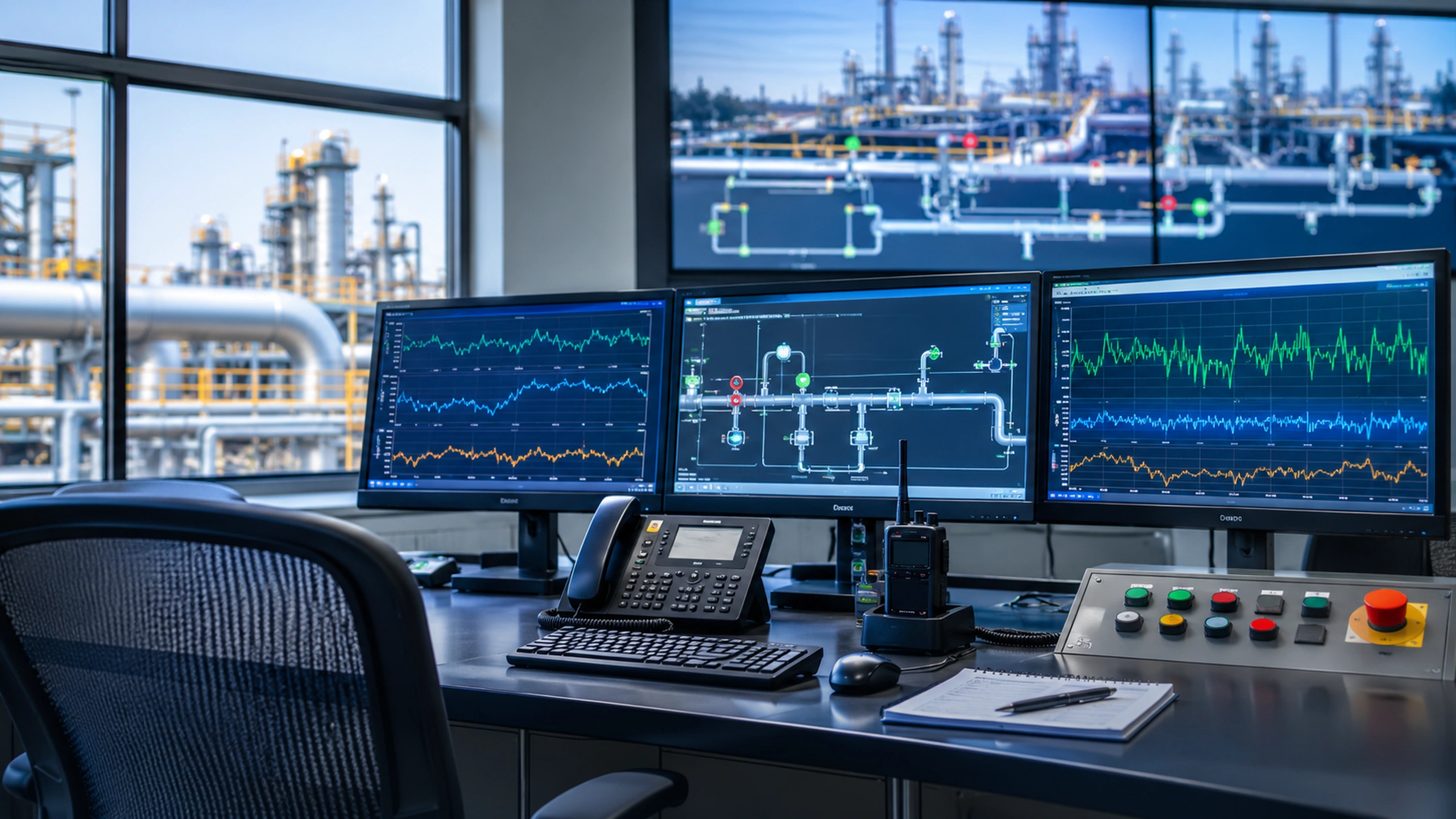
A telemetry value or command acknowledgment does not, by itself, establish the current condition of a pipeline asset or prove that an intended action occurred. A pressure reading may be delayed, a sensor may drift, a remote terminal unit may buffer data during an outage, or a command may reach a controller without producing the expected equipment response. Decisions based on incomplete context can create unnecessary alarms, delayed intervention or actions that no longer match the operating state.
For midstream applications, verification connects the information used by an AI-supported decision with independent evidence of the resulting condition. That evidence may include a subsequent instrument reading, controller status, equipment position, a separate measurement channel or an operator’s field confirmation. The appropriate evidence depends on the asset, process boundary, consequence of error and site operating procedures.
The research focus is not to remove operators from the control loop. It is to determine when an automated function can continue, when it should hold or reject a request, and when it should notify an authorized person for review.
Research areas
Runtime assurance and independent outcome verification
Runtime assurance examines system behavior while an application is operating. For a pipeline monitoring or equipment-support workflow, a monitoring layer can check whether inputs are current, whether the operating context is within the evaluated range, and whether a proposed response satisfies defined constraints. If a required condition is not met, the system can abstain, restrict its output or escalate the issue rather than proceed on an unsupported assumption.
Independent verification focuses on the physical result after a response. For example, a valve-position request should not be treated as completed solely because a message was acknowledged. A separate position indication or other approved confirmation is needed to establish whether the expected state was reached. The research questions include which signals are sufficiently independent, how disagreement between sources should be handled, and how verification evidence should be recorded.
Human oversight and operator decision support
Control-room personnel need concise, actionable explanations when an AI-supported system flags an abnormal condition or proposes a response. Relevant context may include the affected asset, the measurements used, data age, uncertainty, operating mode, applicable constraints and the reason for escalation. The operator should be able to understand what is known, what remains uncertain and what decision is being requested.
Research can examine the timing and design of operator interventions, including acknowledgment, review, approval, rejection and override. It should also consider alarm load, competing tasks, shift handovers and the consequences of repeated low-value notifications. Human oversight is effective only when the person has adequate context, authority and time to act.
Communication-aware sensing and control
Remote midstream assets may rely on wired infrastructure, industrial wireless links, cellular service, radio systems or other communication arrangements. The suitability of each option depends on site coverage, latency, availability, power, environmental conditions, maintenance access and the function being supported. Wireless sensing and integrated sensing and communication are research topics, not evidence that a particular PipeNex device or network configuration is currently supported.
A communication-aware application considers more than whether a link is connected. It can evaluate message age, sequence, delivery delay, loss, duplication and reordering. It can also distinguish a fresh measurement from a value that has been held during an outage. The system response should reflect the age and quality of the information, rather than treating all received values as equally current.
Hybrid terrestrial and non-terrestrial connectivity for remote assets
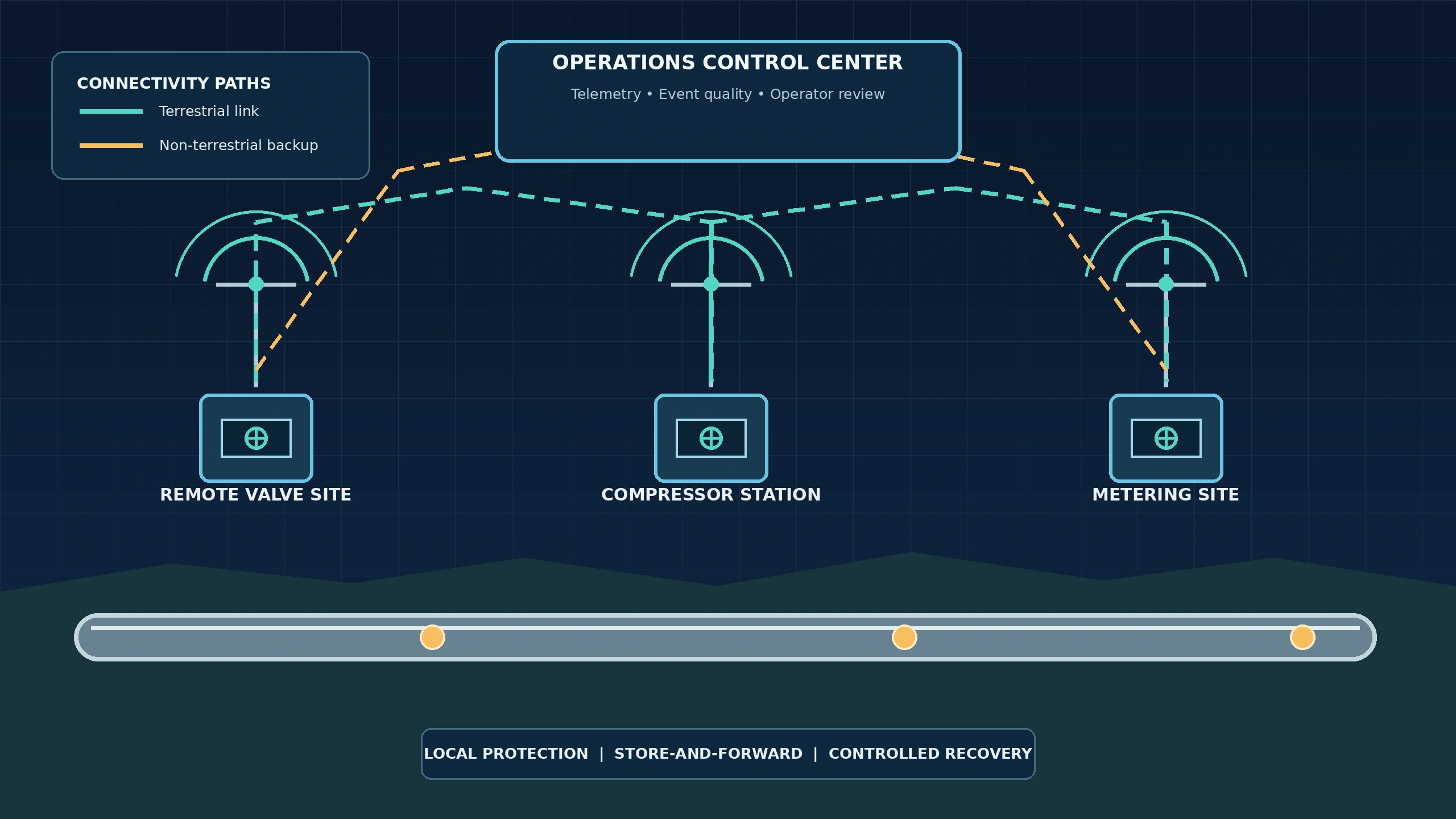
Some remote pipeline locations may have limited terrestrial coverage or face intermittent network availability. Research can assess whether a hybrid arrangement that combines available terrestrial links with non-terrestrial communication can improve the delivery of selected monitoring data. The design must account for bandwidth, latency, service continuity, cost, power demand, data prioritization and cybersecurity.
Loss of wide-area connectivity must not remove local protective functions or transfer authority to an unverified remote process. Site-level control and independent protective systems must remain governed by the facility’s approved engineering design. A restored connection should trigger controlled data reconciliation and state confirmation before any deferred request is considered.
Research questions for midstream applications
- How can a system identify stale, missing, duplicated or reordered telemetry before that information influences an operational recommendation?
- Which independent measurements or status signals are appropriate for verifying a selected equipment response at a compressor station, pump station or remote valve site?
- When should an AI-supported function continue in advisory mode, request operator approval, abstain or enter a restricted state?
- How should explanations present uncertainty, data age, operating context and the basis for escalation without increasing control-room workload?
- What local functions should remain available during a loss of wide-area communications, and what conditions should be checked before normal operation resumes?
- How do terrestrial and non-terrestrial communication options affect measurement age, intervention time, data completeness and recovery for remote pipeline assets?
Proposed demonstration and evaluation approach
A proposed demonstration can use a bounded pipeline operations scenario represented in a controlled test environment or simulator. The scenario should include a remote asset with pressure, temperature, flow or equipment-status observations; a supervisory decision workflow; an operator review point; and a defined outcome check. Numerical operating limits must be selected through engineering review for the specific scenario. This page does not prescribe deployment settings.
The test should introduce communication and information faults deliberately, including delayed, dropped, duplicated and reordered messages; uncertain or conflicting observations; a stale command request; an unavailable communication path; delayed human intervention; and recovery after service returns. Candidate oversight and fallback policies can then be compared with a documented baseline policy under matched test conditions.
Evaluation measures
- Detection coverage: proportion of injected communication or observation faults correctly identified under the defined test conditions.
- Detection and intervention latency: elapsed time from fault introduction to system detection, escalation and authorized human response.
- Stale-command rejection: proportion of requests rejected when the supporting observation or authorization is no longer valid.
- Operator workload: review time, intervention frequency, repeated alerts and unresolved tasks during the test window.
- Retained functions: monitoring, local control and protective functions that remain available during specified communication failures.
- Recovery performance: time to restore data flow, reconcile buffered events, confirm current asset state and resume permitted functions.
- Verification coverage: proportion of attempted eligible actions with an independently confirmed physical outcome.
Results should include adverse cases and situations in which the candidate method performs no better than the baseline. Formal verification claims must identify the exact properties checked, assumptions, modeled interfaces and excluded conditions. A proof about a bounded model does not establish that the complete physical installation is safe or correct.
Data, interfaces and platform requirements
A credible evaluation needs timestamped observations with asset identity, units, operating mode, source, quality status and data-ingestion time. It should preserve the distinction between the physical event time and the time a message reaches the application. Decision proposals, operator approvals, command requests, acknowledgments and independently observed outcomes should be stored as separate linked records.
The implementation boundary should identify the relevant supervisory control and data acquisition (SCADA) environment, programmable logic controllers (PLCs), remote terminal units (RTUs), gateways, sensors, historian records and operator workflows. The actual interfaces and read/write permissions must be confirmed for each facility. Candidate wireless or satellite connectivity should be treated as an option for evaluation until coverage, performance, security and integration are demonstrated.
The research may also examine bounded formal verification of specified action properties and interfaces to foundation models. Such work should constrain model outputs to defined schemas and allowed operations, validate requests before they reach an operational interface, and preserve human authorization where required. A language-model explanation or generated plan is not a substitute for deterministic command validation or independent protective functions.
Limitations and current research status
The research program identifies runtime monitoring and assurance, human intervention, operator explanations and workload, communication-aware behavior, and recovery during degraded operation as areas for investigation. The shared research initiative is attributed to Aperture Venture Studio, GAO RFID Inc. and GAO Tek Inc., and uses the approved shared name Aperture Physical AI Research Labs. This relationship does not establish a separate PipeNex research team, a completed midstream experiment, a customer deployment or a commercially available connectivity feature.
The proposed midstream evaluation described here is a research direction. No PipeNex-specific test results, validated field performance, formal assurance proof, supported satellite service, certified safety function or customer outcome is claimed on this page. Any future publication of results should state the test environment, assumptions, evidence type, implementation status, evaluation method, limitations and review date.
How this research relates to the PipeNex engines
Verification and oversight support the full Physical AI and AIoT workflow. Identification associates observations with the correct pipeline asset. Sensing captures operating conditions. The AI Decision Engine interprets the available context and produces a recommendation or decision proposal. Where a physical response is in scope, the Physical AI Action Engine connects an authorized decision to an approved operational interface. Feedback then records the observed result.
Identification
Associates observations with the correct pipeline asset.
Sensing
Captures operating conditions.
AI Decision Engine
Interprets the available context and produces a recommendation or decision proposal.
Physical AI Action Engine
Connects an authorized decision to an approved operational interface where a physical response is in scope.
These assurance functions do not add another engine. They provide cross-cutting checks for data quality, decision authority, action boundaries and outcome evidence. The appropriate deployment may remain advisory or human-approved; bounded automation should be considered only after the relevant interfaces, protections and operating assumptions have been validated.
Related resources
Explore PipeNex research
Explore PipeNex research for the wider research program directory.
Physical AI Action Engine
Physical AI Action Engine explains the connection between authorized decisions, execution interfaces and physical outcome feedback.
System Integration and Deployment
System Integration and Deployment covers enterprise interfaces, edge and server deployment, and integration responsibilities.
Cybersecurity and Physical Action Safeguards
Cybersecurity and Physical Action Safeguards addresses security controls around connected devices and command paths.
Verified AI Decisions and Physical Control Research
Verified AI Decisions and Physical Control Research provides related research on constrained decisions and verified equipment actions.
Discuss a midstream assurance evaluation
Discuss a defined pipeline or facility workflow with PipeNex. A useful evaluation starts with the asset boundary, available telemetry, existing operator procedures, communication conditions, authorized interfaces and the physical outcome that must be verified.
Contact PipeNex