
PipeNex | Midstream Operations Solutions
Asset and People Tracking and Traceability for Midstream Operations
Midstream operations depend on knowing which assets and materials are moving, where critical equipment is located, and which personnel are present in defined operating areas.
Explore the SolutionMidstream operations depend on knowing which assets and materials are moving, where critical equipment is located, and which personnel are present in defined operating areas. PipeNex explores Physical AI and Artificial Intelligence of Things (AIoT) approaches that connect identification and location observations with operational records. The right design starts with the task: tracking a pipe spool through a maintenance handover is different from confirming contractor access or supporting an emergency muster.
Traceability Across Pipeline and Terminal Workflows
Pipeline operators, gas processing facilities, storage terminals and related midstream sites manage equipment and materials across dispersed locations, work fronts and contractors. A physical transfer may be recorded in a work package, inventory system or maintenance record, while the corresponding movement happens in the field. When those records are disconnected, teams may need to reconcile asset identity, location, custody and receipt manually.
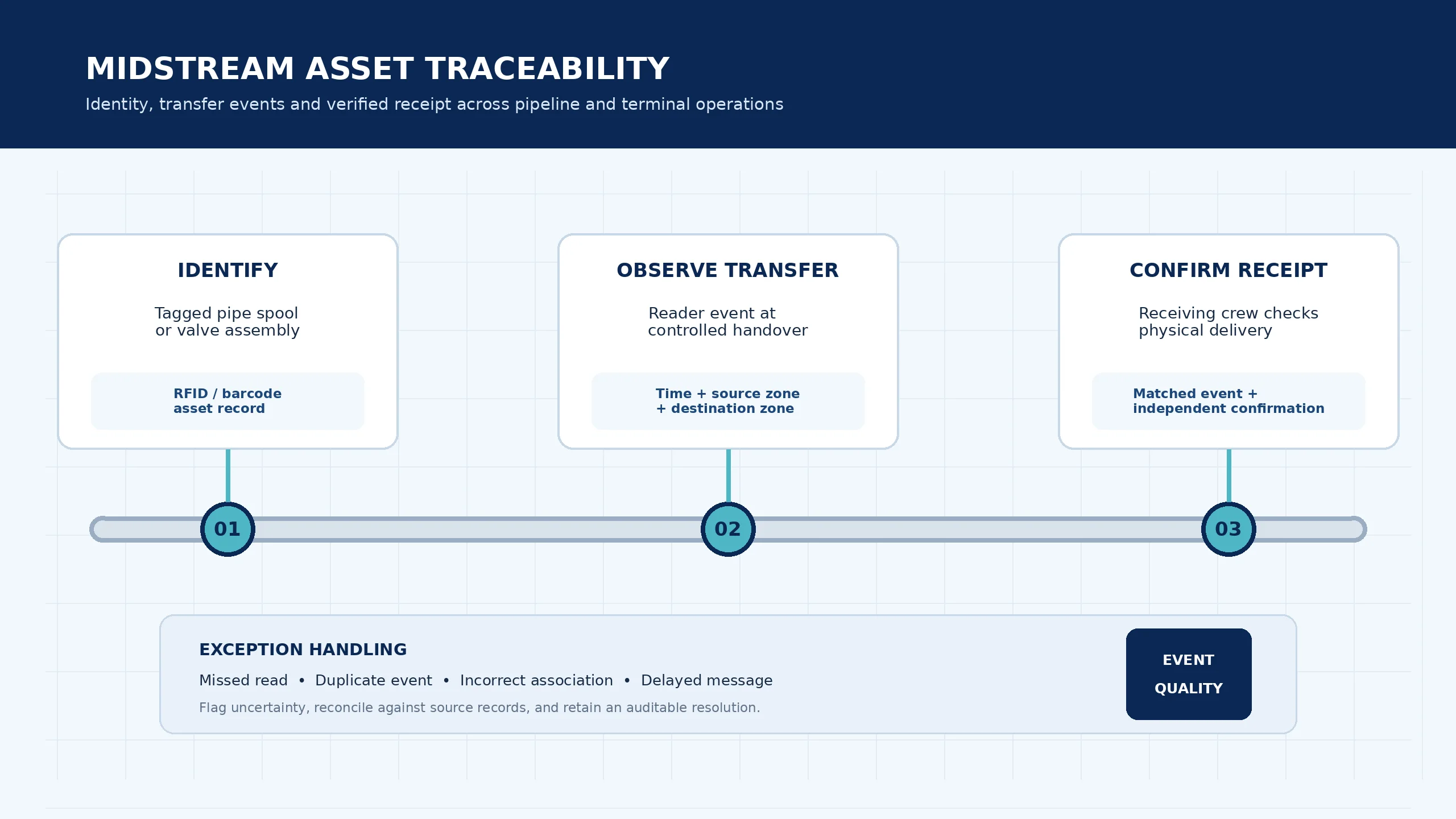
A traceability workflow links an identifiable item to a sequence of time-stamped events. Depending on the operating task, the item may be a pipe spool, valve assembly, meter component, pump package, maintenance tool, inspection instrument or other controlled asset. The record can capture the asset identifier, observation time, reader or observation source, source location, destination location, event type and confirmation status.
For example, a valve assembly issued from a maintenance store may be identified at dispatch, observed at a designated site handover point and checked by the receiving crew. The system should distinguish an observed tag read from a confirmed transfer. A scan near a destination does not, by itself, prove that custody changed or that the correct item was accepted.
Personnel Visibility for Defined Site Purposes
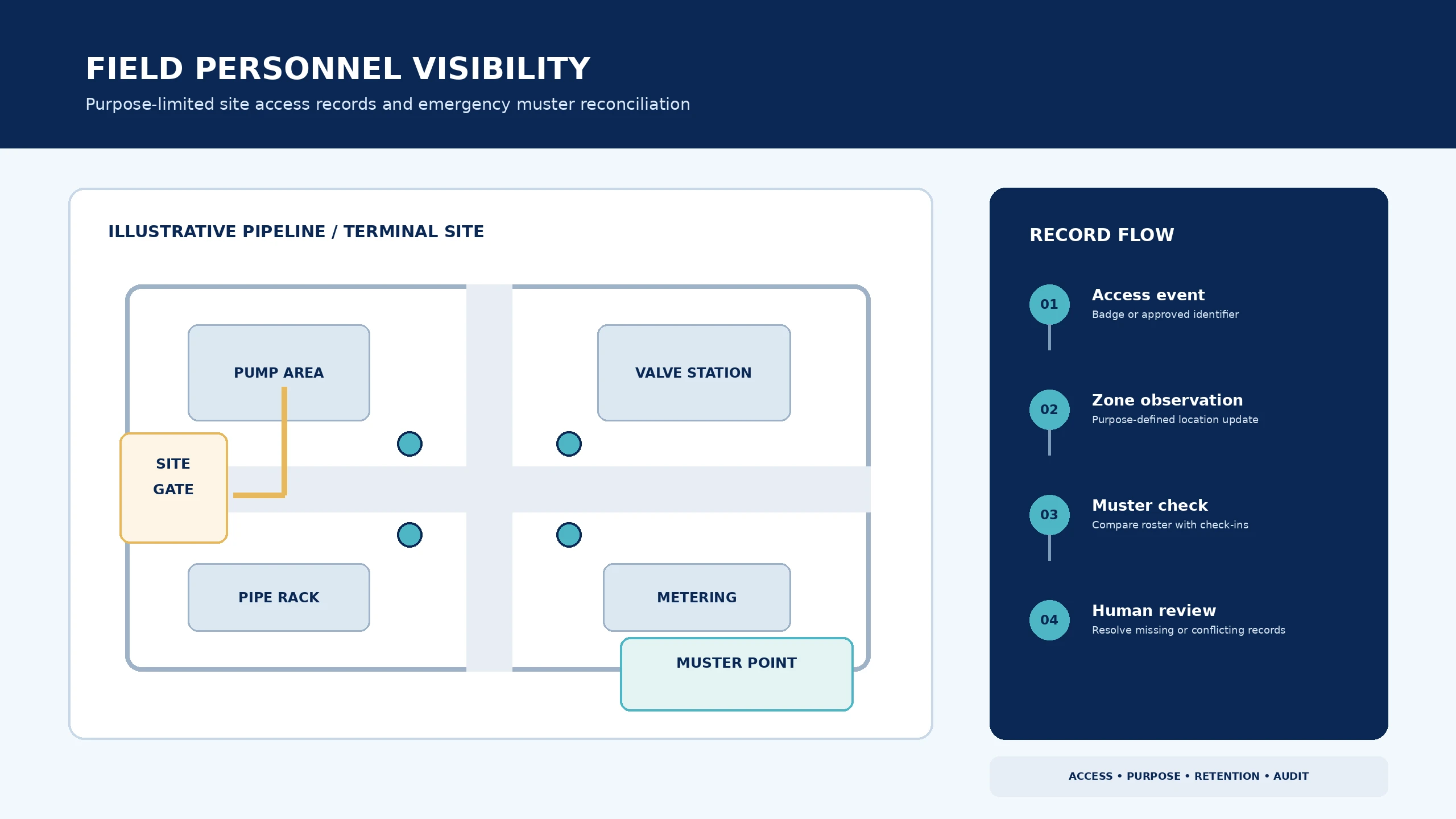
Personnel tracking addresses a different operational question from material traceability. At a pipeline station, compressor site or terminal, operators may need records of site entry, access to restricted zones, contractor presence or personnel check-in during an emergency muster. The purpose, location granularity and update frequency should be defined before selecting a technology.
A site-access workflow may associate an approved badge or other authorized identifier with an entry event and a designated work area. An emergency muster workflow may compare the authorized site roster with check-ins at assigned muster points. Location observations can help identify records that need review, but tracking technology alone cannot guarantee that every person has been accounted for. Procedures, communications, supervisors and physical verification remain essential.
Personnel information requires stricter governance than ordinary equipment records. Define who may view identifiable location data, which operational purposes are permitted, how long records are retained, how access is audited and how exceptions are handled. Apply the organization’s privacy, labor, safety and security requirements before collecting or using personnel-location information.
Choose Identification Technology by Operating Requirement
No single identification or location technology is appropriate for every midstream environment. Selection depends on whether the requirement is a reliable identity read at a known point, a zone-level presence event or more detailed location information. The physical setting also matters: metal pipework, steel structures, hazardous-area requirements, weather exposure, radio interference, line of sight, power availability and maintenance access can affect installation and performance.
RFID for Identity and Transfer Events
Radio-frequency identification (RFID) can support item identification at controlled checkpoints, such as a warehouse issue point, maintenance staging area, gate or designated handover zone. Passive RFID tags do not require an onboard battery, while active RFID devices have their own power source and may support different observation patterns. Tag selection, reader placement, antenna orientation, nearby metal and read-zone design must be evaluated at the actual site.
Bluetooth Low Energy for Presence and Proximity
Bluetooth Low Energy (BLE) beacons and receivers can support proximity or zone-presence workflows when the required coverage and update behavior are suitable. The design must account for beacon power, mounting, radio propagation, receiver placement and the difference between detecting a beacon and establishing a precise position. BLE should not be described as providing a universal location accuracy.
Ultra-Wideband for More Granular Location Tasks
Ultra-wideband (UWB) may be evaluated where a workflow requires more detailed real-time location information, such as tracking selected high-value equipment or supporting a defined personnel-location use case. Anchors, tags, geometry, synchronization, calibration, coverage and site conditions influence results. A site survey and representative field test are needed before making accuracy or coverage commitments.
Vision for Observed Objects and Controlled Areas
Fixed or mobile cameras may support visual identification or observation at selected gates, loading areas and controlled work zones. Performance depends on camera placement, lighting, occlusion, weather, viewing angle, image quality and the ability to distinguish similar objects. Video-based workflows also require appropriate privacy, cybersecurity, retention and access controls.
Turn Raw Observations into Reliable Operational Events
A tag read, beacon detection or camera observation is not yet a complete traceability record. Event processing must associate observations with the correct asset or authorized person, align timestamps, interpret the location or checkpoint, and preserve data-quality status. Relevant records may include the entity identifier, event time, observation time, source location, destination location, observation source, event type and resolution status.
The event pipeline should explicitly handle common data-quality conditions:
- Missed observations, where an expected read or location update is absent.
- Duplicate events, where the same observation is received more than once.
- Stale or delayed messages, where network delivery occurs after the physical event.
- Incorrect associations, where a tag, badge or visual record is linked to the wrong entity.
- Conflicting events, where sources report incompatible locations, times or transfer states.
Use event rules and, where appropriate, artificial intelligence (AI) to identify inconsistencies and prioritize review. Do not silently convert an uncertain observation into a confirmed movement. Keep the original observation, the interpreted event, any manual correction and the person or process responsible for resolution. This creates an auditable record for operations, inventory, maintenance and asset-integrity teams.
Connect Traceability with Midstream Business Systems
Tracking becomes operationally useful when verified events can be associated with the records already used by the organization. Depending on the workflow, relevant destinations may include enterprise resource planning (ERP), computerized maintenance management systems (CMMS), warehouse or inventory applications, work management tools, contractor-management records and supervisory systems. The specific interfaces, data ownership and integration method must be established during requirements assessment.
A practical integration design defines asset identifiers, event types, time zones, units where applicable, source-system references, duplicate handling, access permissions, retention rules and behavior during network outages. Edge gateways may buffer observations when connectivity is intermittent and forward them when communication is restored, subject to the selected architecture. Any proposed connector or protocol should be validated against the actual systems and versions in use.
Decisions, Follow-Up and Operational Boundaries
A tracking workflow can support exception review, inventory reconciliation, maintenance coordination, transfer confirmation and site-access oversight. For example, an unresolved asset transfer can be routed to a storekeeper or field supervisor for confirmation. A personnel muster discrepancy can be escalated to the designated emergency coordinator for direct verification. The tracking record informs the response; it does not replace operational authority or established safety procedures.
PipeNex’s Physical AI and AIoT approach should keep identification, sensing, decision support and physical action distinct. Asset or personnel observations establish a view of what may have happened. Rules or AI-supported analysis can identify a discrepancy and recommend follow-up. Any consequential action remains subject to defined authorization, site procedures and independent verification. Tracking alone is not physical control.
Measure Tracking Quality in a Site Pilot
A pilot should test the complete workflow under representative operating conditions, not just whether a tag or badge can be read in a controlled demonstration. Agree on the baseline, event definitions, observation points, users, operating calendar and acceptance criteria before collecting results. Include routine operations as well as realistic exceptions such as missed reads, duplicate events, network interruptions and delayed responses.
- Event completeness: correctly captured required events divided by required ground-truth events.
- False-event rate: events incorrectly reported as valid, measured against a defined observation period or event population.
- Reconciliation time: time required to resolve an asset or personnel-record discrepancy.
- Association error: observations linked to the wrong asset, material or authorized person.
- Maintenance effort: effort required to install, inspect, calibrate, replace or service tags, readers, anchors, cameras and gateways.
For personnel workflows, separately evaluate access-record completeness, muster reconciliation time, exception handling and compliance with privacy and retention controls. Do not infer emergency-muster completeness from radio coverage alone. A site pilot should include direct checks against an authorized roster and documented response procedures.
Compare results with the current process and report the test conditions, sample size, exclusions and unresolved limitations. A simulated study can help define event logic and test edge cases, but it does not establish field accuracy. Physical validation is required for coverage, association quality, integration behavior, user adoption and operational response time.
Plan a Midstream Tracking and Traceability Assessment
Start with one defined workflow and one asset or personnel use case. Identify the operating boundary, locations, asset classes, users, observation points, source records and the decision that depends on each event. Then assess the physical environment, candidate identification technologies, network conditions, integration requirements, data governance and measures of success.
PipeNex can discuss how an asset-transfer or personnel-visibility workflow could be evaluated in your pipeline, compressor-station or terminal environment. The next step is to define the operational question, confirm the site constraints and agree on the evidence a pilot must produce.
Discuss your tracking and traceability requirementsRelated resources
Identification Engine
Explains identity, location, movement and traceability functions.
IoT Software
Covers device data, event processing, records and operational applications.
Identification and Sensing Hardware
Supports evaluation of tags, readers, anchors, cameras, gateways and edge hardware.
RFID vs. BLE vs. UWB
Provides a technology-selection comparison.
Cybersecurity, Physical Security and Trusted Industrial AI
Relevant to access, data protection and trusted use.
Contact PipeNex
Next step for a site-specific requirements discussion.
Plan a Midstream Tracking and Traceability Assessment
PipeNex can discuss how an asset-transfer or personnel-visibility workflow could be evaluated in your pipeline, compressor-station or terminal environment. The next step is to define the operational question, confirm the site constraints and agree on the evidence a pilot must produce.
Discuss your tracking and traceability requirements