PipeNex | Midstream Operations Research
Equipment Health Inspection and Quality Intelligence Research
Explore equipment diagnostics, pipeline inspection, defect detection, and risk-based maintenance research for midstream operations.
Explore the ResearchMidstream operations depend on the integrity and availability of pipeline systems, compressor and pump stations, valves, metering equipment, and associated infrastructure. Equipment condition is rarely explained by one measurement. Vibration, temperature, pressure, flow, acoustic signals, electrical data, inspection findings, and maintenance history must be interpreted in the context of asset identity, operating mode, and service conditions.
PipeNex’s research direction examines how Physical AI and the Artificial Intelligence of Things (AIoT) can support equipment diagnostics, pipeline inspection, defect assessment, and maintenance prioritization. The focus is on methods that can be evaluated against representative midstream operating data, with clear limits on what can be concluded from incomplete failure histories, sparse defect examples, or simulated observations.
Why condition intelligence is difficult in midstream operations
A compressor operating at a different load may show vibration and temperature changes that resemble early deterioration. A pump’s pressure and flow behavior can change with process demand. A pipeline inspection finding may require comparison with earlier wall-thickness measurements, corrosion records, coating condition, operating history, and the location of the inspected feature. Without this context, an analytics system can mistake normal operating variation for a fault or overlook a developing condition.
Midstream inspection also spans different physical environments. Compressor stations concentrate rotating machinery, drivers, coolers, piping, valves, and instrumentation. Pipeline systems extend across buried, exposed, elevated, and water-crossing sections, where access, soil conditions, weather, and inspection coverage vary. A useful research method must account for these differences rather than assume that one model or sensor configuration applies to every asset.
Research priorities
Transferable predictive maintenance and equipment diagnostics
This research area examines whether diagnostic methods developed with data from one pump, compressor, motor, or fan can be adapted to another unit or operating regime. Candidate inputs include vibration spectra, bearing and casing temperatures, acoustic measurements, motor current, rotational speed, suction and discharge pressure, flow, load, start-stop events, alarm history, and maintenance records. Each observation should be associated with the correct asset, timestamp, operating mode, and measurement quality.
A central question is how to distinguish deterioration from changes in throughput, pressure ratio, ambient temperature, or operating load. Candidate methods include physics-informed features, trend and threshold analysis, anomaly detection, and domain adaptation. Remaining useful life estimation should be considered only when the available degradation history and validation data support it. Where failure labels are scarce, a method should be able to communicate uncertainty or abstain from a diagnosis rather than present an anomaly as a confirmed fault.
Research questions include how much additional data is needed to adapt a model to a different machine, which operating variables explain a change in condition, and how diagnostic performance changes when the test asset or operating regime was not represented during training. A credible baseline may include existing alarm limits, condition thresholds, or the current inspection and maintenance workflow.
Multimodal pipeline and equipment inspection
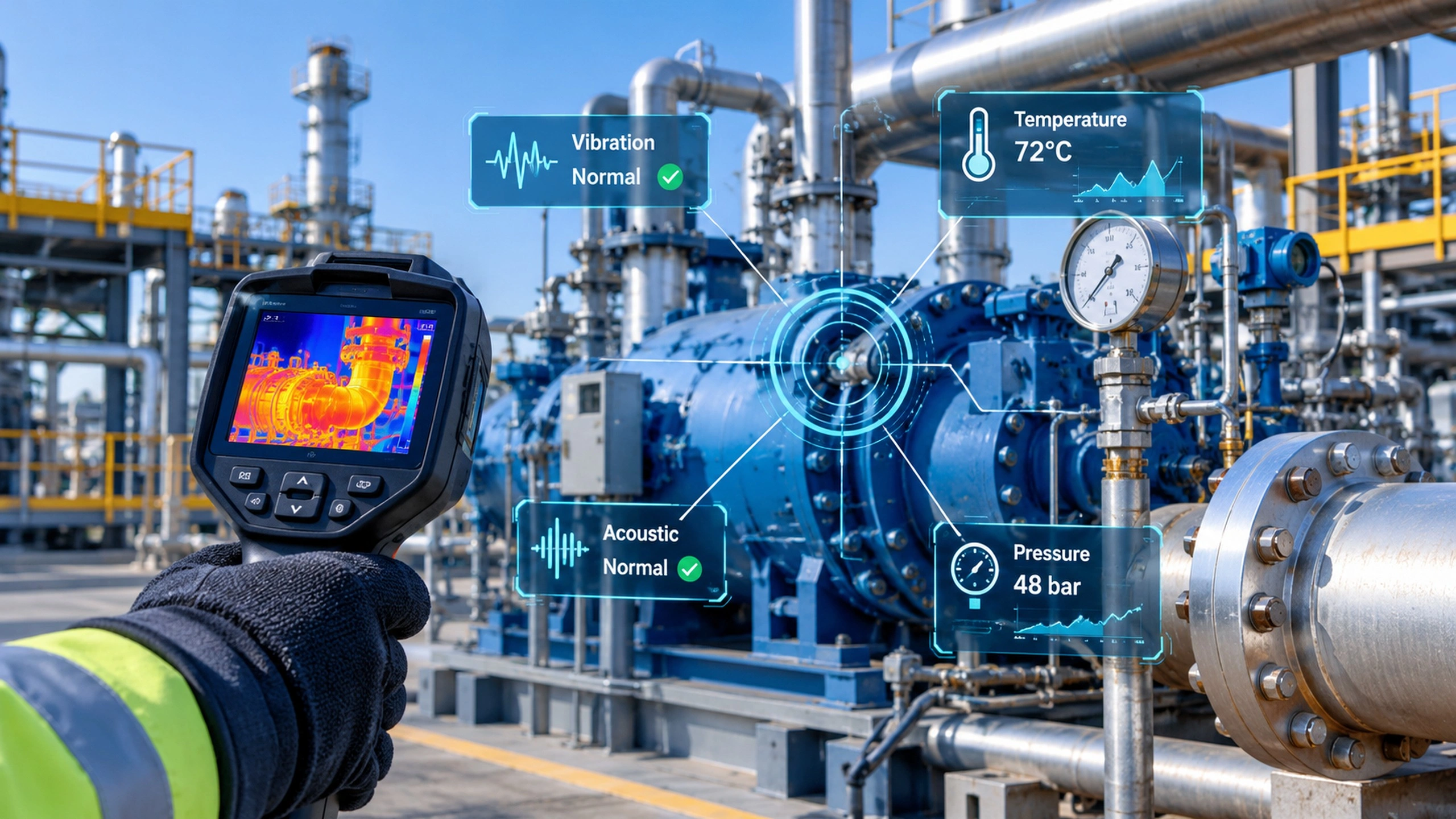
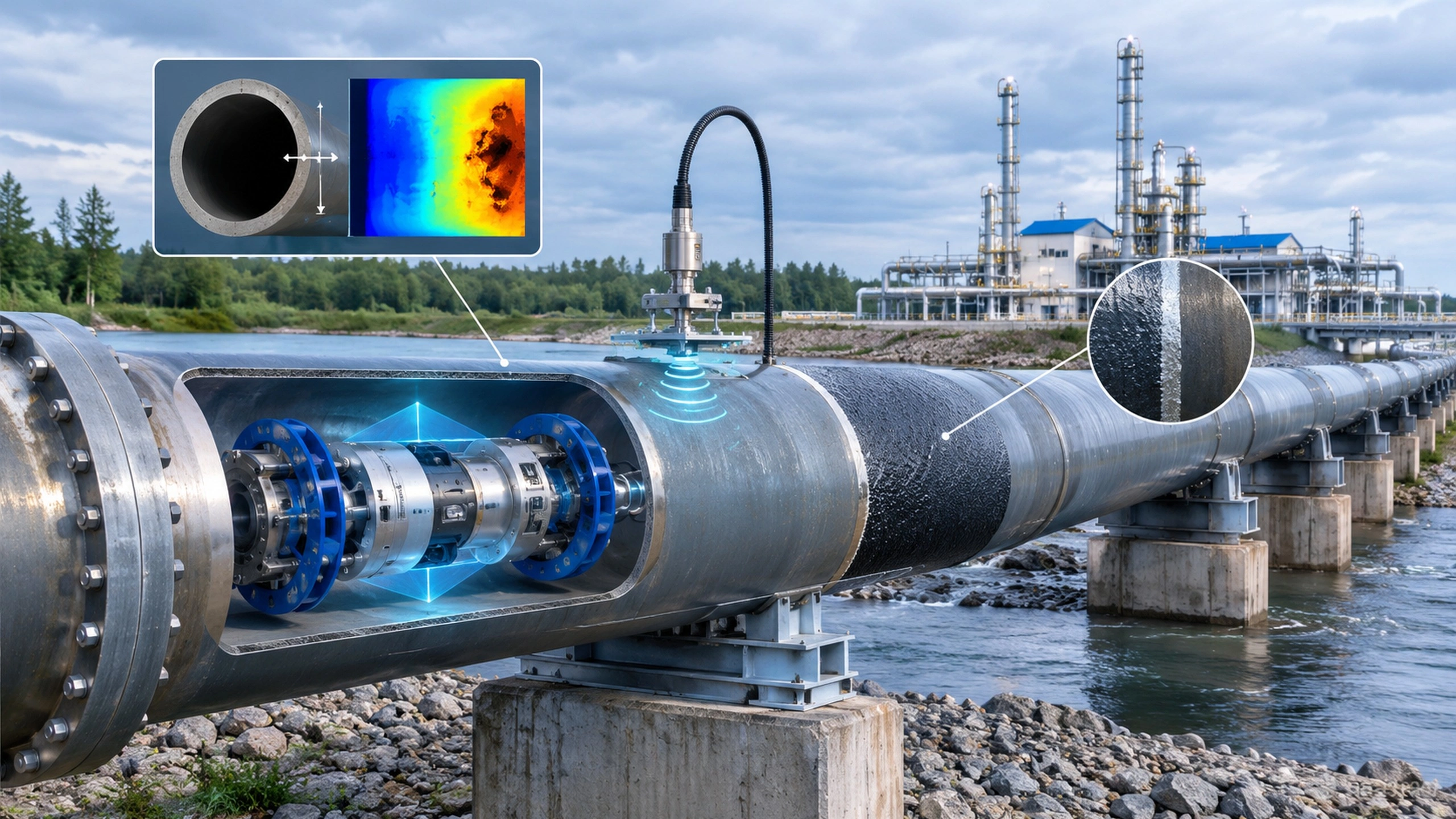
Midstream inspection can combine visible imagery, thermal imaging, ultrasonic thickness measurements, acoustic observations, vibration data, and other non-destructive testing results where the inspection task and equipment support them. For pipeline integrity, relevant subjects include external corrosion, coating damage, wall-thickness change, dents, deformation, weld-related indications, and conditions around supports or exposed sections. In-line inspection data, including magnetic flux leakage or ultrasonic inspection outputs where available, may provide additional evidence about internal pipe condition.
At compressor and pump stations, visual and thermal observations can help document external equipment condition, hot spots, insulation anomalies, leakage indications, and changes around flanges, seals, bearings, and electrical connections. These observations should be interpreted alongside operating state and confirmed inspection records. A camera image alone cannot establish the cause or severity of a suspected defect.
Research questions include when an additional sensing modality improves detection enough to justify its cost, whether an inspection image is suitable for assessment, and how a system should handle unfamiliar defect types or surface conditions. Candidate methods include image classification and localization, novelty detection, sensor fusion, and quality checks for incomplete or poorly captured observations. Initial demonstrations should use a fixed inspection procedure or repeatable test arrangement before introducing mobile or robotic inspection.
Process condition and product-quality context
Equipment condition is only one part of midstream operating quality. Where facility data and operating requirements make it relevant, research can examine relationships among gas-quality analyzer readings, moisture or dew-point measurements, pressure, temperature, flow, metering records, equipment state, and maintenance events. The purpose is to identify measurement anomalies, changing process conditions, or patterns that warrant operator review.
Candidate methods include time-aligned analysis of upstream measurements and downstream quality observations, calibrated prediction, and investigation of plausible contributing factors. A variable correlated with an observed quality deviation is not automatically its cause. Root-cause hypotheses require process knowledge and, where feasible, controlled investigation or independent engineering confirmation.
Pipeline structural health and geotechnical condition assessment
For selected pipeline segments and facilities, condition intelligence may also consider strain, displacement, tilt, vibration, moisture, temperature, and environmental measurements. These data can help frame inspection questions around exposed spans, supports, river crossings, slope movement, erosion, settlement, and other site-specific conditions. The appropriate sensor set depends on the asset, the suspected mechanism, access, and the engineering assessment required.
A research challenge is separating progressive structural change from normal effects such as temperature cycles, changing loads, seasonal ground conditions, or sensor movement. Candidate methods include change detection, sensor fusion, sparse monitoring informed by structural models, and uncertainty-aware alerting. An abnormal measurement should trigger engineering review where needed; it should not be presented as a definitive structural integrity conclusion without independent assessment.
Risk-based maintenance planning and intervention priorities
Condition estimates become operationally useful when they help maintenance and integrity teams decide what to inspect, investigate, repair, or monitor next. Research can examine how equipment criticality, estimated condition, uncertainty, inspection history, consequence of failure, crew availability, spare parts, access constraints, and planned maintenance windows affect prioritization.
Candidate planning methods can be compared with periodic maintenance schedules and existing condition-threshold rules. The evaluation should consider whether the resulting work plan is feasible, whether high-risk work is deferred, and how sensitive the priorities are to uncertain fault estimates, repair durations, and resource availability. Recommendations remain decision support unless a separately reviewed and authorized workflow permits further action.
Proposed demonstration and evaluation
Proposed demonstration
A practical first study could focus on a defined asset class, such as a compressor train or a pipeline inspection segment. The evaluation would use representative maintenance, operating, and inspection records where access and data rights permit. Candidate inputs may include time-series sensor measurements, equipment operating modes, alarms, work orders, inspection findings, and independently confirmed fault or defect labels.
The candidate method would be compared with an existing diagnostic or inspection baseline. Training and evaluation data should be separated so that test cases are not used to construct the faults or tune the method. Where possible, entire machines, pipeline sections, or operating conditions should be held out from model development. If physical records are unavailable, a controlled test rig or synthetic dataset may support early method development, but simulated findings must be labeled and must not be described as field validation.
Evaluation measures
Measures should be selected before testing and reported with their definitions, units, operating conditions, and evaluation population. Relevant measures include:
- Missed-fault rate and fault recall, with results separated by fault type and severity where labels support that distinction.
- False alarms per operating hour or inspection interval, including how repeated alerts are grouped.
- Detection lead time or warning time, reported only when timestamps and a confirmed event endpoint support the calculation.
- Defect detection and localization performance, including false accepts and false rejects by defect class.
- Calibration and uncertainty, including whether confidence estimates correspond to observed outcomes.
- Transfer performance across different machines, asset sections, loads, or environmental conditions.
- Inspection time, review workload, and the usefulness and feasibility of maintenance priorities.
Detection performance should be reported separately from operational benefits. A detected anomaly does not automatically establish avoided downtime, lower maintenance cost, or improved integrity. Those outcomes require a defined intervention, available resources, a feasible response, and evidence of the resulting condition.
Data requirements and candidate methods
A useful evaluation dataset should preserve asset identity, event time, observation time, units, operating mode, measurement source, sensor health, quality flags, and relevant environmental or process context. Maintenance and inspection records should retain the relationship between an observation, a finding, a work order, an intervention, and any subsequent verification. Missing readings, sensor drift, timestamp mismatch, duplicate events, changes in sensor placement, and incomplete inspection coverage should be represented and assessed.
Candidate methods may include rules-based thresholds, statistical trend analysis, anomaly detection, supervised diagnosis where reliable labels exist, computer vision for defined inspection tasks, multimodal sensor fusion, and risk-based scheduling. Method selection should follow the data and decision need. A complex model is not automatically more useful than a transparent baseline.
Evaluation should include normal operating variation as well as degraded conditions. Test sets should include machines and conditions that were not used for training where practical. Deliberately injected faults can help test sensitivity, but performance on injected faults alone is limited evidence. Independent inspection findings, controlled test-rig measurements, or other suitable ground truth are needed to establish whether a detected condition corresponds to a real fault or defect.
Limitations and validation requirements
The availability and quality of failure histories, inspection labels, and synchronized operating data will vary by asset and operator. Differences in equipment design, sensor placement, maintenance practice, operating envelope, and environmental exposure can limit transfer from one machine or facility to another. Models may also respond to changing loads, seasonal conditions, sensor drift, or data gaps in ways that resemble deterioration.
An anomaly is not a diagnosis, a predicted risk is not a confirmed failure, and an image indication is not an engineering disposition. Remaining useful life estimates require suitable degradation histories and validation conditions. Structural and geotechnical findings require appropriate engineering review. Before any operational use, candidate methods need evaluation with site-specific data, representative operating conditions, independent test cases, and review by qualified personnel.
Research status and collaboration
This page describes a PipeNex-specific adaptation of a broader Physical AI and AIoT research agenda. The shared research initiative is attributed to Aperture Venture Studio, GAO RFID Inc., and GAO Tek Inc. Shared research may inform PipeNex’s technical direction, but it does not establish a separate PipeNex research team, a completed PipeNex product, a customer deployment, or measured performance at a midstream facility.
The research topics described here are proposed areas for industry-specific evaluation. Demonstrations, data access, technical implementation, and performance findings should be identified separately as they are reviewed and verified. No field results or performance guarantees are claimed on this page.
Related resources
Predictive Maintenance
Inspection and Quality Intelligence
Sensing Engine
AI Decision Engine
Pilot Evaluation Guide
PipeNex Research
Discuss an equipment-health evaluation
Discuss a defined compressor, pump, pipeline, or inspection workflow with PipeNex. A useful initial conversation can identify the asset boundary, available operating and inspection records, current diagnostic baseline, responsible engineering users, and the evidence required for a site-specific evaluation.
Contact PipeNex