The right tracking technology depends on what an
operation needs to know. Radio frequency identification
(RFID) is often a practical choice when the requirement
is to identify equipment or record a movement event
at a defined read point. Bluetooth Low Energy (BLE)
can support proximity and location services, from
zone-level presence to more structured positioning.
Ultra-wideband (UWB) is suited to applications that
need frequent distance measurements and more precise
real-time location, provided the site can support
the required anchors and calibration.
There is no universal winner. Start by separating
asset identity from location: do teams need to
confirm which valve, tool, meter, or maintenance
item is present, or do they need to know where
a tagged asset or person is moving now? Then
assess the facility layout, metal structures,
liquids, obstructions, hazardous-area requirements,
network coverage, update frequency, battery
maintenance, and integration effort.
For midstream operators, the distinction matters
across pipeline stations, compressor and pump
facilities, tank farms, terminals, metering sites,
and maintenance yards. A technology that works
well for a fixed inspection checkpoint may be
unsuitable for continuous location across
a large outdoor corridor.
Technology Selection
Quick selection guide
Choose passive RFID when
The main requirement is low-maintenance
identification at a known inspection,
inventory, or transfer point. Tags do
not need batteries, but a reader must
be brought within the designed read zone.
Consider active RFID when
An asset needs to announce its identity
over a broader area or be detected by
fixed readers. Battery life, reader
placement, and tag servicing become
part of the operating plan.
Consider BLE when
The requirement is proximity, zone presence,
or location estimates using beacons and receiving
devices. RSSI-based location is an estimate;
BLE direction finding uses additional
antenna infrastructure.
Consider UWB when
The workflow needs more precise, frequently
refreshed location or ranging in a defined
area, and the site can install and maintain
a suitable anchor network.
Consider another approach when
The requirement is continuous location across
long, open pipeline routes. GNSS or a hybrid
design may be more appropriate than treating
RFID, BLE, or UWB as universal wide-area
tracking systems.
Technology Overview
Understand what each technology provides
RFID
Radio frequency identification (RFID)
RFID identifies a tagged object when it enters
a reader’s effective field. Passive tags draw
energy from the reader signal and respond with
an identifier; they do not carry a battery.
This makes passive RFID useful for asset
registers, tool control, inspection records,
and event capture at gates, work areas,
storage locations, or other defined checkpoints.
A handheld reader can support a technician
who scans tagged equipment during a field
inspection. Fixed readers can capture events
at selected passage points.
Active RFID tags contain a battery and transmit
or respond without relying on the reader to
energize the tag. They can support broader
detection areas than passive tags, depending
on the system design, but add battery replacement,
tag lifecycle, and fixed-reader planning.
RFID should not automatically be described as
continuous real-time location. A passive tag
read generally confirms that a tag was detected
in a reader zone at a particular time. It does
not, by itself, provide a continuous path between
read points. Read reliability depends on tag
type, reader configuration, tag orientation,
mounting surface, nearby metal, liquids, and
the geometry of the read area. Metal equipment
may require purpose-designed on-metal tags
and site testing.
BLE
Bluetooth Low Energy (BLE)
BLE is a low-power wireless technology used
for short data exchanges and location services.
A BLE beacon or tag can advertise an identifier
that nearby receivers detect. Received signal
strength indication (RSSI) can be used to
estimate proximity or approximate location,
but the result varies with antenna placement,
obstructions, reflections, and the
surrounding radio environment.
More structured BLE positioning is possible
with direction finding. Angle of Arrival (AoA)
systems typically use a tag that transmits
and fixed locators with antenna arrays that
estimate signal direction. Angle of Departure
(AoD) reverses the roles: fixed locators
transmit using antenna arrays, and a receiving
device estimates direction. These designs
require compatible devices, suitable locator
placement, and location software. They should
not be treated as equivalent to a simple
beacon-based proximity system.
BLE may be appropriate for zone-level awareness
of portable maintenance equipment, tools, or
personnel within a terminal or facility.
The design must account for tag battery service,
receiver coverage, interference, and the location
detail actually needed by the workflow.
UWB
Ultra-wideband (UWB)
UWB uses very wide radio-frequency bandwidth
and precise timing methods to measure the time
a signal takes to travel between devices.
A system can use these ranging measurements,
together with known anchor positions, to estimate
the location of a tag. This makes UWB a candidate
for workflows that need more detailed and frequently
updated location within a defined operating area.
A UWB deployment commonly requires tags, fixed
anchors, a communications path, location processing,
and a surveyed or calibrated site layout. The
number and placement of anchors affect coverage
and location quality. Reflections from steel
structures, blocked paths, equipment movement,
and non-line-of-sight conditions can affect
measurements. Battery-powered tags also require
a lifecycle and maintenance plan.
UWB should be evaluated against a stated location
requirement, not selected because a specification
advertises a particular accuracy. The achievable
result depends on the device design, anchor geometry,
site conditions, tag placement, update rate, and
the method used to establish ground truth.
Comparison Matrix
Technology comparison for midstream facilities
The following matrix is a selection aid, not a
product compatibility statement. Actual performance
and cost depend on the selected equipment, facility
layout, operating conditions, and implementation design.
On mobile, scroll horizontally to see all columns.
RFID, BLE, and UWB selection comparison
Decision factor
Passive / active RFID
BLE
UWB
Primary output
Tag identity and read event at a reader zone;
active systems may support wider-area detection.
Proximity or estimated location; direction
finding can add directional positioning.
Time-based ranging and location estimates
using tags and fixed anchors.
Identity vs. position
Strong fit for identity and checkpoint events.
Not continuous location by default.
Can provide zone presence or estimated position
when receiver coverage is designed for it.
Designed for ranging and more detailed location
in a defined instrumented area.
Tag power
Passive: no tag battery. Active: battery-powered tag.
Usually battery-powered beacon or tag;
fixed infrastructure may be powered
or battery-operated.
Usually battery-powered tag; anchors and
network equipment require power.
Infrastructure
Handheld or fixed readers, antennas,
tag encoding, and event processing.
Beacons or tags, receivers / gateways;
AoA or AoD adds antenna-array locators
and compatible devices.
UWB tags, fixed anchors, network backhaul,
location engine, and site layout calibration.
Update behavior
Read events when a tag is presented to or
passes a configured reader zone;
active systems vary.
Beacon advertising and receiver scan intervals
determine event cadence; positioning systems vary.
Ranging and location updates can be frequent;
configured update rate affects power and network load.
Metal and liquid effects
UHF performance can be affected by metal
and liquids. Use suitable on-metal tags
and test actual mounting positions.
Metal structures and obstructions can attenuate
or reflect radio signals and distort RSSI
or direction estimates.
Metal structures, blocked paths, and multipath
can affect ranging and location estimates.
Typical cost drivers
Tag type and volume, reader count, antennas,
installation, handheld devices, integration,
and read-zone tuning.
Tag / beacon count, batteries, receiver coverage,
mounting, network connectivity, software,
and maintenance.
Tag and anchor count, anchor installation and survey,
network, location software, calibration,
battery service, and support.
Good fit to assess
Equipment identification, inspection confirmation,
tool accountability, and transfer events
at known points.
Zone-level visibility and proximity workflows
across selected buildings or terminal areas.
High-resolution location workflows in
instrumented areas where the operational
value justifies the infrastructure.
Midstream Application 01
Midstream use case 1: identify equipment during
inspection and maintenance
A maintenance technician may need to confirm the
identity and history of a valve, meter, actuator,
pressure instrument, portable tool, or removable
equipment item before completing an inspection or
work order. If the task is to identify the asset
at a known location, passive RFID can be evaluated
first. A rugged handheld reader can capture the
tag ID during a planned inspection, while a fixed
reader may be considered at a controlled equipment
or material transfer point.
The tag must be selected for its mounting surface
and environment. Standard labels may not perform
as expected when attached directly to steel.
Specify on-metal tags where appropriate, confirm
the tag’s environmental and hazardous-area suitability,
and test it on the actual asset with the intended
reader. For outdoor equipment, include weather exposure,
temperature range, corrosion, vibration, cleaning
practices, and access for future tag replacement
in the test plan.
The resulting read event should be associated with
a trusted asset identifier, timestamp, reader location,
and inspection or work-order reference. A successful
tag read confirms an identification event; it does
not prove that the inspection was completed or
that the equipment is in a safe operating condition.
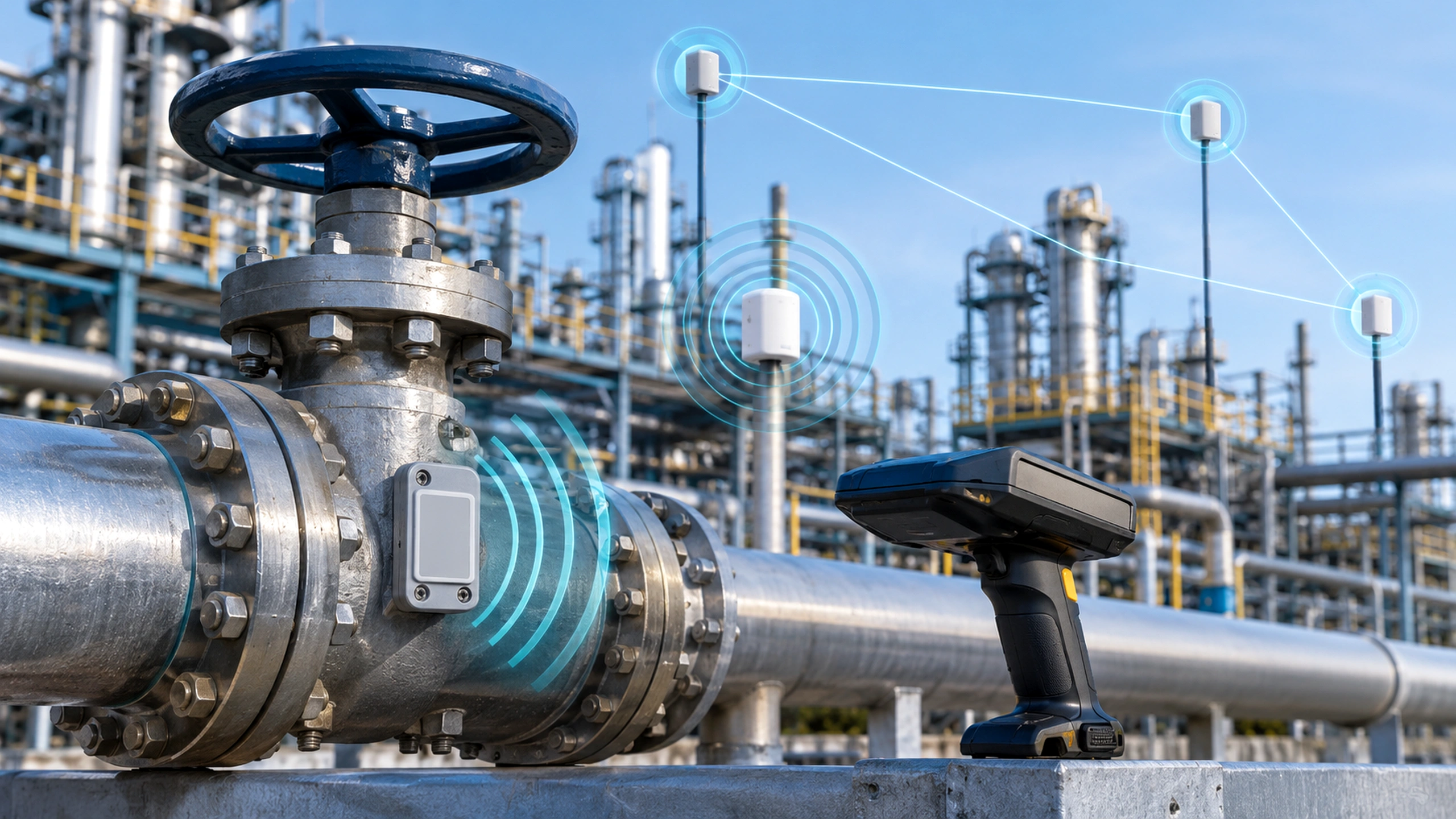
RFID Identification for Midstream Pipeline Assets
The visual shows a tagged pipeline valve and a nearby
handheld reader in a processing-facility setting.
It represents an RFID inspection checkpoint where
an operator can associate an equipment identity
with a time-stamped maintenance or inspection event.
The key distinction is that a read confirms detection
at the checkpoint, not continuous location
or completed work.
Midstream Application 02
Midstream use case 2: locate portable assets
or personnel within a terminal
A terminal, tank farm, compressor station, or pump
facility may have a different requirement: operations
personnel may need to estimate where selected portable
equipment or authorized personnel are within a defined
operating area. BLE may be sufficient when the required
result is room-level or zone-level presence. RSSI-based
estimates can be useful for proximity workflows, but
should not be represented as precise coordinates
without a validated positioning design.
If the workflow requires more detailed position updates,
evaluate BLE direction finding or UWB. BLE AoA / AoD
requires compatible tags or devices and fixed locators
with antenna arrays. UWB uses ranging measurements
from fixed anchors and may be better suited when
location error and update rate are important acceptance
criteria. Both require site-specific design and testing.
The facility layout should drive the anchor or locator
plan. Pipe racks, tanks, steel buildings, vessels,
moving equipment, and personnel traffic can block or
reflect radio signals. Survey coverage across the
actual routes and work areas, including stairways,
enclosed buildings, loading zones, and outdoor
transitions. Verify behavior during network outages
and define what users should see when a tag
has not reported recently.
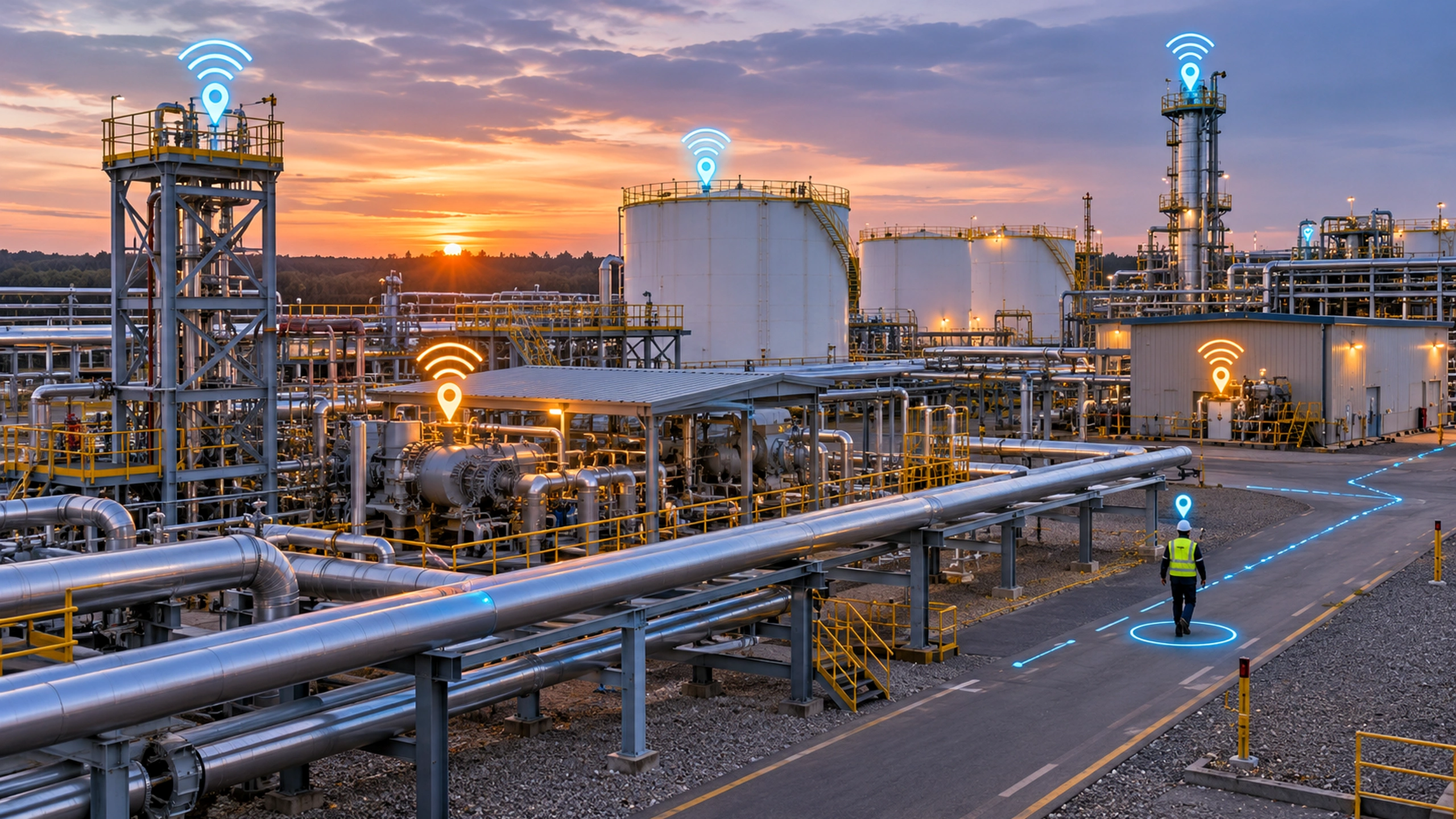
Wireless Location Infrastructure for Midstream Terminals
The visual illustrates a terminal-scale wireless
coverage concept, with fixed location points
distributed across tanks, process structures,
and service areas. It supports a discussion of
BLE or UWB infrastructure planning for selected
zones. The image is conceptual and does not represent
an installed PipeNex system, a surveyed coverage
map, or measured positioning performance.
Technology Suitability
Where RFID, BLE, and UWB may not be the right answer
Long, open pipeline corridors present a different
location problem from an instrumented terminal.
RFID read points are useful for defined checkpoints
but do not continuously locate a moving asset
between them. BLE and UWB depend on radio infrastructure
and geometry; extending either across a long linear
route may be impractical. GNSS-based tracking,
cellular communications, or a hybrid design may
be more appropriate for mobile equipment and vehicles
across open routes. Select the technology from
the required operating outcome rather than forcing
every tracking problem into the same radio system.
None of these technologies should be treated as a
safety system by default. Personnel location information
can support operational awareness, but it does not
guarantee emergency mustering completeness, collision
avoidance, or safe access control. Any use in classified
or potentially explosive areas requires equipment and
installation approval for the site’s applicable
hazardous-area classification. Confirm certifications,
temperature ratings, ingress protection, battery
restrictions, and installation practices with qualified
engineering and safety personnel.
Pilot Planning
How to evaluate the options at your facility
A pilot should test the workflow under representative
conditions before a technology is selected for broader
use. Define the question, establish a baseline, and
record the actual operating conditions. Do not use
a vendor’s nominal radio range or an assumed accuracy
as a substitute for field evidence.
Define the tracked entity:
valve, meter, actuator, portable tool,
maintenance equipment, vehicle, or
authorized personnel tag.
Define the required result:
identity confirmation, passage event,
zone presence, approximate location,
or coordinate-level position.
Map the operating area:
pipeline station, compressor building,
pump station, tank farm, loading rack,
maintenance shop, or outdoor route.
Record physical conditions:
steel structures, vessels, liquid proximity,
obstructions, tag orientation, moving equipment,
weather, temperature, and access constraints.
Specify system behavior:
update interval, acceptable event latency,
coverage gaps, missed reads, duplicate events,
stale locations, and outage recovery.
Measure performance against ground truth:
event completeness, false associations, location
error, event latency, coverage by zone, and recovery
after interruptions.
Assess lifecycle requirements:
tag and anchor installation, battery replacement,
inspection access, device replacement, calibration,
network support, and software maintenance.
Review data handling:
asset registry mapping, user permissions,
personnel privacy, retention, audit records,
and integration with maintenance or
work-management systems.
Compare total cost categories:
tags, readers or anchors, installation,
connectivity, software, integration,
training, maintenance, and ongoing support.
For location testing, establish surveyed reference
points or another independent ground-truth method.
Report the distribution of location error by area
and operating condition, not only an average.
For identification testing, count required events
and correctly captured events, then record missed
reads, duplicate reads, false associations,
and manual reconciliation effort.
Data and Integration
Integration: turn observations into operational records
A tracking device produces observations, not a complete
business record. The system should associate each
observation with a stable asset or personnel identifier,
event time, observation time, reader or locator identity,
source type, and a quality status. An event-processing
layer should handle duplicate messages, delayed delivery,
conflicting observations, and uncertain location estimates
before the information is presented to users or passed
to another system.
Depending on the workflow, useful destinations may
include an enterprise asset management (EAM) system,
computerized maintenance management system (CMMS),
work-order process, inventory record, access-control
system, or operations log. Define the interface and
data ownership for each destination. Do not imply
that a connector or integration is already available
unless it has been verified.
Explore the related asset and personnel tracking approach,
the Identification Engine, and identification and sensing
hardware considerations for related system design topics.
No. Passive RFID usually confirms that a tag
was read in a reader’s zone. It can record movement
at configured checkpoints, but it does not
continuously locate an asset between those points.
Active RFID designs can support broader detection,
depending on their readers and system architecture.
Can RFID tags be attached to steel pipes and valves?
Yes, when the tag is designed for the mounting
surface and the installation is tested.
Standard UHF labels may perform poorly directly
on metal. Use an appropriate on-metal tag
and validate read performance on the actual
asset and reader setup.
Is BLE accurate enough for midstream asset tracking?
It depends on the required location detail.
RSSI-based BLE can support proximity or zone-level
estimates. BLE direction finding can provide
more structured positioning with compatible tags,
antenna-array locators, and a suitable location engine.
Validate the result at the facility.
When should a midstream operator consider UWB?
Consider UWB when a defined area requires frequent
ranging and more detailed location than a basic
presence or proximity system provides. The decision
should account for anchor coverage, site geometry,
tag power, installation, calibration, and the
measured value of the location detail.
Can one technology track assets across a whole
pipeline network?
Usually not as a single universal solution.
A pipeline station or terminal can use local
RFID, BLE, or UWB workflows, while mobile
assets across long outdoor routes may require
GNSS or a hybrid approach. Separate local
facility tracking from wide-area route tracking.
Do these technologies guarantee worker safety
or emergency accountability?
No. Location data can support awareness and
selected workflows, but it does not guarantee
that every person is detected or that an
emergency muster is complete. Any safety-related
use needs a separately validated operating
procedure, system design, and site approval.
Connect With PipeNex
Next step
Start with the operating question, not the radio
technology. Identify the asset or personnel workflow,
the required level of location detail, and the facility
conditions that could affect performance. Then compare
candidate systems through a site-specific pilot with
measurable acceptance criteria.