PipeNex | Midstream Operations Solutions
Condition Monitoring for Midstream Operations
Condition monitoring turns relevant measurements into a view of equipment and process state. In midstream operations, its usefulness depends on sensor suitability, measurement quality, operating context, and a clear response to abnormal conditions.
Explore Condition MonitoringCondition monitoring turns relevant measurements into a view of equipment and process state. In midstream operations, its usefulness depends on sensor suitability, measurement quality, operating context, and a clear response to abnormal conditions.
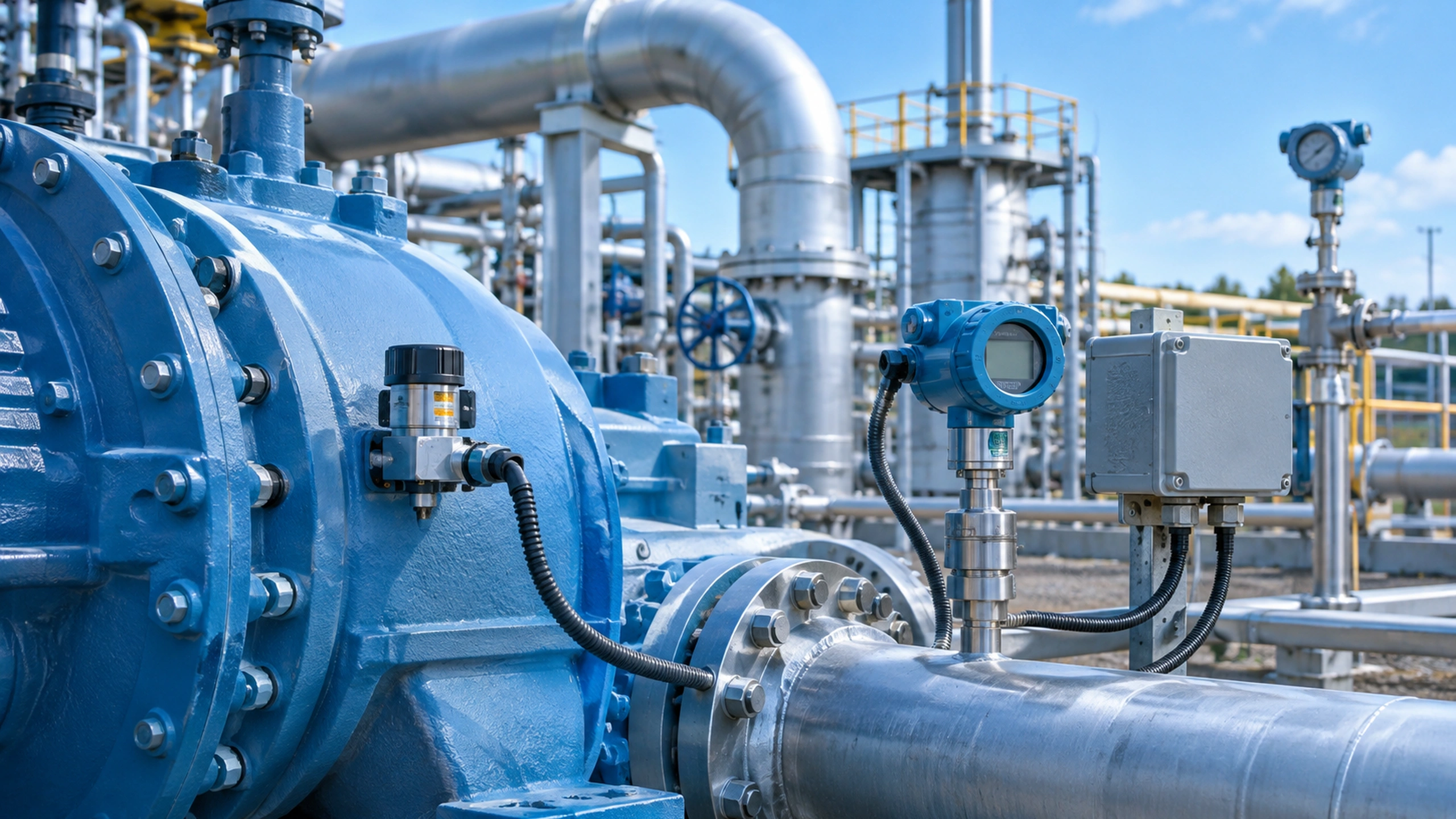
Pipeline operators, terminal teams, and gas compression facilities rely on pumps, compressors, motors, valves, and supporting systems to move and handle products safely and consistently. Condition monitoring brings selected measurements from these assets into a structured view that helps operations and maintenance personnel recognize changes, investigate exceptions, and document what happened.
PipeNex focuses on the practical connection between sensing, data context, interpretation, and reviewed response. The monitoring design should reflect the asset, the operating environment, and the decisions the responsible team needs to make.
Monitor the conditions that matter to midstream assets
A useful monitoring scope starts with a defined asset or process question. A natural gas compressor station, crude oil transfer pump, terminal loading system, and pipeline pressure-control assembly do not share the same measurement needs. Select variables according to the failure modes, operating limits, process role, and available instrumentation for the specific asset.
Rotating equipment: vibration, bearing and casing temperature, motor current, speed, lubrication condition, and relevant acoustic or ultrasound observations.
Pipeline and process systems: pressure, differential pressure, flow, temperature, valve position, and pressure or flow variation across operating states.
Electrical and drive systems: voltage, current, power, frequency, motor temperature, and drive or protection status where the data is available and appropriate.
Facility and environmental conditions: ambient temperature, humidity, enclosure condition, gas detection, and other site measurements where they directly support the monitoring objective.
These measurements are examples for scoping, not a fixed sensor package. Sensor type, range, accuracy, installation point, sampling interval, hazardous-area suitability, and calibration method must be selected for the equipment and site.
Build operating context around every reading
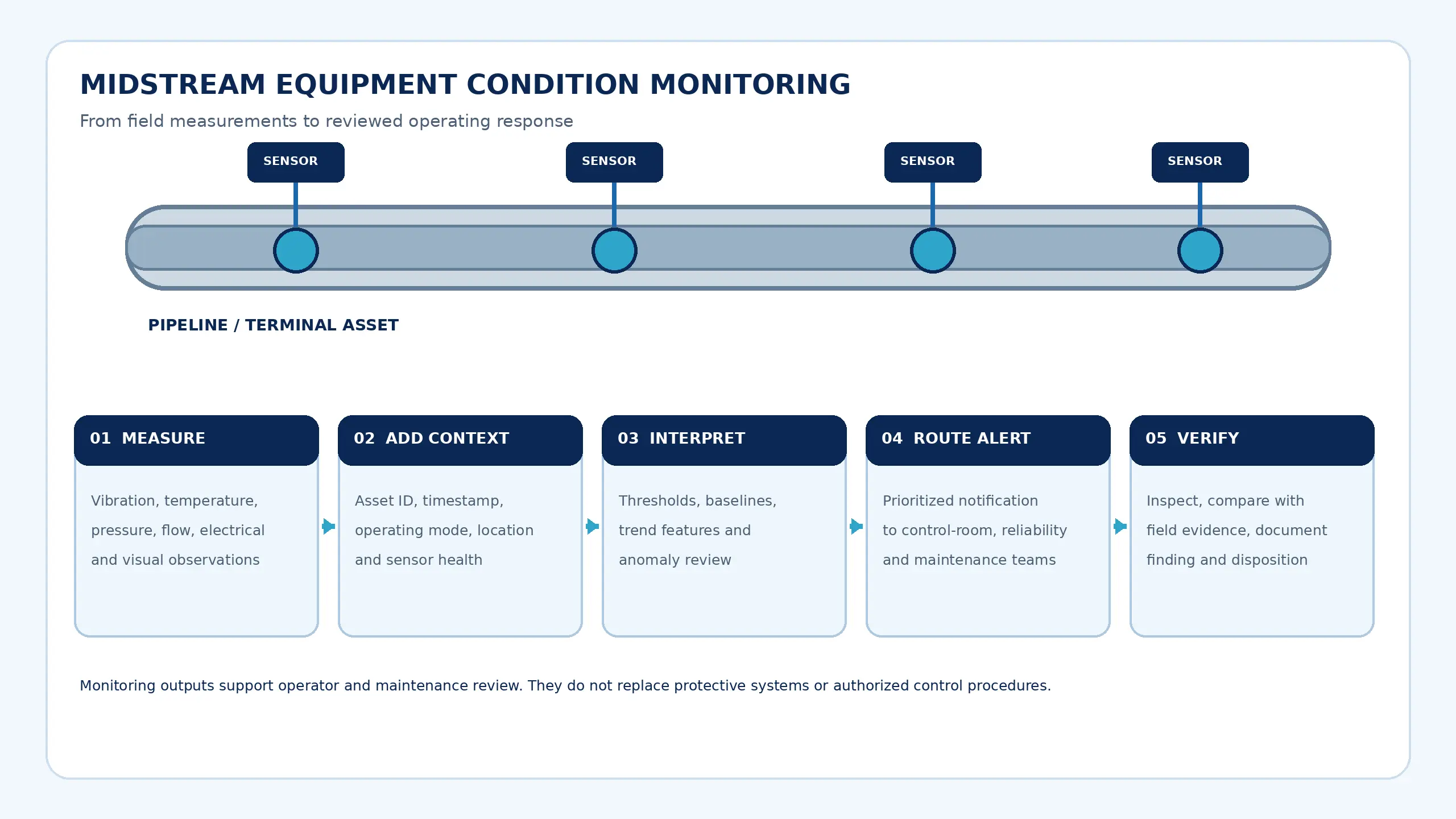
A measurement has limited value when it cannot be tied to the equipment and operating condition that produced it. Condition data should be associated with a stable asset identifier, timestamp, measurement unit, sensor identity, and relevant operating context.
- Asset identity: connect each measurement to the correct pipeline segment, pump, compressor, driver, motor, valve, or instrument tag.
- Time and sequence: preserve timestamps, sampling intervals, clock alignment, and event order across sensors and source systems.
- Operating mode: distinguish startup, shutdown, steady operation, changing throughput, standby, maintenance, and abnormal process states.
- Sensor condition: record calibration status, device diagnostics, communication quality, data gaps, out-of-range values, and known maintenance activity.
For example, a compressor vibration reading should be interpreted with relevant speed, load, and operating mode. A pressure change should be assessed against flow, valve state, process conditions, and instrument health. Without this context, a normal operating transition may be mistaken for an abnormal condition, or a genuine change may be hidden by incomplete data.
From raw signals to condition indicators
Condition monitoring can combine direct measurements with derived features that make patterns easier to review. The distinction should remain clear: a raw signal is the measured value or waveform, while a derived feature is calculated from one or more observations.
- Raw measurements: time-series vibration, temperature, pressure, flow, current, voltage, and instrument status.
- Derived features: vibration amplitude and frequency components, rate of temperature change, pressure deviation, flow variation, rolling statistics, and operating-state-specific trends.
- Threshold rules: compare a measurement or feature with a configured limit, alarm band, or engineering rule.
- Baseline comparison: compare current behavior with an established reference for the same asset and a sufficiently similar operating state.
- Anomaly analysis: identify patterns that differ from learned or defined normal behavior, then present the supporting observations for review.
Thresholds are straightforward to explain and can be effective where engineering limits are known. Learned anomaly methods may help identify multivariable changes that fixed thresholds do not capture, but they require representative data, careful validation, and ongoing review. A learned deviation is not automatically a fault diagnosis.
Route alerts to the people responsible for the response
An alert is useful only when it reaches the right person with enough information to decide what to do next. The response workflow should identify the monitored asset, the condition that triggered attention, the measurements behind the alert, and the appropriate review or escalation path.
Control-room operators review alerts in the context of current throughput, pressure, equipment status, operating procedures, and other active alarms.
Reliability engineers examine trends, baselines, vibration or electrical features, and potential interactions between equipment and process conditions.
Instrumentation and controls personnel investigate sensor faults, calibration issues, wiring, communication failures, and inconsistent readings.
Maintenance planners and technicians confirm findings through approved inspection or diagnostic work and record the disposition in the relevant maintenance process.
Alert routing should account for severity, persistence, operating mode, data freshness, and the consequence of a missed or delayed response. Duplicate or short-lived alerts should be managed to reduce unnecessary alarm volume without suppressing meaningful events.
Where a control action is considered, the action must follow the site’s approved authority, operating limits, and protective procedures. A monitoring alert is not itself permission to change a setpoint, operate a valve, or alter equipment behavior.
Connect monitoring data with operational records
Condition monitoring is more useful when observations can be reviewed alongside the records teams already use. Depending on site architecture and permissions, relevant sources may include supervisory control and data acquisition (SCADA), distributed control system (DCS) histories, programmable logic controller (PLC) data, plant or pipeline historians, asset registers, computerized maintenance management systems (CMMS), and inspection records.
Integration design should define the source of truth for asset identity, tag naming, timestamps, units, quality flags, and maintenance status. It should also specify how data moves across control and enterprise environments, which systems can write or read information, and how access is authenticated and audited.
Connectivity may involve wired instrumentation, industrial Ethernet, serial interfaces, wireless sensors, edge gateways, or approved data services. The appropriate choice depends on distance, power, hazardous-area classification, environmental exposure, bandwidth, latency, cybersecurity requirements, and the cost of installation and maintenance. Compatibility with a named protocol or system should be confirmed for the proposed implementation rather than assumed.
Evaluate monitoring quality before expanding coverage
A pilot should test whether the selected measurements and alert workflow provide reliable, actionable condition information under representative midstream operating conditions. Begin with a bounded asset group, a documented measurement plan, and agreement among operations, reliability, instrumentation, maintenance, and information technology teams.
- Alert usefulness: proportion of alerts judged relevant by qualified reviewers and the reasons for dismissing or escalating them.
- Detection delay: elapsed time between a defined condition change and the alert becoming available to the responsible user.
- Missed and false alerts: known abnormal events not detected, and alerts raised when the equipment was operating acceptably.
- Data availability: completeness, freshness, timestamp consistency, communication interruptions, and handling of missing or invalid readings.
- Calibration and measurement quality: calibration status, sensor drift, repeatability, installation quality, and agreement with reference measurements.
- Follow-up verification: whether alerts led to inspection, diagnostic confirmation, a documented finding, or a justified no-action decision.
- Operational effort: time spent reviewing alerts, investigating exceptions, reconciling records, and maintaining sensors and gateways.
Use historical events, controlled test cases, and representative operating periods where available. Include normal transitions such as startup, shutdown, throughput changes, and standby conditions. Report detection and data-quality measures before estimating financial effects. Results from a limited pilot should not be presented as proof of performance across other assets or sites.
Design for data quality, safety, and maintainability
Midstream facilities operate across remote pipeline locations, compressor stations, terminals, tank farms, and transfer facilities. Equipment may be exposed to vibration, weather, temperature extremes, moisture, corrosion, electromagnetic interference, and restricted maintenance access. Sensor installation and communications plans must account for these conditions.
- Select measurement devices for the variable, range, accuracy, response time, environmental rating, and installation location.
- Define calibration intervals, inspection responsibilities, sensor replacement procedures, and spare-parts requirements.
- Design for communication loss, stale readings, clock drift, power interruption, and incomplete sensor coverage.
- Separate monitoring and analytics networks from safety instrumented systems and control functions according to site cybersecurity and safety requirements.
- Apply role-based access, approved data flows, audit logging, and change management to monitoring configuration and alert thresholds.
Monitoring systems should identify when data is unavailable or unreliable. They should not silently interpret missing, stale, or invalid readings as normal equipment condition. When confidence is insufficient or the operating state falls outside the evaluated range, the workflow should flag the limitation and direct the case for human review.
Condition monitoring and predictive maintenance serve different decisions
Condition monitoring describes what is happening to an asset or process now, and how its observed behavior is changing. Predictive maintenance uses condition information together with relevant failure history, operating context, and maintenance evidence to estimate future risk or support intervention timing. The two disciplines can share data, but they answer different operational questions.
Use condition monitoring when the immediate need is to observe equipment state, identify abnormal measurements, route alerts, and verify findings. Consider predictive maintenance when the organization has sufficient asset history and failure evidence to evaluate forecasts or maintenance recommendations. See the PipeNex page on Predictive Maintenance for Midstream Operations .
Related pages and internal links
PipeNex Sensing Engine
PipeNex AI Decision Engine
Identification and Sensing Hardware
Equipment or Process Monitoring Application
Sensor Selection Guide
Predictive Maintenance for Midstream Operations
Contact PipeNex
Discuss your midstream condition monitoring requirements
Start with the asset, operating question, and response workflow. PipeNex can use that discussion to define the measurements, data context, interfaces, and evaluation criteria that would need to be assessed for a condition monitoring application.
Discuss Your Condition Monitoring Requirements