PipeNex | Midstream Operations Research
Industrial Digital Twins and Simulation Research for Midstream Operations
Explore digital twin and simulation research for midstream operations, including pipeline state estimation, action evaluation, and validation.
Explore the ResearchIntroduction
Digital twins and engineering simulations can help midstream operators examine pipeline and facility behavior before changing operating practices or equipment settings. For gathering systems, transmission pipelines, compressor stations, pump stations, metering facilities, and storage assets, a useful model must represent the physical process, operating constraints, and quality of the measurements used to keep it aligned with actual conditions.
PipeNex research in this area focuses on how models can support state estimation, compare candidate operating actions, and expose uncertainty. The goal is not to create a detailed visual replica for its own sake. It is to determine whether a model is accurate enough for a defined operational question, where its predictions become unreliable, and what additional physical testing is needed before its output informs a field decision.
Why digital twins matter in midstream operations
Midstream assets operate as connected systems. Changes in throughput, inlet conditions, pressure, temperature, equipment availability, and line configuration can affect behavior across pipeline segments and facilities. Operators may need to assess a compressor operating point, understand a pressure transient, compare pump configurations, investigate a change in flow balance, or estimate the consequences of taking equipment out of service.
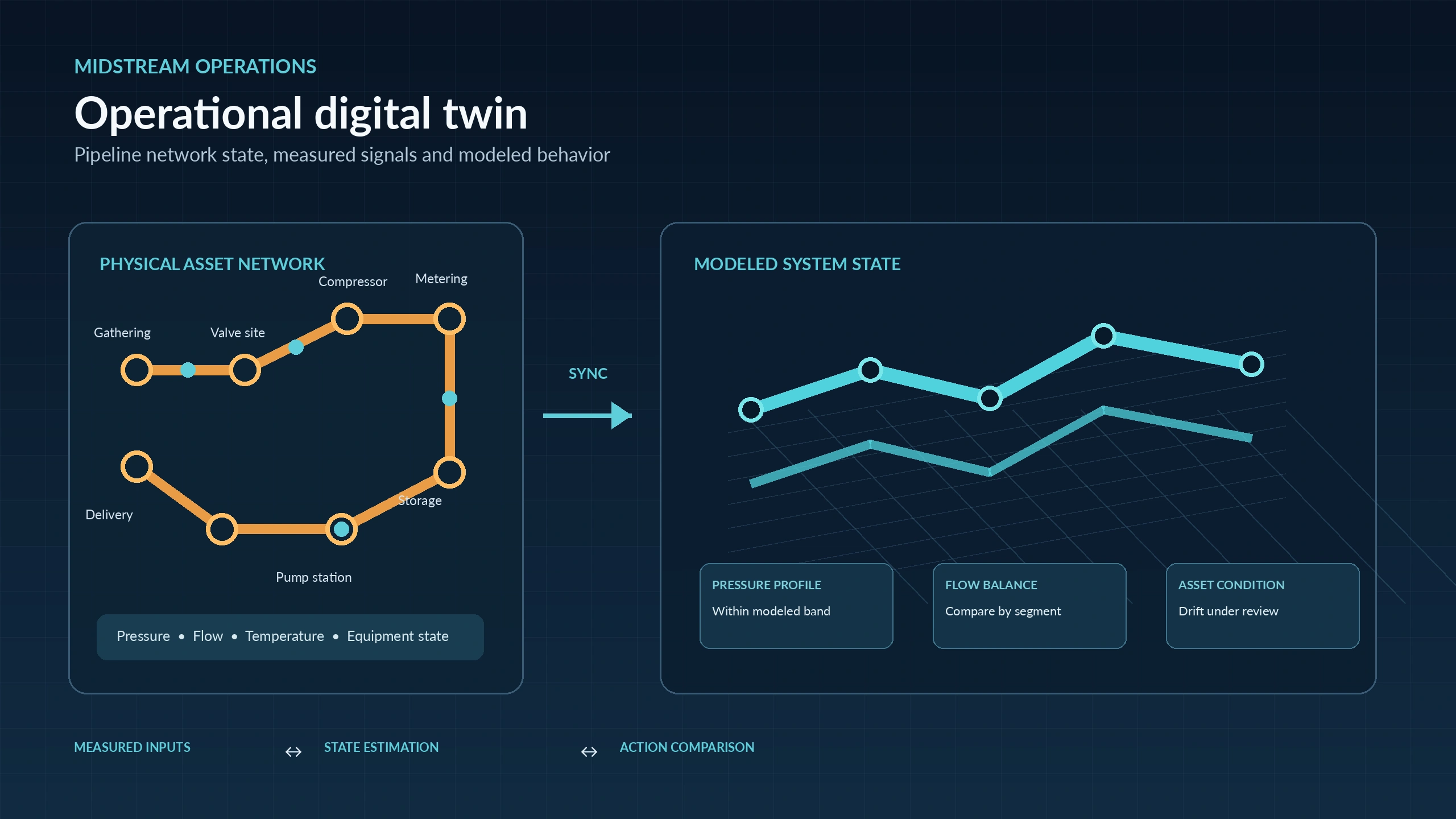
A digital twin can combine a process or equipment model with time-aligned field observations to estimate operating state and compare possible responses. Depending on the asset and the available evidence, the model may represent hydraulic behavior, compressor or pump performance, thermal effects, storage constraints, equipment condition, or interactions among connected assets. The model boundary should be explicit. A model of one compressor station, for example, should not be presented as a validated representation of an entire transmission network.
Relevant inputs may include pressure, flow, temperature, vibration, equipment speed, valve position, operating mode, alarm and event history, maintenance records, and asset configuration. Supervisory Control and Data Acquisition (SCADA) records and historian data may provide process context, while engineering documentation and equipment curves can inform model parameters. Data availability, sampling frequency, sensor calibration, timestamp alignment, and changes to asset configuration all affect model quality.
Research priorities
Operational digital twins for state estimation and action evaluation
A central research question is how accurately a model must estimate the state of a pipeline segment or facility to support a particular decision. The work can examine physics-based models combined with live or recorded measurements, parameter identification, synchronization, and model drift as equipment ages or operating conditions change. It should also test whether online calibration can distinguish a genuine change in equipment behavior from a faulty or drifting sensor.
A proposed demonstration could model a pump, motor, or compressor train and compare predicted responses to controlled changes with independent physical measurements. Candidate measures include state and outcome prediction error, synchronization delay, uncertainty calibration, drift detection, and decision usefulness compared with a sensor-only baseline. A model should identify conditions in which it is unsuitable for a decision rather than presenting an unqualified estimate.
Simulation-to-reality transfer and synthetic industrial data
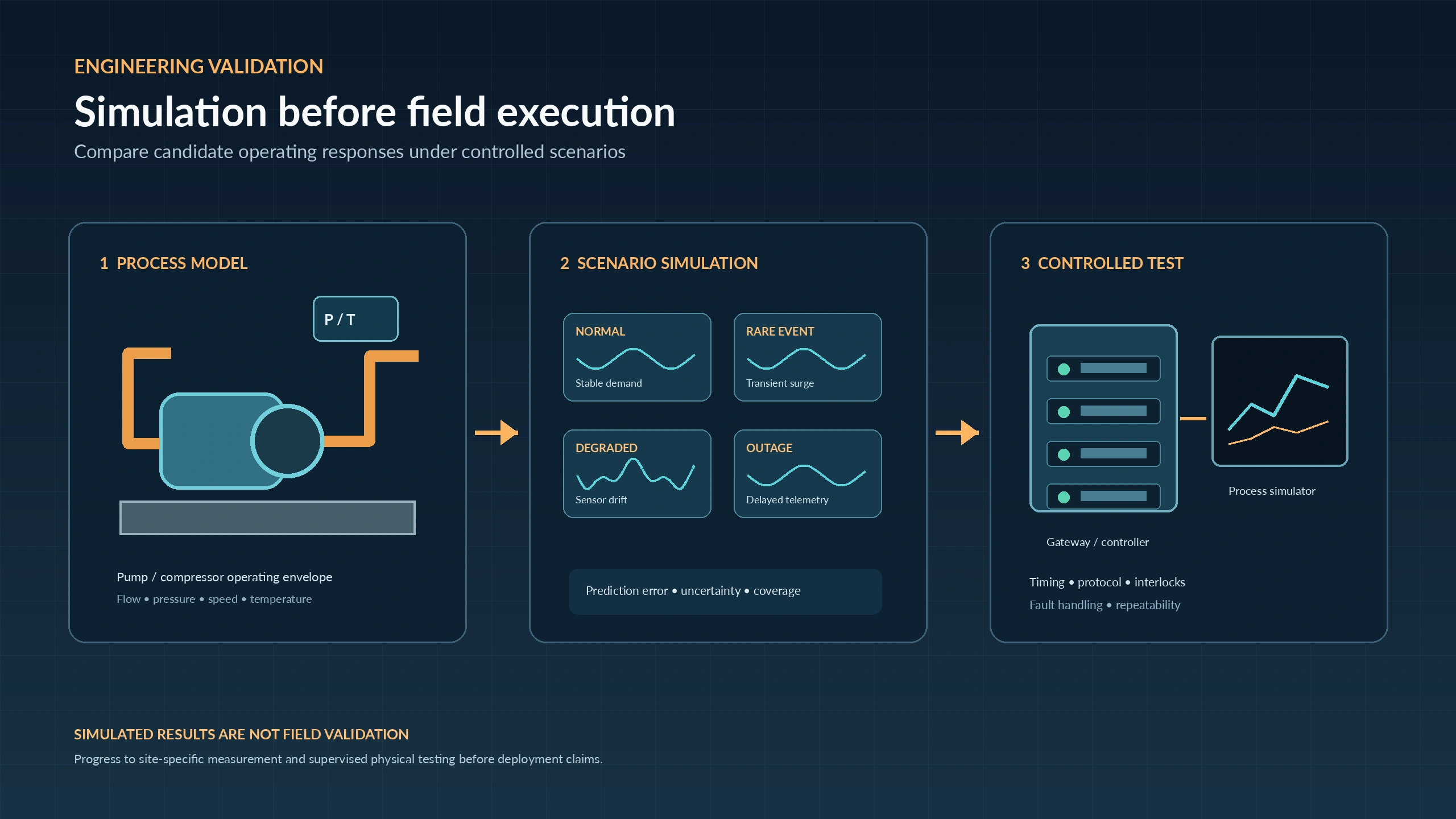
Simulation can generate operating variations and rare conditions that may be difficult or costly to capture in field data. For midstream workflows, scenarios could include demand changes, pressure transients, changing inlet conditions, equipment degradation, sensor drift, delayed telemetry, communications interruptions, and equipment availability constraints. Synthetic observations must remain distinguishable from measured field data, and the assumptions used to generate them must be documented.
Research questions include which simulated variations improve model robustness, which create misleading patterns, and whether a decision method can recognize when actual operations fall outside the simulator’s assumptions. Candidate methods include domain randomization, hybrid physical and data-driven models, and calibration using a limited set of authorized physical observations. Evaluation should use untouched physical measurements where available and report transfer degradation, rare-scenario coverage, prediction error, and the amount of physical data needed. Without physical reference data, a model can be described as assumption-based and plausibility-reviewed, not field-validated.
Hardware-in-the-loop testing and scenario coverage
Hardware-in-the-loop testing connects real control hardware, gateways, or communication interfaces to a simulated process. This arrangement can help examine timing, protocol behavior, command handling, and recovery without applying every test condition to an operating pipeline. A midstream test environment could connect a selected controller or gateway to a process simulator representing a pump or compressor station, subject to approved test boundaries.
The scenario set should include normal operation and degraded conditions such as stale measurements, sensor saturation, delayed messages, communications loss, conflicting commands, and equipment trips. Evaluation can measure scenario coverage against defined operating requirements, detected integration faults, timing violations, repeatability, and agreement between simulated and controlled hardware-rig results. Hardware-in-the-loop results do not establish that a live installation is safe or ready for deployment.
Counterfactual process experiments and flow models
Counterfactual simulation can compare how a defined operating system might respond under alternative conditions or policies. For midstream operations, relevant questions may involve flow allocation across connected segments, pump or compressor availability, storage constraints, maintenance windows, and response to changing throughput demand. The model should represent the process boundary and constraints that materially affect the decision rather than treating the pipeline as an unconstrained flow diagram.
A proposed study could use discrete-event simulation for equipment availability, maintenance queues, response delays, and shared resources, alongside engineering equations for hydraulic or equipment behavior. Historical event logs and operating records may inform the model when access and data rights permit. Evaluation measures could include pressure and flow prediction error, throughput, constraint violations, equipment utilization, response time, and feasibility under uncertain operating conditions. Counterfactual results are decision hypotheses and require operational validation.
Industrial world models and action-conditioned prediction
Learned world models attempt to predict how a physical system will respond to a candidate action based on sensor histories and process measurements. Research can compare these models with physics-based twins and hybrid approaches in which engineering constraints limit learned predictions. For midstream applications, a bounded study might examine predicted responses to a change in pump speed, compressor operating point, or valve configuration within an approved simulation environment.
The evaluation should measure prediction error at different forecast horizons, uncertainty calibration, out-of-distribution detection, decision quality, data requirements, and computational cost. Prediction quality may degrade as the forecast horizon extends or as the operating state moves beyond the training and calibration range. A model should abstain or escalate for review when uncertainty or model mismatch exceeds the criteria defined for the task.
Demonstration and evaluation approach
A proposed PipeNex research demonstration should begin with one clearly bounded midstream asset or process, such as a pump station, compressor train, or selected pipeline segment. The scenario specification should record the operational question, asset boundary, operating modes, available measurements, relevant equipment constraints, baseline workflow, candidate method, and intended decision. Assumptions should be recorded with units, ranges, sources, dates, confidence, and sensitivity importance.
The simulation should generate observations under normal, rare, and degraded conditions. Where authorized physical observations are available, predictions should be compared with held-out measurements that were not used to tune the model. Where no physical observations are available, the work should be identified as an assumption-based simulation and limited to plausibility review. Candidate actions should first be compared in simulation, followed by controlled hardware testing where appropriate and site-specific validation before operational use.
- State and outcome prediction error, reported with units, time horizon, and operating condition.
- Model mismatch and drift detection as process conditions, equipment behavior, or sensor quality change.
- Scenario coverage across normal, rare, and degraded operating conditions.
- Simulation-to-reality transfer degradation when predictions are checked against held-out physical measurements.
- Decision usefulness compared with a credible baseline, including cases where the model offers no benefit or performs worse.
- Compute cost, synchronization delay, data requirements, and the effort needed to maintain model parameters.
Limitations and validation requirements
A simulation is only as credible as its system boundary, assumptions, parameter sources, and validation evidence. A visually detailed model may still produce poor predictions if its process equations, equipment parameters, measurement inputs, or operating context are inaccurate. Sensor faults can be mistaken for process changes, and changes to pipeline configuration or equipment condition can invalidate previously calibrated parameters.
Synthetic data do not establish real-world performance. A model calibrated against one asset or operating range should not be assumed to transfer to another facility, equipment configuration, or operating regime. Rare-event tests can improve coverage but should not be presented as evidence of real-world event frequency. Simulation results also do not establish that a control strategy is safe, certified, or suitable for unsupervised operation.
Before a model informs an operational decision, the responsible engineering team should define acceptance criteria, independent measurement checks, uncertainty limits, escalation conditions, human authority, and rollback or fallback procedures. Any physical command path must remain subject to the facility’s established control and protective systems. Model output should not bypass operator procedures or independent safety functions.
Current research status
For this PipeNex page, industrial digital twins and simulation are presented as a proposed research direction adapted to midstream operations. The supplied project brief does not establish a completed PipeNex digital twin, an executed PipeNex simulation, a hardware-in-the-loop demonstration, customer deployment, or measured operational result. No performance figures or customer outcomes are claimed here.
The broader research agenda is associated with Aperture Physical AI Research Labs and shared research activity involving Aperture Venture Studio, GAO RFID Inc., and GAO Tek Inc. That shared initiative should not be interpreted as proof of a separate PipeNex research team or a PipeNex-specific completed result. Company-specific work, demonstrations, and findings should be added only after their scope and evidence have been reviewed.
How this research connects to PipeNex technologies
Digital twin inputs depend on the identification and sensing functions described in the Sensing Engine and the asset context established by field devices and operational records. Model outputs can inform analysis and decision support through the AI Decision Engine. When a study evaluates a physical response, the boundary between recommendation and authorized execution must remain explicit and should be considered alongside the Physical AI Action Engine. These relationships describe architectural context, not verified integrations.
For pilot planning and evidence design, see the guide to designing and evaluating a Physical AI or AIoT pilot. For the wider research program, visit the PipeNex Research hub. Related research includes equipment health, inspection, and quality intelligence and verified AI decisions and physical control.
Sensing Engine
Identification, sensing, and field observations.
AI Decision Engine
Analysis and AI-supported operational decisions.
Physical AI Action Engine
Authorized physical response and execution boundaries.
PipeNex Research
Wider Physical AI and AIoT research programs.
Discuss a midstream modeling or simulation study
A useful starting point is a defined operational question, an agreed asset boundary, and a review of the measurements and engineering records available for that system. PipeNex can use that discussion to identify whether an assumption-based simulation, a calibrated digital twin, or a controlled hardware test is the appropriate next step. The scope should identify the evidence required before any model output is considered for operational use.
Discuss a midstream research application