PipeNex | Midstream Operations Technology
AI Software and Analytics for Midstream Operations
Artificial intelligence (AI) software can help midstream operators interpret the data generated by pipeline networks, compressor stations, pump stations, metering systems, and related infrastructure.
Discuss Your AI Software RequirementsArtificial intelligence (AI) software can help midstream operators interpret the data generated by pipeline networks, compressor stations, pump stations, metering systems, and related infrastructure. Its operational value depends on more than the model. Data must be associated with the correct asset, aligned with operating conditions, checked for quality, and delivered in a form that supports a defined engineering or operations decision.
PipeNex focuses on Physical AI and Artificial Intelligence of Things (AIoT) for midstream operations. This page explains the software and analytics considerations behind that work, from preparing operational data to deploying inference services and monitoring model performance. The appropriate design depends on the facility, available records, network conditions, control boundaries, and the responsibilities of operations and reliability teams.
Prepare Midstream Data for Reliable AI Analysis
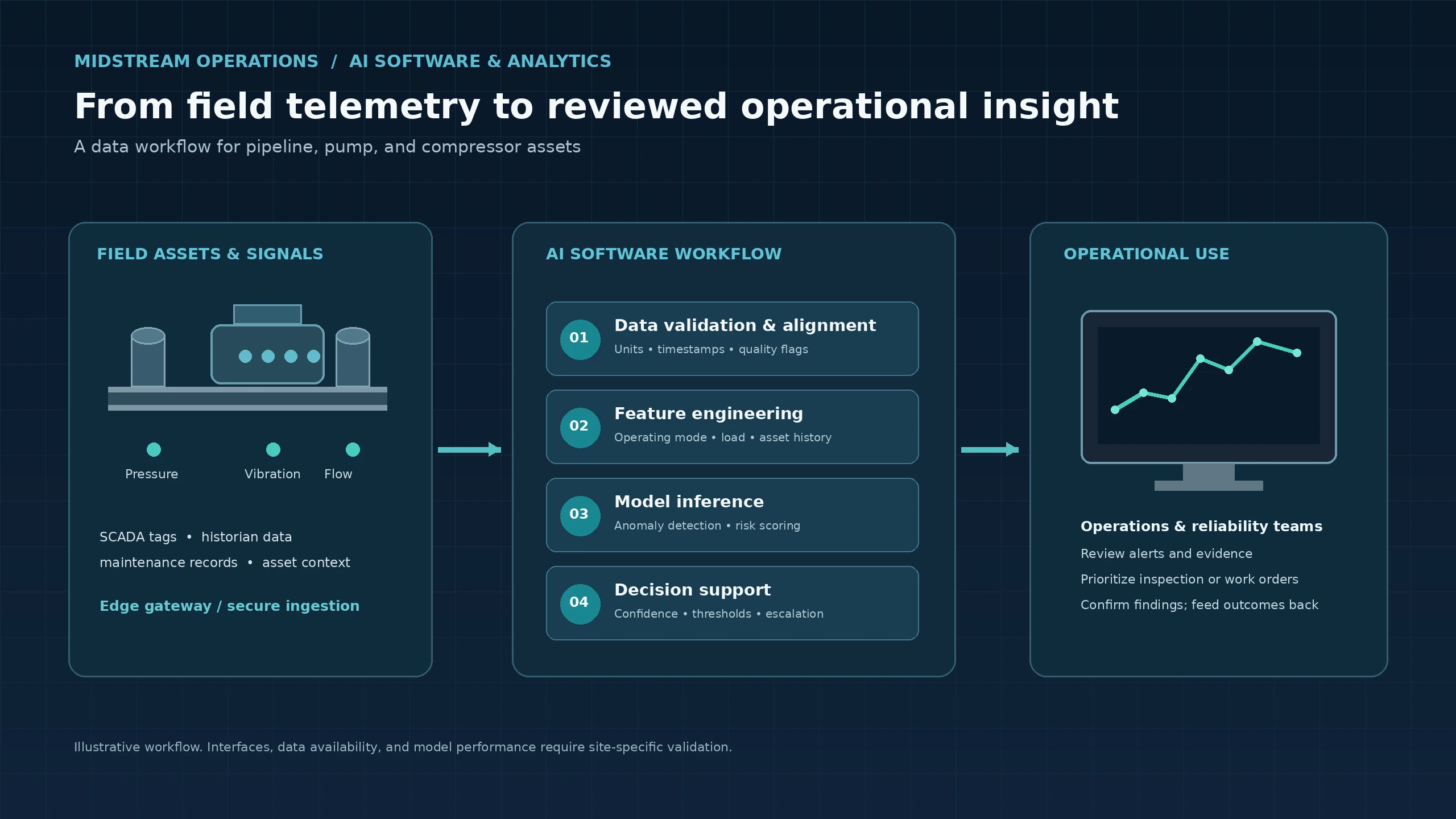
Midstream assets produce time-series measurements, alarms, status changes, inspection findings, and maintenance records. Typical inputs may include suction and discharge pressure, flow rate, temperature, vibration, motor current, valve position, compressor speed, equipment state, and ambient conditions. Supervisory control and data acquisition (SCADA) systems and process historians may provide time-stamped measurements, while computerized maintenance management systems (CMMS) hold work orders, inspection notes, and maintenance history.
Before these sources are used together, the data pipeline needs a consistent asset identifier, event time, ingestion time, engineering unit, operating mode, source, and quality flag. Engineers should check sensor ranges, calibration status, missing intervals, duplicate messages, clock differences, stale values, and changes in tag definitions. Pressure values recorded in different units or vibration samples associated with the wrong compressor train can produce misleading features and model outputs.
Labels require particular care. A maintenance work order does not always identify the onset or cause of a fault, and a closed work order is not necessarily proof that a suspected failure mode was confirmed. Data teams should document label definitions, reviewer responsibilities, uncertain records, and the relationship between alarms, inspection findings, and corrective work. Where failure labels are sparse, anomaly detection may be more supportable than a failure-probability or remaining-useful-life claim.
Feature engineering can add context that raw measurements do not provide on their own. Examples include rolling pressure variability, vibration trends, compressor load bands, starts and stops, time since maintenance, and comparisons between operating modes. Features should preserve the distinction between measured values and derived indicators. Development data and evaluation data should be separated by time, asset, or operating condition to reduce leakage and provide a more realistic test of performance.
Apply AI Methods to Defined Midstream Workflows
AI methods should be selected according to the decision they are intended to support and the evidence available for evaluation. A single model should not be presented as a general solution for every pipeline or rotating-equipment problem.
Anomaly detection for operating conditions
Anomaly detection can identify measurements or combinations of measurements that differ from an established operating baseline. For example, an analytics service may flag an unusual relationship among compressor discharge pressure, vibration, temperature, and load. The alert is a prompt for review, not a confirmed diagnosis. Threshold rules provide a useful baseline and may remain preferable where engineering limits are clear and stable.
Prediction and forecasting
Forecasting can estimate expected values or operating trends over a defined horizon. Failure-risk estimation and remaining-useful-life prediction require stronger evidence, including representative failure histories, consistent event labels, and a defensible evaluation design. If those inputs are not available, the page and product materials should describe the implemented function more narrowly, such as trend analysis or anomaly scoring.
Vision and inspection analytics
Computer vision may support selected inspection tasks when images are available and the target condition can be labeled consistently. Potential inputs include inspection photographs or video of pipeline rights-of-way, equipment surfaces, corrosion indicators, leaks, or facility conditions. Image quality, camera position, lighting, weather, occlusion, and the prevalence of each defect class affect evaluation. Human review and traceable inspection records remain important, particularly when a missed finding could affect safety or asset integrity.
Optimization and decision support
Optimization methods can compare operating choices against defined objectives and constraints, such as energy use, throughput, equipment availability, or response time. The method must use current and trustworthy operating context and make constraints visible. Recommendations should be distinguished from commands. Any connection to physical execution requires a separately defined authorization path, approved operating limits, suitable equipment interfaces, and independent confirmation of the resulting state.
For each selected method, document the input data, output, uncertainty, baseline, evaluation metric, and intended user. Operations personnel should know when a model abstains or escalates a case because measurements are stale, confidence is insufficient, or conditions differ from those represented in evaluation data.
Deploy AI Software at the Edge or on a Server
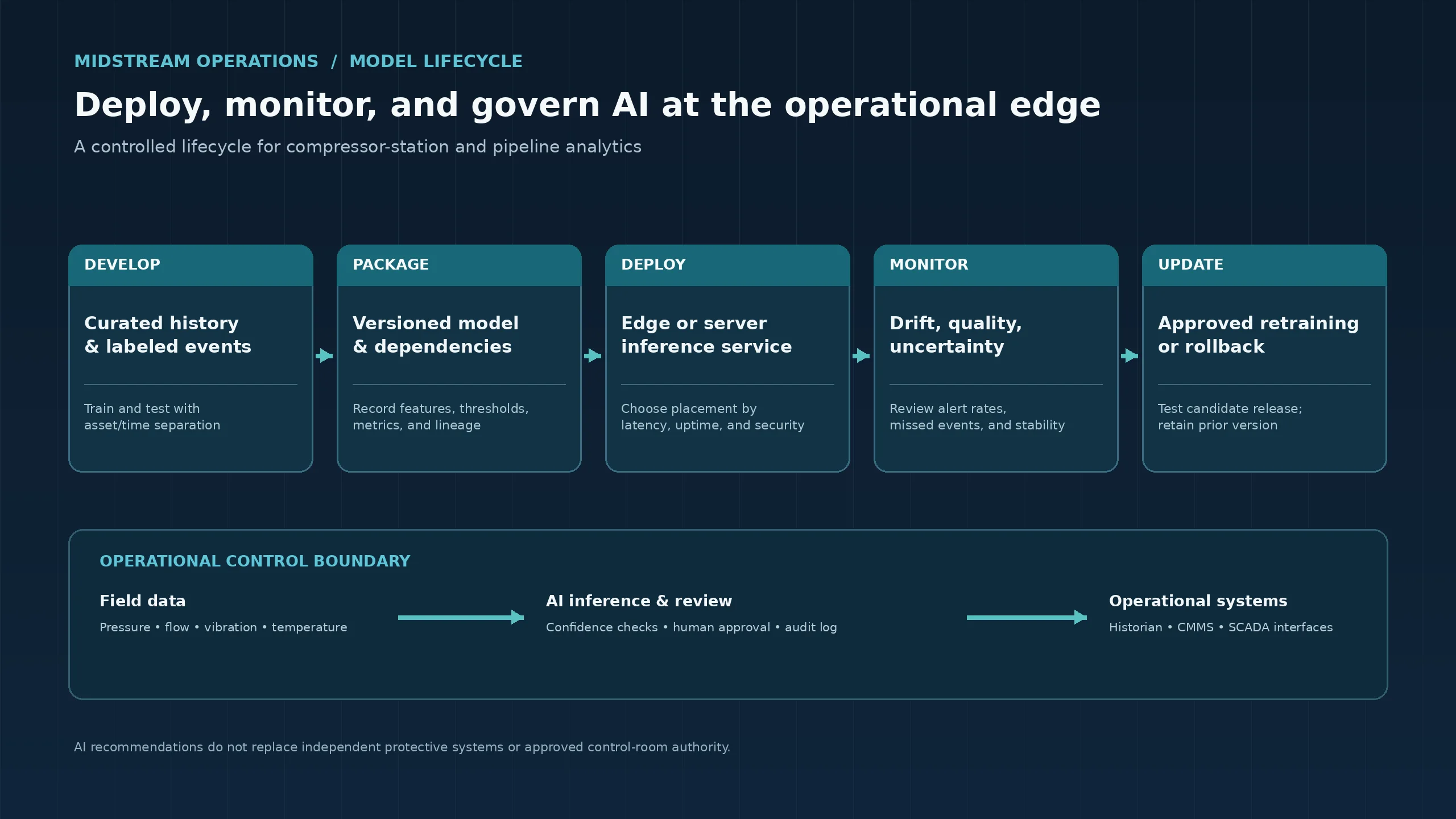
Model placement should follow operational requirements rather than a default preference for cloud, edge, or server deployment. Edge inference may be appropriate when a response depends on low latency, local availability, limited backhaul connectivity, or keeping selected data within a facility. A customer-managed server or approved hosted environment may suit workloads that need centralized data aggregation, larger compute resources, or coordination across multiple sites. The final design depends on network architecture, cybersecurity policy, data governance, support responsibilities, and the functions that must remain available during an outage.
A practical deployment design defines how source data reaches the inference service, how asset identity and timestamps are preserved, and how results are returned to the applications used by operations and maintenance teams. Integration may involve SCADA, a process historian, an enterprise asset management system, or a CMMS. The existence of a named system or protocol does not establish a tested connector. Each interface should be documented as verified, under evaluation, or proposed, with its data contract and acceptance tests.
Production model serving also requires version control. Record the model version, feature definitions, training dataset lineage, software dependencies, configuration, and release date. Keep development, validation, and production environments distinct. A deployment should support controlled updates, rollback to a known version, and an audit trail of the model and configuration used to generate each result.
Monitor Model Quality and Operational Use
A model that performs well on a historical test set can become less reliable as equipment ages, operating modes change, sensors are replaced, or process conditions shift. Monitoring should therefore cover both the input data and the model outputs. Relevant checks include missing-data frequency, sensor drift, timestamp delays, asset-association errors, feature distribution changes, alert volume, uncertain predictions, and performance against later-confirmed inspection or maintenance findings.
Model performance should be reviewed using metrics tied to the workflow. Depending on the use case, these may include fault recall, false-alert rate per operating hour, detection delay, precision by fault class, review workload, or the proportion of alerts that lead to a confirmed finding. State the denominator, time window, exclusions, and method for grouping repeated alerts. Report results by asset type and operating condition where the sample size supports it.
Retraining should be a governed engineering process, not an automatic response to every data change. A candidate model should be tested against a representative evaluation set, reviewed for regressions, approved by the designated owner, and released with a rollback plan. Operations and reliability teams should have a clear path to report incorrect alerts, missed conditions, and changes in equipment configuration. Those records can inform future evaluation when their provenance and labels are reviewed.
Evaluate Software Before Operational Release
An evaluation should begin with a defined operational question, a credible current-practice baseline, and acceptance criteria agreed upon by the technical and operating teams. Use representative data from the relevant asset classes and operating modes. Preserve a held-out test period or asset group, and include degraded conditions such as missing measurements, sensor drift, delayed messages, and changes in load. Where data are synthetic, label the exercise as a simulation and do not present its results as field performance.
Separate model metrics from operational benefits. A higher detection rate does not by itself demonstrate reduced downtime, lower maintenance cost, or improved throughput. Those outcomes depend on whether a finding is actionable, whether personnel and parts are available, how quickly an intervention can be completed, and whether the intervention changes the operating outcome. A pilot should measure the complete workflow, including data preparation, integration effort, user review, inspection findings, maintenance actions, and ongoing support.
Before release, document known limitations, operating conditions represented in testing, unsupported use cases, human oversight requirements, and the owner responsible for monitoring. A model should not be used to bypass existing safety instrumented functions, protective relays, control-room procedures, or other independent safeguards.
PipeNex AI Software and Analytics: Scope and Evaluation
PipeNex applies a Physical AI and AIoT perspective to midstream workflows that connect identification, sensing, AI-supported decisions, and, where separately authorized, physical action. The software functions described here are implementation areas, not a claim that every algorithm, connector, or deployment configuration is currently available as a released product. Specific capability status should be confirmed for each proposed application.
A requirements discussion should identify the target assets, operating question, data sources, sampling intervals, existing enterprise and control systems, preferred deployment boundary, cybersecurity requirements, and responsible technical owners. It should also establish the baseline workflow, evaluation metrics, and evidence required before any operational use.
Discuss your AI software requirements with PipeNex. The team can review a defined midstream use case and identify the data, integration, and evaluation work needed for a site-specific assessment.
Related pages
AI Decision Engine
IoT Software
System Integration and Deployment
Pilot Evaluation Guide
Equipment Health, Inspection,
and Quality Research
Contact PipeNex
Discuss Your AI Software Requirements
Discuss your AI software requirements with PipeNex. The team can review a defined midstream use case and identify the data, integration, and evaluation work needed for a site-specific assessment.
Discuss Your AI Software Requirements