PipeNex | Knowledge Center
Sensor Selection for Midstream Operations
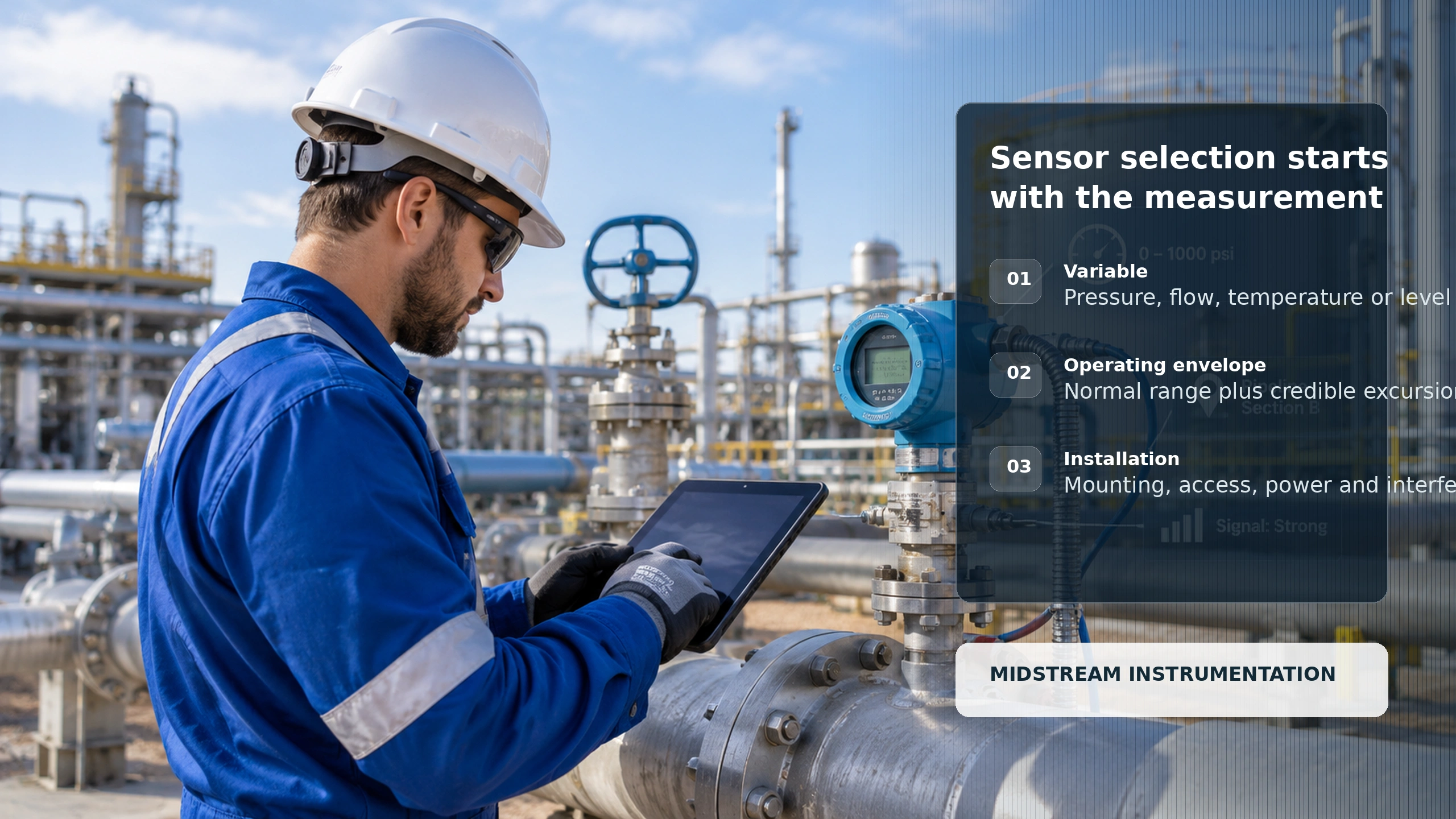
Sensor selection begins with the physical question to be answered. In midstream operations, a useful measurement must match the process variable, operating envelope, installation point, data requirements, and decision the measurement will support. A pressure, flow, temperature, level, vibration, electrical, visual, or environmental sensor can produce technically valid readings and still be a poor fit if its range, placement, response, maintenance needs, or signal quality do not match the operating context.
For pipeline, compressor station, gas processing, storage, and terminal workflows, start by defining what the operations or engineering team needs to know. Then evaluate the instrument and its installation as part of the complete sensing path, from the physical asset through the field device, communications layer, and downstream analytics or supervisory control and data acquisition (SCADA) system.
Measurement Planning
1. Define the measurement before selecting the sensor
Write the measurement requirement before comparing sensor models. Specify the physical variable, engineering units, expected operating range, required uncertainty, response time, sampling needs, and the operating conditions under which the reading must remain useful.
01
Pressure
Pressure: define the process location, normal pressure range, credible excursions, required resolution, and whether the measurement is used for monitoring, alarm support, or another operational decision.
02
Flow
Flow: define the fluid or gas service, expected flow range, required update rate, and the measurement context needed to interpret changes.
03
Temperature
Temperature: identify the process location, normal thermal envelope, response needs, and the consequences of a delayed or biased reading.
04
Level
Level: define the vessel or tank, expected level range, process conditions, and whether the measurement supports inventory, process control, or an operational alert.
05
Equipment Condition
Equipment condition: identify variables such as vibration, temperature, or electrical behavior and connect each to a specific equipment state or maintenance question.
Do not choose a sensor simply because its nominal specification appears to cover the process. The measurement requirement should also describe what could make the reading misleading, including transient conditions, installation effects, process pulsation, vibration, temperature exposure, electrical interference, or changes in operating mode.
Installation Environment
2. Match the sensor to the midstream operating environment
The physical installation can determine whether a sensor produces reliable information over its service life. Evaluate the location before finalizing the device and mounting method. Consider process connection, mounting orientation, accessibility, ambient temperature, vibration, weather exposure, electrical noise, hazardous-area requirements where applicable, and the maintenance access available to field personnel.
Pipeline and Station Piping
Pipeline and station piping: assess the process connection, mechanical loading, vibration, temperature, and access required for inspection or replacement.
Compressor Stations
Compressor stations: consider vibration, pulsation, heat, rotating-equipment proximity, and the effect of operating states on the measured signal.
Gas Processing and Storage Facilities
Gas processing and storage facilities: consider environmental exposure, process conditions, instrument location, and the need to distinguish process changes from sensor behavior.
Remote Pipeline Locations
Remote pipeline locations: evaluate power availability, communications, enclosure requirements, service intervals, and what happens when communications are delayed or unavailable.
Installation design should also account for how a technician will inspect, calibrate, replace, and troubleshoot the instrument. A sensor that is difficult to access can increase maintenance effort even when its measurement performance is acceptable.
Data Requirements
3. Specify the data the sensor must deliver
A sensor is not only a physical device. Its output becomes useful when the measurement is associated with the correct asset, timestamp, operating mode, units, and quality state. For AIoT and Physical AI applications, preserve enough context to distinguish a real process change from a measurement problem.
Record the asset or measurement-point identity with each reading.
Preserve event time and ingestion time when network delays can affect interpretation.
Store engineering units and scaling information with the measurement definition.
Use quality flags to identify missing, stale, suspect, or otherwise unusable observations.
Record operating mode where the same measurement can behave differently during startup, steady operation, shutdown, or abnormal conditions.
This distinction matters when sensor data feeds anomaly detection or other AI-supported analysis. Raw signals should remain distinguishable from derived features, and the data pipeline should preserve enough information to trace an alert back to the observations that produced it.
Instrument Maintenance
4. Evaluate calibration, drift, and maintenance
Measurement quality can change after installation. Build calibration and maintenance expectations into the sensor-selection decision rather than treating them as a later field issue. Define the reference method, review interval, acceptable deviation, and responsibility for investigating questionable readings.
Calibration
Calibration: identify the reference check and the conditions under which it will be performed.
Drift
Drift: define how changes in sensor behavior will be detected and documented.
Missing Readings
Missing readings: specify how gaps are represented and how downstream users should treat them.
Outliers
Outliers: distinguish genuine process excursions from measurement artifacts using operating context and independent evidence where available.
Maintenance
Maintenance: document access requirements, replacement procedures, configuration records, and the effect of servicing on historical continuity.
Measurement Validation
5. Validate the measurement before connecting it to analytics
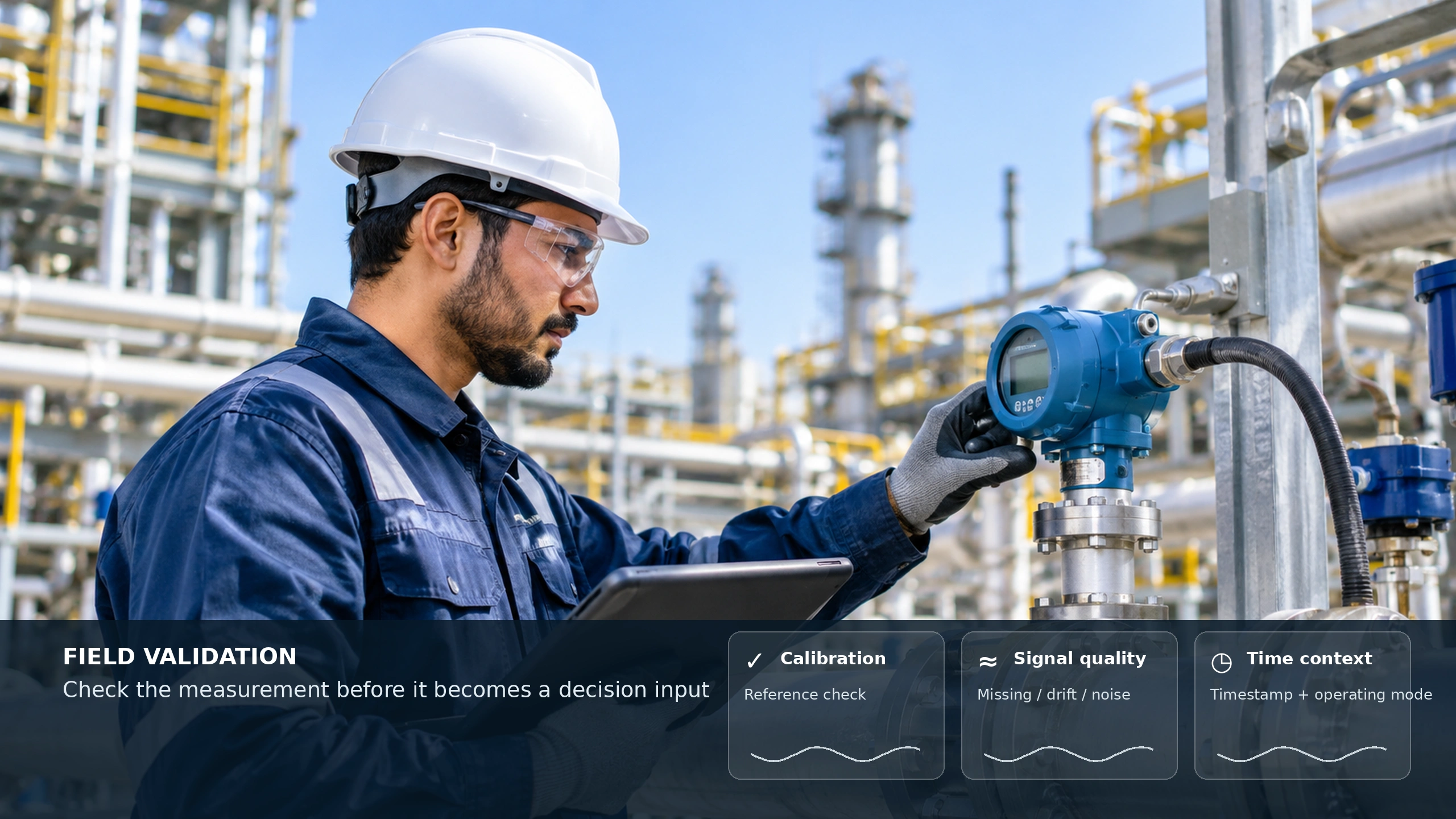
Before a new sensor becomes a decision input, verify that its readings behave as expected under representative operating conditions. A practical acceptance plan should connect the instrument specification to field evidence rather than relying only on the manufacturer’s nominal specifications.
Reference checks: compare readings against an appropriate reference instrument or established verification method.
Operating conditions: test representative normal states and relevant excursions rather than evaluating the sensor at only one convenient condition.
Signal behavior: review missing data, noise, drift, timestamp quality, and communication delays.
Installation effects: confirm that mounting, process connections, cabling, shielding, and nearby equipment do not introduce unacceptable measurement error.
Review responsibility: assign ownership for engineering acceptance, field verification, data-quality review, and final approval.
Practical Example
6. Worked example: selecting a pressure measurement for a pipeline station
Consider a pipeline station where operations needs a dependable pressure measurement at a defined process point. Start with the operating question: what pressure state must the team observe, over what range, and for what operational purpose? Define the normal envelope, credible excursions, required response, measurement uncertainty, installation location, and maintenance access before choosing the instrument.
Next, compare candidate pressure-measurement approaches against the actual installation. A pressure transmitter may be appropriate where continuous digital data is required, but the decision still depends on the process connection, environmental exposure, power and communications, calibration approach, and the quality requirements of the downstream application. A local mechanical gauge can provide an independent reference for field verification even when it is not the primary data source.
The final selection should document the chosen measurement source, units, required range, expected uncertainty, mounting location, sampling or update interval, calibration method, communications path, and the conditions that would invalidate the selection. Those same fields can later define the assumptions and observation behavior used in a synthetic-data or pilot-evaluation workflow.
Sensor Evaluation
7. Sensor selection checklist
- What physical variable must be measured?
- What are the normal operating range and credible excursions?
- What uncertainty and response time are acceptable for the decision?
- Where will the sensor be installed, and what environmental conditions will it experience?
- How will it be powered, connected, serviced, and replaced?
- How will calibration and drift be detected?
- How will missing, stale, duplicate, or suspect readings be represented?
- How will the measurement be associated with the correct asset and operating mode?
- What reference check or field test will establish acceptance?
- Who owns engineering approval, field verification, and data-quality review?
Explore PipeNex
Related resources
Condition Monitoring for Midstream Operations
PipeNex Sensing Engine
Identification and Sensing Hardware
Pilot Evaluation Guide
Connect With PipeNex
Next step
Use the selection checklist to document one measurement point, then evaluate the proposed sensor against its operating envelope, installation conditions, data-quality requirements, and field acceptance plan.
Discuss Your Sensor Selection Requirements