PipeNex | Midstream Operations Technology
Physical Action and Control Technologies for Midstream Operations
Physical execution in midstream operations depends on more than a software command. Pipeline valves, pump and compressor equipment, electric drives, and station control systems each have defined operating limits, interfaces, and responsibilities.
Explore Control TechnologiesPhysical execution in midstream operations depends on more than a software command. Pipeline valves, pump and compressor equipment, electric drives, and station control systems each have defined operating limits, interfaces, and responsibilities. PipeNex examines how Physical AI and Artificial Intelligence of Things (AIoT) workflows can connect an authorized operational decision with a controlled equipment response, while preserving the site’s established automation and protective architecture.
The technologies described here are implementation categories, not a claim that every device, protocol, or control interface is currently supported by PipeNex. Equipment compatibility, write access, and operating authority must be established for each facility.
Physical Action Equipment in Pipeline and Station Operations
Midstream facilities use several types of equipment to move, regulate, and condition transported products. The relevant action technology depends on the asset, process duty, control philosophy, and operating environment.
Valves and Actuators
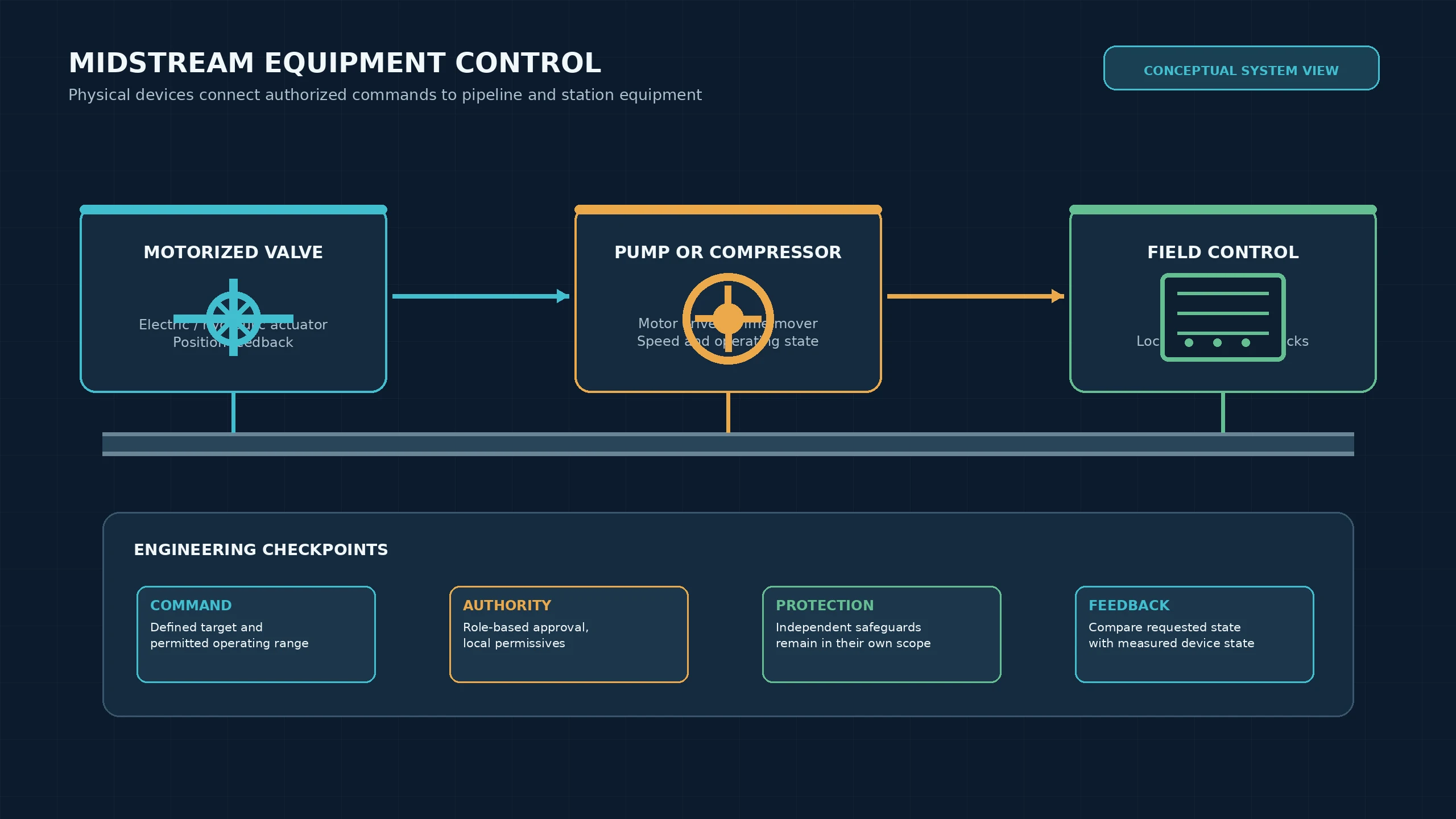
Motor-operated, pneumatic, and hydraulic actuators can position or operate pipeline and station valves when the valve assembly and control system are designed for that duty. Relevant interface information may include the commanded position, actual position, travel status, fault indication, local or remote mode, and permissive state. A command should be evaluated against the equipment’s approved operating envelope and the facility’s operating procedures.
Pump, Compressor, and Drive Systems
Pump stations and compressor stations rely on rotating equipment and associated drivers to maintain the required movement and operating conditions. Electric motors, variable frequency drives, engine or turbine controls, and package controllers may expose selected supervisory functions and status information. Any proposed adjustment must account for equipment limits, process conditions, equipment availability, and the control responsibilities assigned to the local package or station system.
PLC, RTU, and Station Control Equipment
Programmable logic controllers (PLCs) and remote terminal units (RTUs) commonly provide local control, status acquisition, and communications with supervisory systems. Their role is distinct from an AI model or business application. A proposed integration must identify which system owns each control function, which data are read-only, which commands are permitted, and how local logic behaves if upstream communications become unavailable.
Robotic and Autonomous Systems
Robotic inspection devices, remotely operated equipment, and autonomous systems may support defined inspection or field tasks where the facility, equipment, and procedures permit their use. Their inclusion requires a specific operating case, defined mission boundaries, communications planning, human oversight, and a method to confirm task completion. No general compatibility or autonomous operating capability is implied.
Command Interfaces and Control Boundaries
An equipment interface should define more than a command name. It should specify the target asset, permitted operation, units or position convention, command source, authorization requirements, timing expectations, acknowledgment behavior, and the status information returned by the device or controller.
For midstream operations, supervisory commands may request an approved change to a valve position or equipment operating target. Low-level control loops and equipment protection logic remain within the validated control system responsible for the process or package. An AI application should not be treated as a substitute for a PLC, RTU, distributed control system (DCS), safety instrumented system (SIS), or other independently engineered protective function.
A useful interface contract distinguishes these states:
Proposed: an application has generated an action recommendation, but no command has been issued.
Authorized: the required person, role, or approved operating rule has permitted the action.
Validated: the receiving control system has checked the command against its configured permissives and limits.
Dispatched: the command has been transmitted to the intended controller or device.
Acknowledged: the receiving interface has confirmed receipt or processing. This does not prove that the physical action completed.
Verified: independent or otherwise appropriate field observations indicate that the intended equipment state was reached.
Rejected, timed out, or failed: the command was denied, not confirmed within the defined time, or did not produce the expected state.
The interface design should also address duplicate requests, stale measurements, out-of-sequence messages, clock differences, loss of connectivity, and recovery after communication is restored. A command identifier and traceable event record help operators and engineers reconstruct what was requested, accepted, executed, and observed.
Separate Advisory AI from Validated Equipment Control
AI can analyze operating data, identify an abnormal condition, rank response options, or recommend an adjustment. Those functions do not by themselves establish authority to operate equipment. The transition from recommendation to physical execution requires a separately defined control path.
A practical architecture keeps AI-supported decision logic at the supervisory level unless a specific, reviewed design establishes otherwise. Existing PLC, RTU, DCS, package control, and independent protection functions retain their assigned responsibilities. Any write interface should be narrowly scoped, authenticated, logged, and tested against the receiving system’s actual behavior.
Independent protective functions must not depend on an AI recommendation to perform their required role. Interlocks, trips, permissives, emergency shutdown functions, and manual controls must remain governed by the facility’s approved engineering design and procedures. A software demonstration or simulated control sequence does not establish that a real installation is safe, certified, or ready for operation.
Operating Conditions, Authority, and Fault Handling
Midstream control decisions take place across remote pipeline assets, compressor and pump stations, terminals, and other facilities with differing communications, access, and environmental conditions. A proposed action workflow should be assessed against the conditions at the target site.
- Authority and permissions: define who may request, approve, dispatch, inhibit, and override each action. Use role-based access and retain an auditable record.
- Interlocks and permissives: identify the local conditions that must be satisfied before the control system accepts a command. Do not infer or replace site-specific interlock logic.
- Manual and local control: document how personnel can retain or regain control, how local/remote mode is represented, and how conflicting requests are handled.
- Fault response: define behavior for actuator faults, drive trips, invalid feedback, partial movement, rejected commands, and equipment unavailable states.
- Communications loss: establish whether the relevant function holds its last valid state, continues under local control, transitions to a defined fallback, or stops accepting supervisory requests. The correct response is site- and equipment-specific.
- Cybersecurity: protect command interfaces through identity controls, least privilege, network boundaries, secure communications, logging, and controlled change management.
These controls require review by the facility’s operations, instrumentation and controls, process engineering, functional safety, and cybersecurity stakeholders as appropriate. The technology selection should fit the site’s existing management of change and commissioning processes.
From Authorized Decision to Verified Equipment State
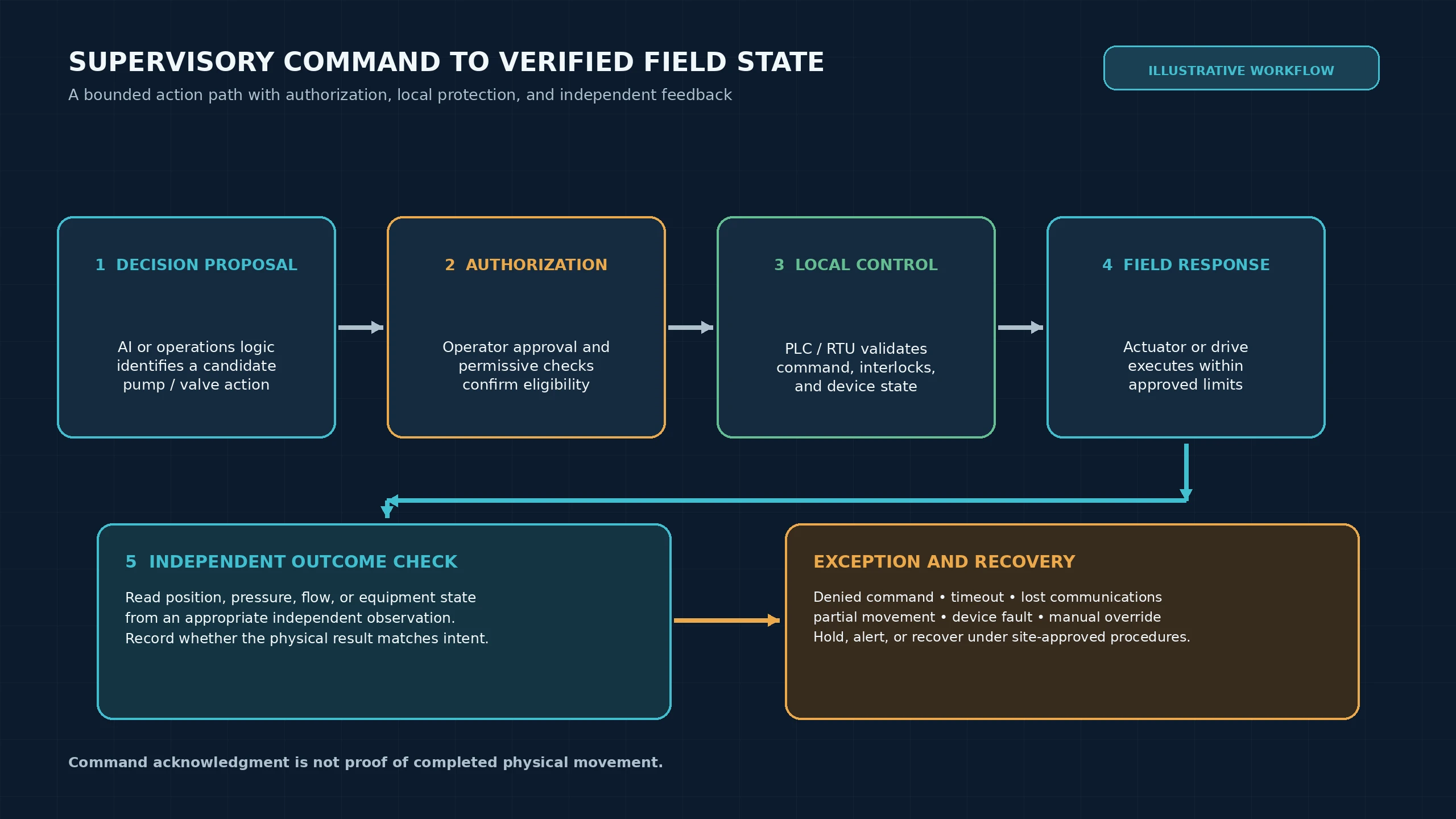
A representative workflow may begin when operating measurements or equipment status indicate that a bounded action should be considered. The decision function produces a proposal with its supporting observations and constraints. An authorized operator or approved control policy determines whether the proposal may proceed. The receiving PLC, RTU, or package controller then applies its own validation and local control logic before dispatching an instruction to the actuator or drive.
After dispatch, the system should distinguish receipt acknowledgment from physical completion. Valve position feedback, drive status, equipment measurements, or another suitable observation can be used to assess the resulting state. If the observed state does not match the intended result, the workflow should record the discrepancy and route it through the facility’s approved fault and recovery procedures.
For example, a proposed valve adjustment at a pipeline or station asset would need a confirmed asset identity, current and sufficiently fresh operating data, a defined permitted action, required authorization, local controller acceptance, and an appropriate post-action observation. This is an illustrative workflow, not an operating instruction or a claim of a deployed PipeNex control integration.
Technology Selection and Site Evaluation
Selection should start with the operating task and the equipment owner’s control requirements, not with a preferred protocol or device category. The engineering review should establish:
Asset and action scope: identify the exact valve, pump, compressor, drive, robotic device, or other target and the action being considered.
Control ownership: document the existing PLC, RTU, DCS, package controller, supervisory system, and independent protection boundaries.
Interface definition: confirm available read and write points, data types, units, command limits, status codes, timing, and interface version.
Authority model: specify operator approval, role permissions, local/remote mode, interlocks, override, and command rejection behavior.
Communications and resilience: test latency, intermittent connectivity, message loss, buffering, duplicate handling, and recovery behavior.
Verification method: identify the field measurement or device feedback that can confirm the physical outcome independently of command receipt.
Commissioning evidence: retain test cases, expected and observed results, exception tests, approvals, configuration records, and rollback arrangements.
Evaluation should include normal operating conditions and relevant exceptions, such as stale observations, unavailable equipment, denied authorization, delayed acknowledgment, communication interruption, partial execution, and manual override. Acceptance criteria should be agreed before testing and should cover both intended outcomes and adverse cases. No universal performance threshold or equipment setting is prescribed here.
How This Fits with PipeNex Engines and Integration
The PipeNex Physical AI Action Engine describes the functional role of connecting an approved decision with an operational response. This technology page addresses the equipment and interface considerations behind that role. The system integration and deployment overview covers broader enterprise and equipment integration responsibilities. For command permissions, cyber safeguards, and operational oversight, see the cybersecurity and physical action safeguards guide.
Related Pages
PipeNex Physical AI Action Engine
System Integration and Deployment
Cybersecurity and Physical Action Safeguards
Verified AI Decisions and Physical
Control Research
Discuss a Midstream Physical Action Workflow
To assess a potential application, define the target equipment, proposed action, current control architecture, available status and measurement points, authorization requirements, and method for verifying the physical result. PipeNex can use these details to frame an integration discussion and identify the site-specific engineering questions that must be resolved before any physical control is considered.
Contact PipeNex to discuss your application