
PipeNex | Midstream Operations Solutions
Predictive Maintenance for Midstream Operations
Predictive maintenance uses equipment condition and operating information to support maintenance decisions. In midstream operations, the value of an approach depends on the assets being monitored, the quality of operating and failure records, and the maintenance actions a team can realistically take.
Explore Predictive MaintenancePredictive maintenance uses equipment condition and operating information to support maintenance decisions. In midstream operations, the value of an approach depends on the assets being monitored, the quality of operating and failure records, and the maintenance actions a team can realistically take. PipeNex focuses on Physical AI and Artificial Intelligence of Things (AIoT) applications that connect physical-world observations with reviewed operational decisions.
Where predictive maintenance fits in midstream operations
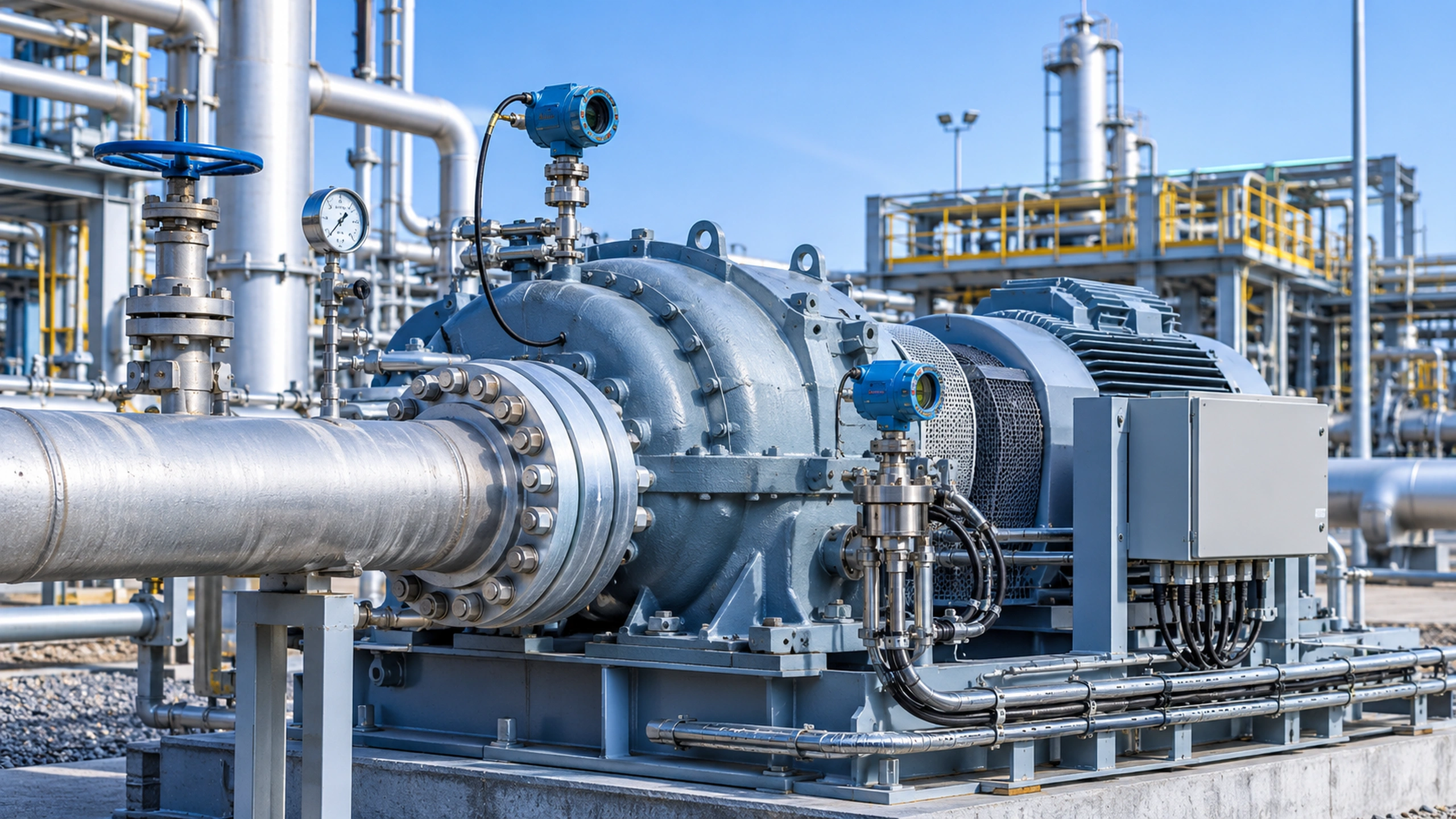
Midstream facilities depend on equipment that moves, compresses, measures, treats, and stores hydrocarbons. A maintenance evaluation may focus on rotating equipment at pipeline pump stations, natural gas compressor stations, terminals, or related processing facilities. The relevant asset boundary should be defined with the operator before selecting sensors or analytical methods.
Potential asset classes for an initial assessment include:
Pipeline and terminal pumps, including pump drivers and associated motors.
Natural gas compressors, compressor drivers, and supporting lubrication or cooling systems.
Electric motors, bearings, couplings, seals, and other maintainable components associated with selected rotating assets.
Supporting equipment and instrumentation where condition measurements can be tied to a defined maintenance decision.
The evaluation should identify the failure modes that matter for the selected equipment, such as bearing degradation, abnormal vibration, temperature excursions, lubrication-related issues, seal problems, or changes in operating performance. These are candidate topics for engineering review, not a universal failure list. Asset design, service conditions, process fluids, duty cycle, and site maintenance practices determine which conditions are relevant.
What information is needed?
A predictive maintenance method is only as useful as the evidence available to develop and evaluate it. Begin with a specific asset class and assemble the records that connect observed conditions to operating state and confirmed maintenance outcomes.
- Condition measurements: vibration, bearing and casing temperature, pressure, flow, motor current or power, and other measurements selected for the asset and failure mode.
- Operating history: load, speed, start and stop events, operating mode, process conditions, run hours, and relevant operating changes.
- Maintenance records: work orders, inspection notes, corrective and preventive tasks, component replacements, repair findings, and return-to-service records.
- Failure evidence: confirmed failure events, failure mode descriptions, dates, affected components, and the method used to verify each label.
- Asset context: asset identifiers, equipment hierarchy, location, manufacturer and model where available, configuration, and relevant maintenance strategy.
- Data quality information: sensor identity, calibration and maintenance history, sampling frequency, units, missing intervals, time alignment, and known data gaps.
Records should be aligned by asset identity and time. A vibration reading without its operating mode may be difficult to interpret. A work order that records a repair but not the confirmed finding may be insufficient as a failure label. Before model development, review whether historical records consistently distinguish suspected faults, confirmed failures, inspections that found no defect, and maintenance performed for other reasons.
Choosing an analytical approach
Predictive maintenance can refer to several different analytical tasks. They should be described separately because they require different evidence and support different decisions.
Anomaly detection
Anomaly detection identifies measurements or patterns that differ from an established operating baseline. It can be useful when confirmed failure examples are limited, provided the baseline represents normal behavior across relevant loads, speeds, and operating modes. An anomaly is an indication for review, not proof that a component is failing or that a specific failure will occur.
Failure-risk estimation
Failure-risk estimation evaluates the likelihood or relative risk of a defined failure event over a stated time horizon. It requires reliable event definitions, enough representative failure and non-failure history, and careful treatment of maintenance interventions and changing operating conditions. Outputs should include the prediction horizon, uncertainty, and conditions in which the estimate should not be used.
Remaining useful life prediction
Remaining useful life prediction estimates the time or operating exposure remaining before a defined failure threshold or maintenance endpoint. This is a more demanding task than anomaly detection. It requires suitable degradation histories, defensible endpoint labels, and evidence that the modeled degradation process applies to the equipment and operating conditions being assessed. Do not present anomaly scores or simulated warning windows as validated remaining-life predictions.
Where the available evidence supports only anomaly detection, the solution should be described as condition-based anomaly identification and review. More advanced failure-risk or remaining-life claims should wait until the data and evaluation support them.
From condition signals to a maintenance decision
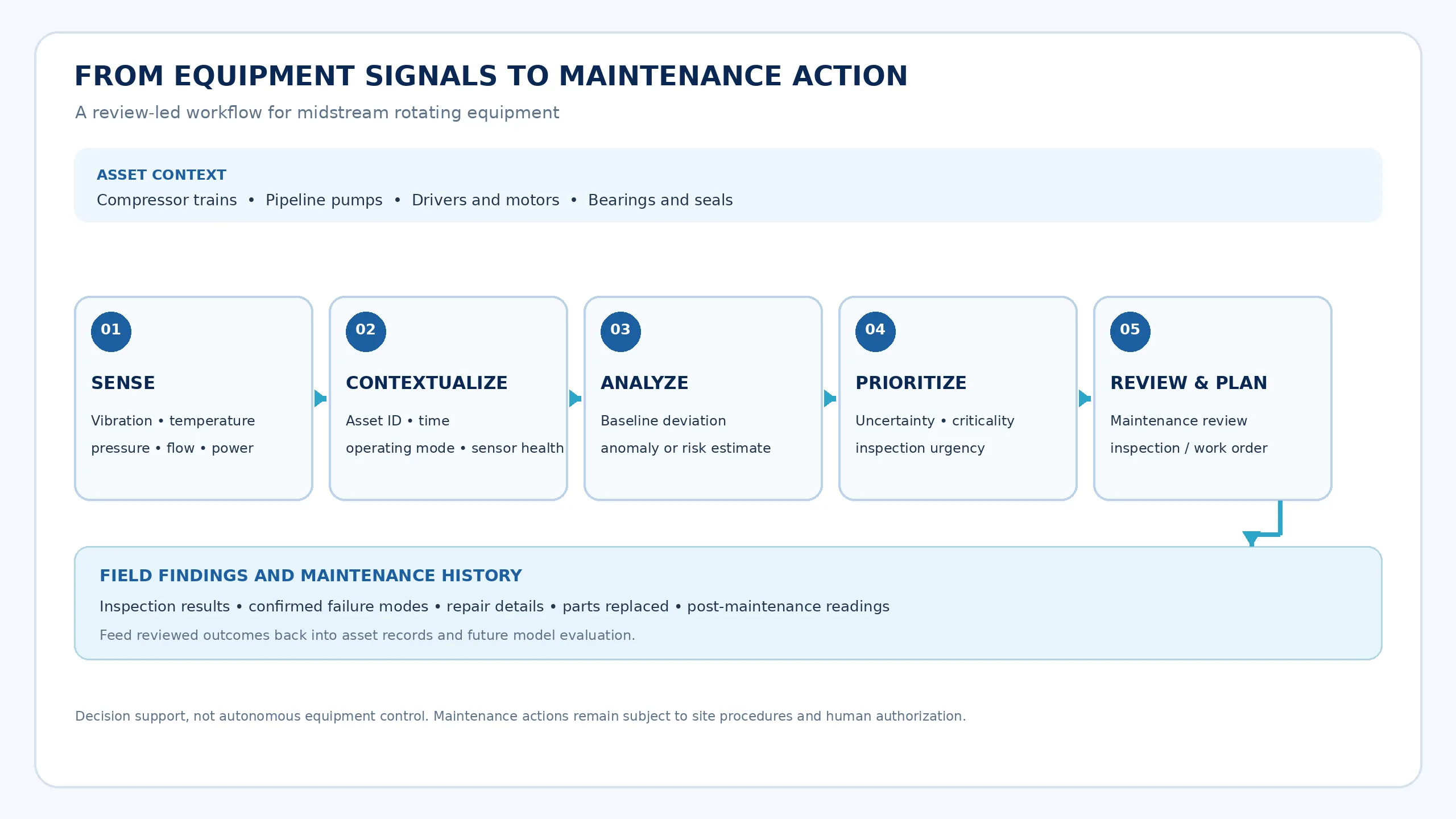
A useful workflow connects measurements to a reviewable decision and then captures what the maintenance team found. A typical evaluation sequence is:
- Acquire condition and process measurements from selected assets using suitable installed instrumentation or approved data sources.
- Associate each observation with the correct asset, timestamp, units, operating mode, and data-quality status.
- Compare current behavior with an appropriate baseline or apply an evaluated analytical method.
- Present an alert or risk indication with the supporting trend, relevant context, uncertainty, and recommended review priority.
- Have the responsible reliability or maintenance personnel assess the indication and determine whether further inspection is warranted.
- Record the inspection finding, maintenance decision, work order, repair details, and post-maintenance condition where available.
- Use reviewed outcomes to improve asset history and assess whether the method remains useful under changing conditions.
The output may support maintenance prioritization, inspection scheduling, or a work-order recommendation. It should not bypass site procedures, safety requirements, operating authority, or existing protective systems. Any connection to equipment control requires a separate engineering and authorization review.
Maintenance workflow and operational responsibilities
Predictive maintenance should fit the way a midstream operator plans and executes work. Reliability engineers may define failure modes and review model outputs. Instrumentation and controls personnel may validate measurement sources and data quality. Maintenance planners may translate approved findings into inspection plans or work orders. Operations supervisors coordinate access, equipment availability, and operating constraints. Technicians perform inspections and repairs and record findings.
A practical process defines who receives each alert, what evidence is displayed, when an alert is escalated, and how an inspection result is recorded. It should also define how duplicate alerts are grouped, how stale or missing data are flagged, and when the method abstains because the asset is operating outside the conditions used for evaluation.
Integration and deployment considerations
The data path may involve condition-monitoring systems, historians, supervisory control and data acquisition (SCADA) environments, computerized maintenance management systems (CMMS), enterprise asset management records, and other site applications. The exact interfaces, data ownership, access permissions, and deployment location must be confirmed for each operator. A named protocol or enterprise system should be treated as an integration option until compatibility has been tested.
An implementation assessment should document:
- Which assets and data sources are in scope, including the owner and update frequency of each source.
- How asset identifiers, timestamps, units, operating modes, and maintenance events will be reconciled.
- Whether processing is required at the edge, on a customer-managed server, or in an approved cloud environment.
- How access control, cybersecurity review, audit logging, data retention, and system availability will be handled.
- What happens when data are delayed, missing, inconsistent, or unavailable.
- Which interfaces are already tested and which remain proposed or require site-specific development.
PipeNex’s Physical AI and AIoT approach can be evaluated in relation to the PipeNex AI Decision Engine and the Technology and Integration resources. These links describe related architecture and implementation topics; they do not imply that a particular connector or deployment configuration has been verified.
Is the maintenance data ready?
Before selecting a predictive method, review the available evidence against the intended task. A readiness assessment should answer the following questions:
- Is the target equipment class and the maintenance decision clearly defined?
- Are asset identifiers consistent across condition records, operating history, and work orders?
- Are failure events confirmed, time-stamped, and described at a useful component or failure-mode level?
- Do inspection and maintenance records distinguish confirmed faults from suspected issues and routine work?
- Are normal operating conditions represented across relevant loads, speeds, seasons, and operating modes?
- Are sensor gaps, calibration changes, replacements, and data-quality issues documented?
- Is there enough independent history to separate model development from fair evaluation?
- Can maintenance personnel review an alert and take a feasible action within the available operating constraints?
If failure labels are sparse or inconsistent, begin with data-quality improvement, baseline condition analysis, or anomaly detection. Do not force a failure-risk or remaining-life model onto records that cannot support it.
How to evaluate a pilot
A pilot should compare the candidate method with the operator’s existing maintenance or condition-monitoring workflow. Define the asset population, operating period, failure events, baseline, decision thresholds, and success criteria before reviewing results. Where practical, evaluate on assets or time periods that were not used to develop the method.
- Useful warning time: time between a valid alert and a confirmed failure or maintenance endpoint, reported only when the event timeline supports the calculation.
- False-alarm rate: alerts assessed as not requiring the defined maintenance response, normalized by a stated operating-time denominator.
- Fault recall: confirmed fault episodes detected by the method divided by the confirmed fault episodes in the evaluation set.
- Inspection findings: proportion and type of alerts that lead to a confirmed finding, with no-fault inspections also recorded.
- Maintenance effort: inspection hours, review workload, work orders created, and time spent investigating alerts.
- Data availability and quality: missing observations, delayed data, sensor faults, and periods excluded from analysis.
- Transfer across conditions: performance across different assets, operating modes, loads, or seasonal conditions where relevant.
Report the number of assets and events, evaluation period, exclusions, metric definitions, and uncertainty. Separate model performance from operational outcomes. Earlier detection does not by itself establish avoided downtime, lower maintenance cost, or improved throughput. Those outcomes require evidence that an intervention was feasible, performed in time, effective, and captured in the evaluation.
What the results can and cannot establish
A controlled evaluation can establish whether a method identifies defined patterns or events in the tested data and whether its outputs are useful to the maintenance workflow. It cannot automatically establish performance on untested assets, other operating conditions, or future equipment configurations. Simulation can help examine assumptions and workflow behavior, but simulation-derived warning time does not establish production remaining-life accuracy or avoided downtime.
Any published example should identify whether it is an illustrative scenario, an executed simulation using synthetic data, a controlled hardware test, a customer pilot, or an operational customer result. Do not present modeled results as customer outcomes or imply a deployment that has not been verified.
Related pages
Condition Monitoring
PipeNex AI Decision Engine
AI Software and Analytics
System Integration and Deployment
Equipment Health, Inspection,
and Quality Research
Contact PipeNex
Discuss a predictive maintenance evaluation
Start with one equipment class, one maintenance question, and the records available to answer it. PipeNex can use that scope to structure a discussion of asset context, data readiness, candidate analytical methods, integration dependencies, and a fair pilot evaluation.
Discuss a Predictive Maintenance Evaluation