
PipeNex | Knowledge Center
Designing and Evaluating a Physical AI or AIoT Pilot
A useful pilot answers a defined operational question under representative conditions. In midstream operations, that may mean determining whether connected sensing and AI-supported analysis can improve visibility into a pipeline segment, identify an equipment condition that warrants review, or make an inspection workflow more consistent. The pilot should establish the operating boundary, baseline workflow, data requirements, success measures, and decision criteria before equipment is configured or results are assessed.
Pilot Planning
Start with an operational question and a bounded asset group
Begin with a question that an operations, pipeline integrity, or reliability team can answer using evidence. Avoid starting with a broad objective such as adding AI to a facility. Identify the specific decision or task that needs better information, who is responsible for it, and what action may follow.
A suitable first scope might cover a defined pipeline segment, a meter station, a compressor station, or a pump station. The asset boundary should identify the equipment included and excluded, relevant operating modes, normal production conditions, and any maintenance or inspection activities that affect the data. Depending on the use case, relevant assets may include pressure transmitters, flow meters, temperature instruments, vibration sensors, compressor trains, pump assemblies, valves, and associated control or monitoring equipment.
Document the primary users and their responsibilities. These may include control-room operators, field operations technicians, pipeline integrity engineers, reliability engineers, instrumentation and controls personnel, and operational technology (OT) and information technology (IT) teams. Record who can view data, review alerts, approve follow-up, maintain devices, and authorize any change to an operational workflow.
The pilot charter should state the problem, target asset group, operating location, duration, intended capability, known constraints, and exclusions. For a first evaluation, read-only monitoring and decision support can provide a bounded way to assess data quality and alert usefulness. Any connection to equipment control requires a separate engineering, authorization, and safety review. A monitoring pilot should not be presented as proof that an AI system can safely control a compressor, pump, valve, or pipeline process.
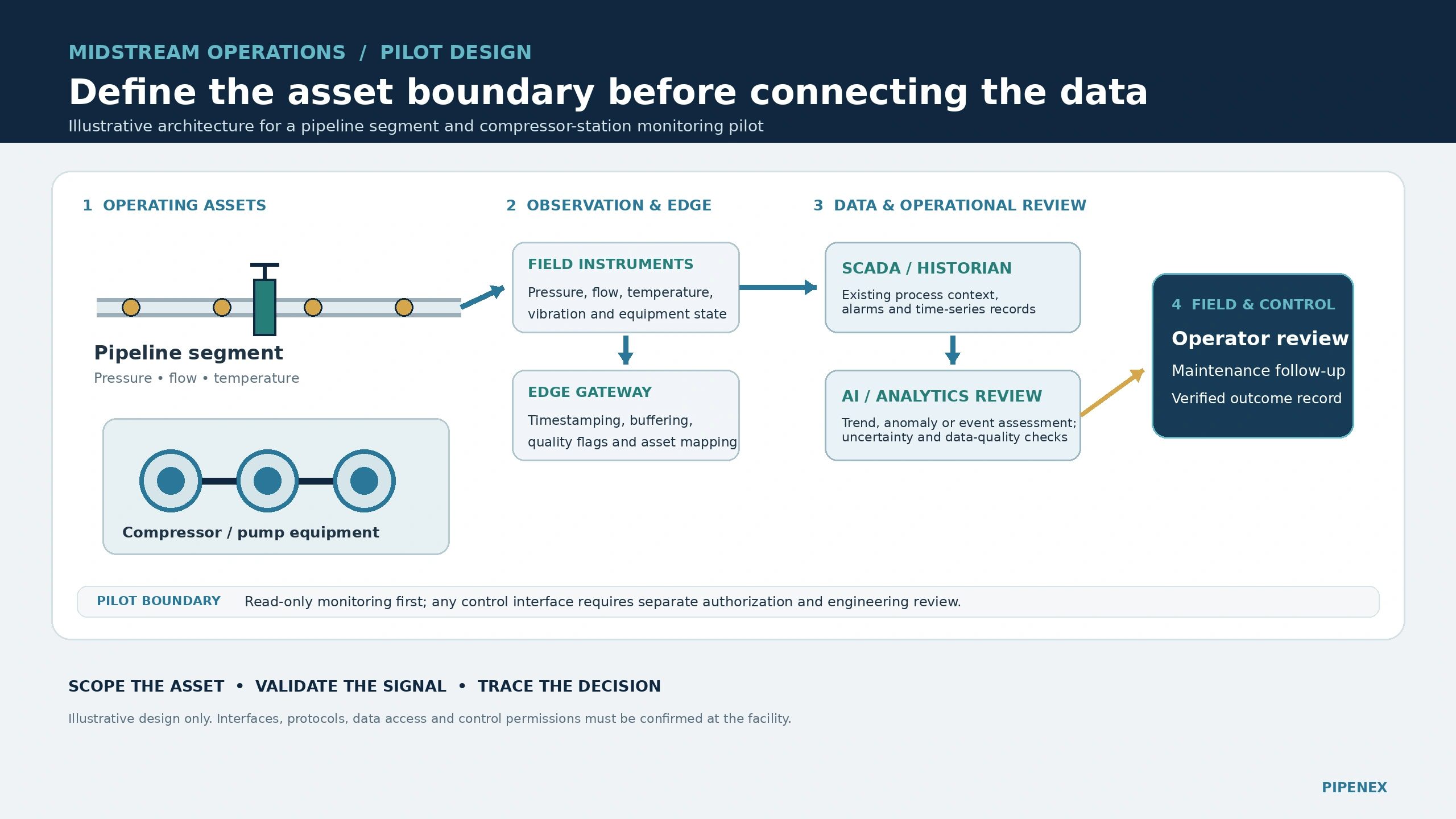
Technical illustration. It is not a representation of a deployed PipeNex installation or a validated system configuration.
Baseline Evaluation
Define the baseline before introducing the candidate approach
A pilot needs a credible picture of the current workflow. Record how the organization performs the task today, which systems and instruments are involved, how often information is reviewed, how exceptions are handled, and what evidence is retained. Depending on the use case, the baseline may include control-room alarms, SCADA (supervisory control and data acquisition) trends, historian records, operator rounds, inspection reports, work orders, and maintenance records.
Choose a baseline period that includes representative operating conditions. Account for planned maintenance, seasonal variation, throughput changes, startup and shutdown periods, and other events that may affect measurements or workload. If the baseline period does not contain a relevant fault or exception, state that limitation rather than treating the absence of an event as evidence of detection performance.
Compare the candidate approach with the baseline using equivalent assets, time windows, event definitions, and operating conditions wherever practical. Record any differences that cannot be controlled. This helps separate a genuine change in workflow performance from changes in operating conditions or data availability.
Pilot Data Requirements
Identify data sources, interfaces, and quality requirements
List each required data source and the role it plays in the evaluation. Potential inputs include pressure, flow, temperature, vibration, motor current, equipment state, alarm history, maintenance events, inspection findings, and asset metadata. Select measurements that are relevant to the operational question. More data does not automatically produce a better pilot.
For every signal or event, document the source instrument or system, asset identifier, unit of measure, sampling or event frequency, timestamp convention, time zone, expected range, quality indicator, and responsible data owner. Record calibration status where applicable, known measurement limitations, and how missing, stale, duplicate, or out-of-range observations will be represented.
Map the path from field device to gateway, network, data service, historian, and any enterprise application involved. Confirm access permissions, data ownership, retention rules, network segmentation, cybersecurity review, and the process for handling delayed or rejected records. Potential interfaces may include SCADA, a historian, a computerized maintenance management system (CMMS), or enterprise resource planning (ERP) records. These are candidate integration points, not claims of pre-existing PipeNex connectors or compatibility.
Decide where processing is expected to occur. An edge device may be relevant when local buffering, low-latency processing, or operation during intermittent connectivity is important. Server or cloud processing may be appropriate for other workloads. The pilot plan should identify the actual hosting, support, update, and recovery responsibilities instead of assuming that every deployment option is available.
Success Measures
Choose measures that match the operational task
Define metrics before testing begins. Each metric needs a clear unit, denominator, time window, event definition, and aggregation method. The right measures depend on whether the pilot evaluates identification, condition monitoring, anomaly detection, workflow support, or an authorized physical action.
Event completeness: correctly captured required events divided by the required events established through an independent reference.
Fault or anomaly recall: detected fault episodes divided by the fault episodes represented in the evaluation set. State how episodes are grouped and labeled.
False-alert rate: false alerts per operating hour or another explicitly defined exposure period. Explain how repeated alerts are handled.
Detection delay: elapsed time between the defined onset or reference point and the alert, when the available evidence supports that calculation.
Task time: time required to complete a defined inspection, review, reconciliation, or exception-handling task.
Alert usefulness: the proportion of reviewed alerts that lead to a documented finding or an agreed follow-up decision.
Verified action rate: actions confirmed by independent observation of the resulting state divided by eligible attempted actions, if physical action is in scope.
Data availability and quality: expected observations received with valid timestamps, units, identity, and quality status.
Do not treat model accuracy as a substitute for operational value. A detection result does not by itself demonstrate avoided downtime, reduced maintenance cost, or improved throughput. Those outcomes require evidence about intervention feasibility, response time, available personnel and parts, action effectiveness, and the consequences of the intervention.
Pilot Test Design
Design tests around normal operation and difficult conditions
A pilot should include representative normal operation as well as the conditions most likely to expose weaknesses. Agree on test cases with operations, engineering, and OT/IT stakeholders before reviewing results. The test plan should cover:
Normal operating ranges and relevant changes in throughput, pressure, temperature, or equipment load.
Startup, shutdown, maintenance, and other operating modes that may change the meaning of a measurement.
Missing, duplicate, delayed, stale, or incorrectly associated observations.
Sensor drift, instrument faults, calibration issues, and values outside expected ranges.
Network interruption, delayed message delivery, edge buffering, reconnection, and data reconciliation.
Unusual but plausible process conditions and known equipment exceptions.
Operator review delays, alert escalation, rejected recommendations, and unresolved exceptions.
Keep deliberately enriched fault or exception tests separate from tests intended to represent normal event prevalence. Report the test composition so that readers can understand how representative the results are. If synthetic data or simulation is used during preparation, label it clearly and do not present simulated performance as field evidence. A successful simulation is a reason to test an approach, not a substitute for a customer pilot.
Operational Governance
Assign responsibilities and operational oversight
A pilot needs named owners for installation, data access, data quality review, operational oversight, issue handling, cybersecurity, and acceptance approval. One person may hold more than one role, but the responsibilities must be explicit. Include a technical owner who can investigate device, data, and interface issues, and an operational owner who can determine whether the proposed workflow is appropriate for the facility.
Define how alerts or recommendations reach the responsible user, how they are acknowledged, and what record is retained. Operators should be able to distinguish an observation, an AI-generated assessment, and an approved operational decision. Establish escalation and fallback procedures for uncertain results, stale inputs, connectivity loss, and system unavailability.
If the pilot includes any physical action, define the target equipment, command interface, authorization authority, operating limits, independent protective functions, and method for verifying the resulting physical state. A command acknowledgment is not proof that an action completed as intended. A workflow request or maintenance work order is not the same as direct equipment control. Simulated safeguards do not establish that a real installation is safe or certified.
Acceptance Criteria
Evaluate results against pre-agreed acceptance criteria
Set acceptance criteria before the evaluation starts. Criteria should state the required metric, target or acceptable range, minimum data coverage, operating conditions, review period, and any disqualifying failure. Include technical performance and operational fit. For example, a condition-monitoring pilot may require a defined level of event coverage, an acceptable false-alert burden, and evidence that alerts can be reviewed within the existing maintenance workflow.
Review results by asset, operating mode, and relevant environmental or process condition. Examine false positives, missed events, data gaps, delayed messages, unresolved exceptions, and cases where the candidate method performs worse than the baseline. Record uncertainty and limitations. Do not select only favorable time windows or test cases.
Where the sample is small or the evaluation period contains few relevant events, report the limitation directly. Avoid presenting a percentage without its denominator and event count. If no qualifying fault occurred during the pilot, the evaluation may still establish data availability, integration behavior, alert routing, or workflow readiness, but it cannot establish field fault-detection performance for an event that was not observed.
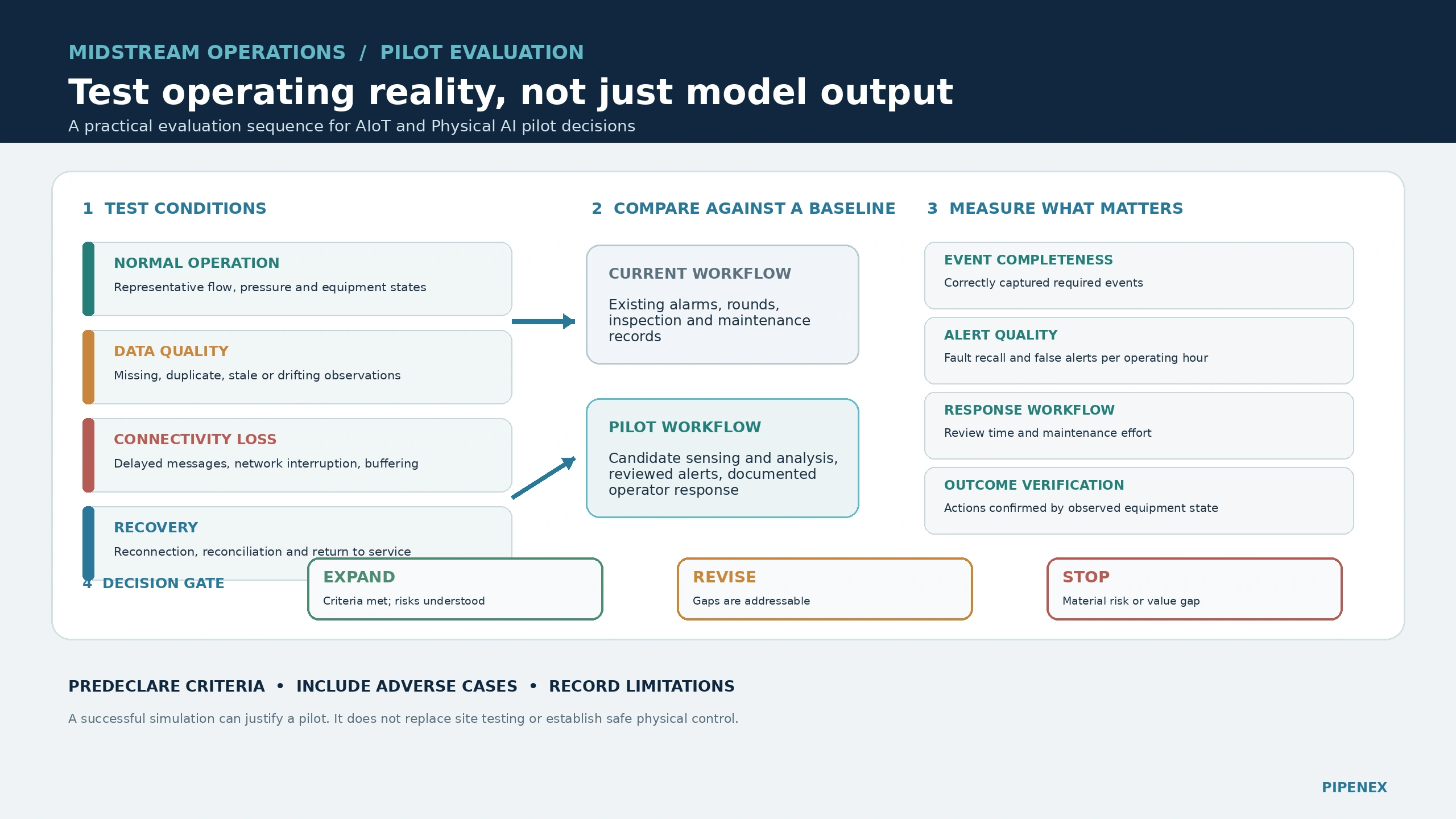
Technical illustration. It does not report measured PipeNex customer results or a completed pilot.
Pilot Decision
Document the decision and define the next step
At the end of the evaluation, prepare a decision record that summarizes the original question, scope, baseline, test coverage, data quality, measured results, limitations, unresolved risks, and stakeholder approvals. Link the reported results to the source records and analysis version used to calculate them. Preserve configuration details, model or rule versions, test cases, issue logs, and any changes made during the pilot.
Use three clear decision paths:
Expand
Expand when the agreed criteria are met, the operating workflow is acceptable, and remaining risks and deployment requirements are understood.
Revise
Revise when the approach shows potential but specific gaps in sensing, data quality, integration, alert logic, or user workflow need correction and retesting.
Stop
Stop when the evidence does not support the intended use, the operational burden is unacceptable, required data cannot be obtained, or material risks remain unresolved.
Expansion should be treated as a new deployment decision, not an automatic continuation of the pilot. A larger rollout may introduce different equipment types, network conditions, user groups, operating modes, and integration dependencies. Reassess those factors before extending the scope.
Implementation Readiness
From simulation to a customer pilot
Simulation can help teams examine assumptions, test data structures, compare candidate methods, and identify difficult operating cases before a site evaluation. Before moving from simulation to a customer pilot, identify which assumptions need to be checked against real measurements, what site data is required, how long the baseline should run, which operating conditions must be represented, and who will own the review and acceptance process.
A simulation based on synthetic operational data must be labeled as such. It is not a customer deployment, and its results depend on the modeled assumptions. Site-specific validation is required to establish performance under actual instrument behavior, process variation, connectivity conditions, operator practices, and maintenance constraints.
For a pilot planning discussion, PipeNex can work with the relevant stakeholders to define the operational question, asset boundary, data and interface requirements, evaluation measures, and evidence needed for a decision. The proposed scope and any implementation claims should be confirmed for the specific facility.
Explore PipeNex
Related resources
Physical AI and AIoT solutions for midstream operations
System integration and deployment
Cybersecurity and physical action safeguards
Contact PipeNex
Connect With PipeNex
Plan a midstream Physical AI or AIoT pilot with PipeNex
Start with a defined operating problem and a measurable evaluation plan. Discuss the assets, data sources, existing systems, users, constraints, and acceptance criteria that will determine whether a pilot is appropriate.
Contact PipeNex to discuss your pilot scope