
AIoT Resources for Midstream Pipeline and Storage Operations

Successful deployment of Artificial Intelligence and Industrial IoT technologies requires more than hardware and software. Engineering teams, operations managers, maintenance organizations, security personnel, and technology stakeholders need access to accurate technical information, deployment guidance, architecture references, implementation best practices, and operational recommendations.

Documentation

Technical documentation provides detailed information about platform capabilities, deployment models, system architecture, device integration, operational workflows, and administration procedures.

The documentation library helps organizations plan, deploy, operate, and expand AIoT environments throughout midstream infrastructure.

01

Platform Documentation

Platform documentation covers:

01

System architecture

02

User administration

03

Device onboarding

04

Site configuration

05

Operational workflows

06

Data management

07

Analytics configuration

08

Reporting tools

Engineering teams can use these materials to understand platform capabilities and deployment requirements.

02

Workforce Visibility Documentation

Documentation for workforce visibility solutions includes:

01

BLE badge deployment

02

Personnel tracking configuration

03

Geofencing setup

04

Occupancy monitoring

05

Muster management

06

Emergency accountability workflows

Typical deployment environments include:
Compressor stations
Storage terminals
Control facilities
Tank farms
Maintenance facilities
03

Access Control Documentation

Access management documentation covers:

01

Credential management

02

Reader configuration

03

Visitor administration

04

Security policy enforcement

05

Access analytics

06

Audit reporting

Security teams can use these guides to implement facility access controls aligned with operational requirements.

04

Asset Tracking Documentation

Asset visibility documentation explains:

01

RFID deployment architectures

02

Asset tagging procedures

03

GPS tracking configurations

04

Asset lifecycle management

05

Utilization analytics

06

Inventory synchronization

These materials help organizations improve asset accountability across geographically dispersed operations.

05

Inventory Intelligence Documentation

Inventory management documentation includes:

01

Warehouse workflows

02

RFID inventory processes

03

Spare parts management

04

Inventory forecasting

05

Replenishment procedures

06

Multi-site inventory operations

These guides support maintenance and warehouse teams responsible for operational readiness.

Frequently Asked Questions (FAQs)

01

Workforce Tracking FAQs

How is workforce location data collected?

Location information can be collected through BLE badges, RFID credentials, GPS-enabled devices, mobile applications, and supporting IoT infrastructure.

Can contractor personnel be monitored separately?

Yes. Contractor groups, project teams, maintenance crews, and service providers can be managed independently while maintaining enterprise-wide visibility.

Does the system support emergency mustering?

Yes. AI-powered workforce intelligence can assist with personnel accountability, muster verification, and evacuation monitoring during emergency situations.

02

Asset Tracking FAQs

Which assets can be tracked?

Commonly tracked assets include:

Inspection equipment
Pigging tools
Portable instrumentation
Mobile generators
Maintenance equipment
Fleet vehicles
Safety equipment

Which technologies are supported?

The platform supports:

RFID
BLE
GPS
Cellular tracking
LoRaWAN devices
Industrial IoT sensors

Can assets be tracked across multiple facilities?

Yes. Assets can be monitored across pipeline corridors, storage terminals, maintenance depots, compressor stations, and other operational facilities.

03

Inventory Management FAQs

How does RFID improve inventory visibility?

RFID automates inventory identification and movement tracking, reducing manual processes and improving inventory accuracy.

Can inventory forecasting be automated?

Yes. AI models can analyze historical usage patterns, maintenance schedules, and equipment criticality to improve inventory planning.

Does the system support multiple warehouses?

Yes. Multi-site inventory management is supported across geographically distributed operations.

04

Integration FAQs

Can the platform integrate with SCADA systems?

Yes. Integration architectures support data exchange with SCADA environments commonly used throughout pipeline transportation and storage operations.

Can GIS systems be connected?

Yes. Workforce, asset, fleet, and operational information can be visualized within geographic information systems.

Are APIs available?

Yes. Secure APIs support integration with operational and enterprise platforms.

Technical Specifications

Technical specifications help organizations evaluate compatibility, scalability, performance, and deployment requirements.

01

Supported Identification Technologies

The platform supports:

01

UHF RFID

02

HF RFID

03

NFC technologies

04

BLE devices

05

GPS tracking systems

06

Access credentials

07

Mobile identification methods

Typical Use Cases
Personnel identification
Asset identification
Inventory management
Access authorization
Equipment traceability
02

Supported Communication Technologies

Communication technologies include:

01

LoRaWAN

02

Cellular networks

03

Ethernet

04

Wi-Fi

05

Bluetooth Low Energy

06

Industrial communication protocols

These technologies support both local and wide-area operational environments.

03

Gateway and Edge Specifications

Supported edge capabilities include:

01

Local processing

02

Device management

03

Protocol conversion

04

Event processing

05

Data buffering

06

Local analytics

Edge infrastructure helps improve performance and resiliency within remote operational environments.

04

Security Specifications

Security controls include:

01

Role-based access management

02

Data encryption

03

Secure authentication

04

Audit logging

05

Access monitoring

06

Communication security

These controls help support operational cybersecurity objectives.

Integration Guides

Integration guidance helps organizations connect AIoT capabilities with existing operational technology and enterprise systems.

01

SCADA Integration Guide

SCADA integration guidance covers:

01

Architecture planning

02

Data synchronization

03

Event sharing

04

Operational workflows

05

Security considerations

Example Use Cases
Workforce visibility during alarms
Asset status during maintenance
Access event correlation
Operational incident analysis
02

GIS Integration Guide

GIS integration documentation explains:

01

Geospatial visualization

02

Pipeline corridor mapping

03

Workforce location mapping

04

Asset location intelligence

05

Fleet visibility

Geographic awareness helps improve operational decision-making.

03

CMMS Integration Guide

Maintenance integration guidance covers:

01

Work order synchronization

02

Asset histories

03

Maintenance records

04

Inspection workflows

05

Inventory coordination

Organizations can improve maintenance traceability through integrated workflows.

04

ERP Integration Guide

ERP integration documentation includes:

01

Inventory synchronization

02

Procurement workflows

03

Asset acquisition records

04

Spare parts management

05

Supply chain coordination

This helps align operational requirements with enterprise planning activities.

05

Security Platform Integration Guide

Security integration guidance addresses:

01

Access control systems

02

Identity management platforms

03

Visitor management systems

04

Security monitoring tools

05

Incident response workflows

These integrations improve operational security visibility.

AIoT Integration Reference System for Enterprise and Operational Systems Connectivity

Shows how AIoT devices—including RFID readers, BLE systems, GPS trackers, and LoRaWAN sensors—connect through edge gateways and secure middleware to AI analytics platforms, enterprise applications, and cloud infrastructure. The diagram demonstrates end-to-end data flow between operational technologies (SCADA, GIS, CMMS), business systems (ERP), security platforms, and reporting dashboards, enabling real-time visibility, predictive maintenance, and enterprise-wide decision support.
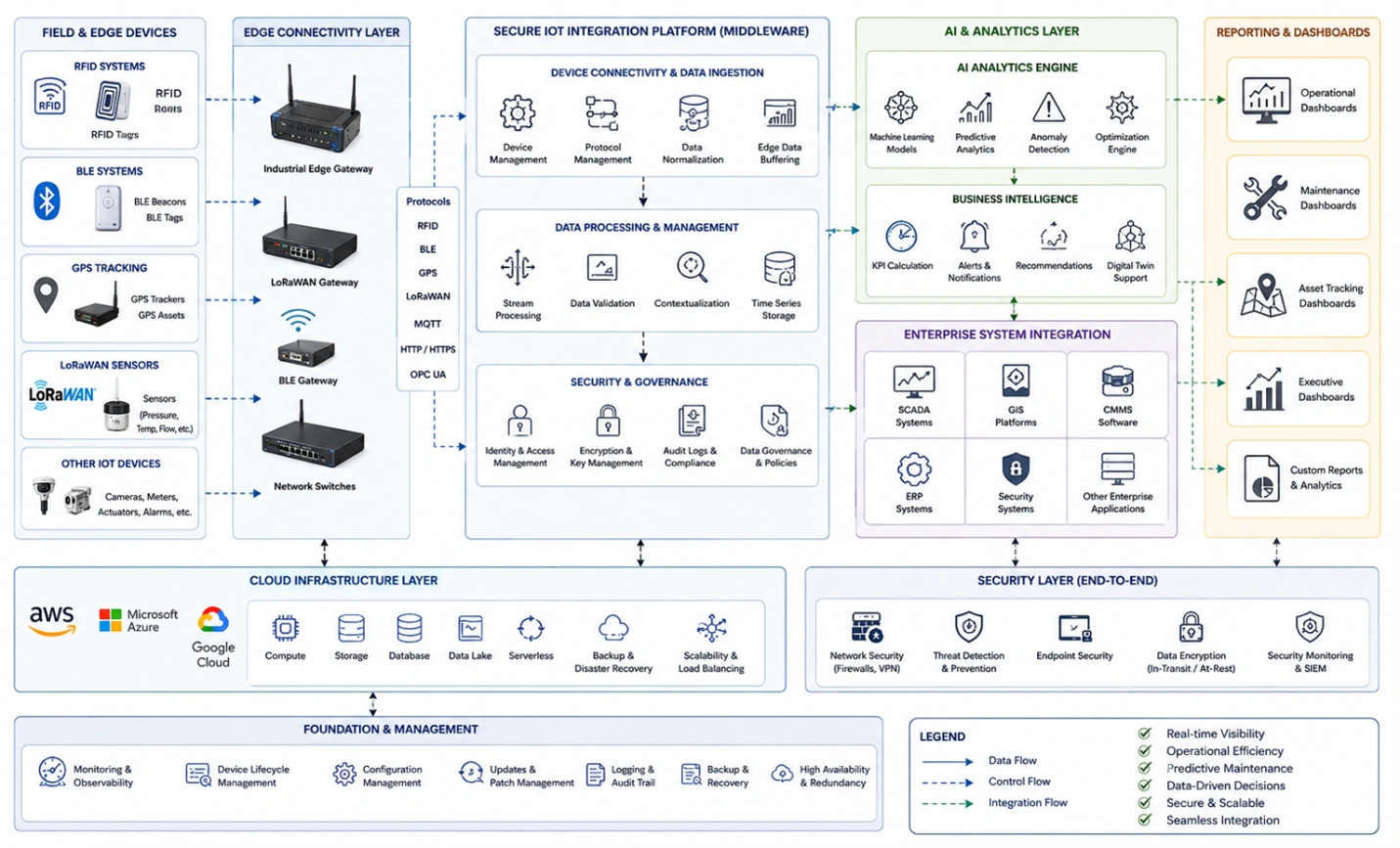
AIoT architecture diagram connecting RFID, BLE, GPS, LoRaWAN, AI analytics, SCADA, ERP, CMMS, and cloud systems.

Deployment Best Practices

Successful deployments typically follow structured implementation approaches.

01

Assessment Phase

Key activities include:

Infrastructure evaluation
Operational workflow analysis
Asset inventory review
Security assessment
Connectivity evaluation
02

Pilot Deployment Phase

Pilot deployments help organizations:

Validate technology selection
Evaluate workflows
Measure operational benefits
Refine deployment strategies
03

Enterprise Rollout Phase

Enterprise deployments focus on:

Multi-site expansion
Workforce adoption
System integration
Operational governance
Performance monitoring

Industry Standards and Compliance Considerations

Midstream operations frequently operate within regulatory and industry compliance frameworks.

Documentation and guidance address considerations related to:

01

Asset integrity management

02

Operational safety programs

03

Workforce accountability

04

Security management

05

Maintenance traceability

06

Operational reporting

Organizations should evaluate compliance requirements specific to their operational jurisdictions and infrastructure assets.

Technical Learning Resources

Additional educational resources include:

01

AIoT deployment guides

02

RFID implementation references

03

BLE location intelligence guides

04

LoRaWAN deployment recommendations

05

Asset tracking methodologies

06

Inventory optimization strategies

07

Workforce visibility frameworks

08

Maintenance traceability practices

These resources help organizations build internal expertise and improve deployment outcomes.

Knowledge Built Through Industrial Experience

The PipeNex AI knowledge base benefits from extensive experience supporting industrial IoT deployments across energy, utilities, transportation, manufacturing, research organizations, government agencies, and large enterprise environments.

Years of implementation experience, research and development efforts, engineering expertise, and real-world project execution contribute to the practical guidance provided throughout the resource center.