Industrial IoT Software for Midstream Pipeline and Storage Operations
Midstream energy operations depend on accurate operational data collected from personnel, assets, facilities, inventory, maintenance activities, and field operations. However, data alone does not improve safety, security, compliance, or efficiency unless organizations have software platforms capable of transforming raw information into actionable operational intelligence.
Software Architecture for Distributed Midstream Infrastructure
Unlike traditional industrial facilities operating within a single location, pipeline and storage operators manage assets distributed across large geographic regions.
The PipeNex AI software architecture is designed to support:
Long-distance pipeline networks
Remote valve stations
Compressor facilities
Storage terminals
Tank farms
Maintenance depots
Metering facilities
Regional operations centers
Field service operations
The software supports both real-time operational visibility and long-term operational analytics.
Core Platform Capabilities
Real-time event processing
Edge computing support
AI-powered analytics
Multi-site visibility
Geospatial intelligence
Historical trend analysis
Regulatory reporting
Enterprise system integration
Mobile workforce support
Asset lifecycle visibility
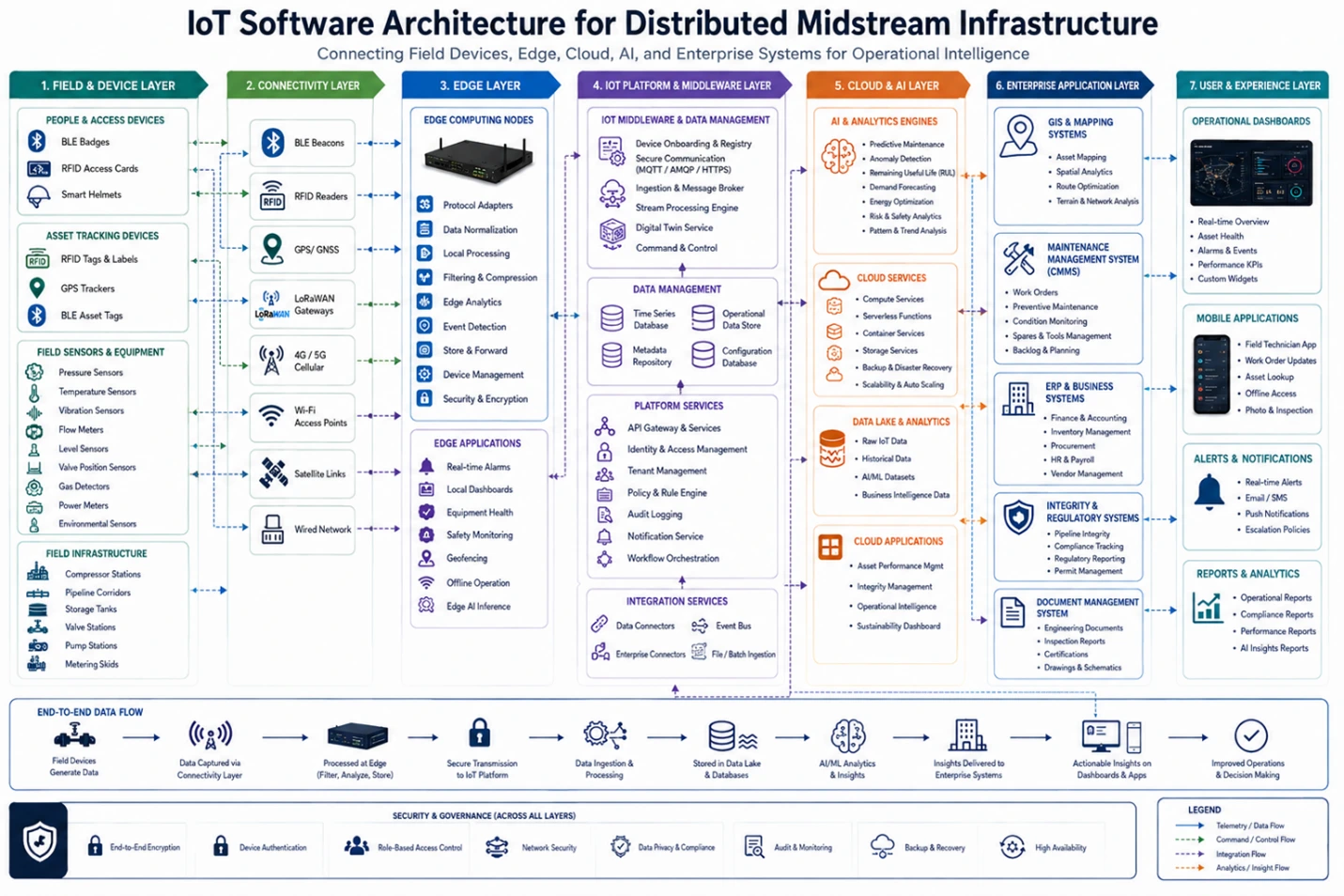
IoT Software Architecture for Distributed Midstream Energy Infrastructure and Operational Intelligence
Shows how BLE badges, RFID readers, GPS trackers, LoRaWAN gateways, and industrial field sensors connect through edge computing, IoT middleware, cloud platforms, and AI analytics engines to support distributed midstream operations. It demonstrates the flow of operational data into GIS platforms, maintenance management systems, ERP applications, integrity management systems, and real-time dashboards, enabling predictive maintenance, asset visibility, workforce intelligence, regulatory compliance, and enterprise-wide decision-making.
Personnel and Access IoT Software
Personnel safety and facility security represent some of the most critical operational priorities throughout midstream infrastructure.
PipeNex AI provides software applications that continuously monitor workforce activity and facility access events.
Access Control Software
The Access Control Software platform manages secure entry and movement throughout operational facilities.
- Credential management
- Role-based access authorization
- Multi-site access administration
- Real-time access monitoring
- Visitor credential management
- Access event analytics
- Security alerting
- Audit reporting
AI continuously evaluates access activity to identify anomalies and potential security risks.
- Improved facility security
- Reduced unauthorized access
- Enhanced audit readiness
- Better operational accountability
- Centralized access management
Workforce Tracking Software
Workforce Tracking Software provides real-time visibility into personnel movement and workforce activity across operational infrastructure.
- BLE badges
- RFID credentials
- Mobile applications
- Geofencing technologies
- Location analytics
- Personnel location monitoring
- Shift attendance tracking
- Workforce accountability
- Crew deployment visibility
- Remote site occupancy monitoring
- Contractor movement analysis
- Emergency response support
Emergency Workforce Intelligence
During operational incidents, the software provides:
- Muster verification
- Personnel accountability reports
- Missing worker identification
- Evacuation progress monitoring
This capability is particularly valuable in geographically dispersed operations where rapid personnel accountability can be challenging.
Visitor Management Software
Visitor Management Software improves operational security while streamlining visitor administration.
- Visitor registration
- Temporary credential issuance
- Access authorization workflows
- Safety orientation tracking
- Visitor location monitoring
- Visit history reporting
Organizations can maintain detailed visitor records while ensuring compliance with security policies.
Asset and Inventory IoT Software
Midstream operators manage large inventories of field equipment, maintenance tools, mobile assets, and critical spare parts.
PipeNex AI delivers specialized software applications that improve asset visibility and inventory intelligence.
Asset Tracking Software
Asset Tracking Software provides location awareness and utilization visibility for operational assets throughout pipeline transportation and storage operations.
- Real-time asset location
- Asset movement history
- Utilization analytics
- Availability monitoring
- Asset lifecycle visibility
- Loss prevention intelligence
The platform supports:
- RFID tracking
- BLE tracking
- GPS monitoring
- Cellular connectivity
- IoT gateways
- Geospatial mapping systems
Inventory Management Software
Inventory Management Software provides comprehensive visibility into spare parts and maintenance inventories distributed across multiple facilities.
- Inventory visibility
- Stock movement tracking
- Receiving verification
- Reorder management
- Inventory forecasting
- Inventory reconciliation
RFID technologies automate inventory identification while AI analytics improve inventory planning.
Spare Parts Tracking Software
Spare Parts Tracking Software focuses specifically on critical maintenance inventory.
- Part locations
- Quantity levels
- Storage conditions
- Inventory movements
- Criticality classifications
- Supplier information
AI-Powered Inventory Intelligence
Artificial intelligence analyzes:
- Historical consumption trends
- Maintenance schedules
- Equipment criticality
- Supply chain lead times
- Failure history
This enables more accurate spare parts planning across operational facilities.
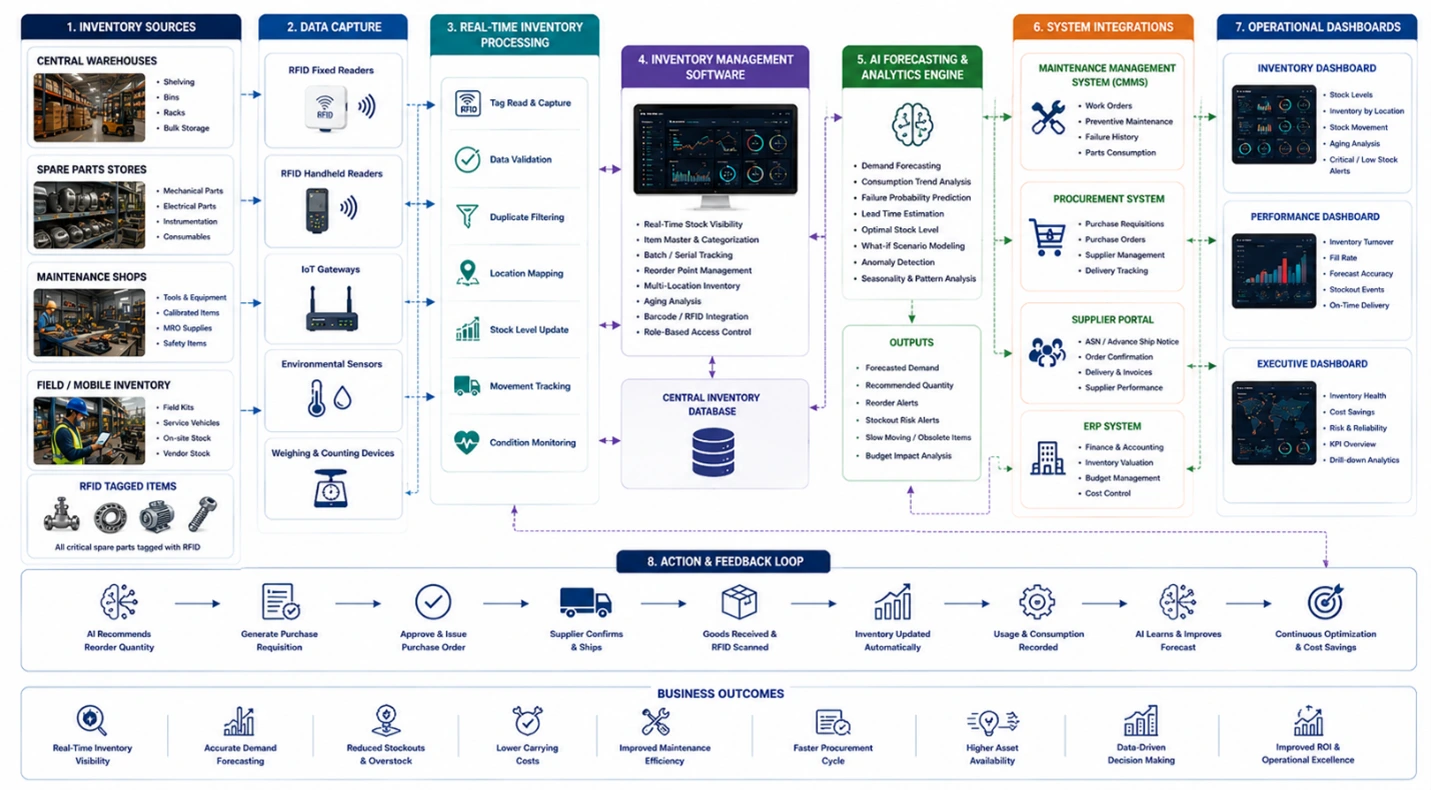
RFID-Enabled Spare Parts Management Workflow with AI Forecasting for Midstream Energy Operations
Shows how RFID-tagged spare parts move through warehouses, storage areas, maintenance shops, and field inventory locations while inventory data is captured in real time through RFID readers, IoT gateways, and inventory management software. AI forecasting engines analyze inventory consumption, demand patterns, stock levels, and maintenance requirements to automate replenishment decisions, improve spare parts availability, reduce stockouts, and optimize procurement and maintenance operations through integrated dashboards and enterprise systems.
Maintenance and Traceability IoT Software
Maintenance programs play a critical role in pipeline reliability, storage facility integrity, and regulatory compliance.
PipeNex AI provides software applications that improve maintenance visibility and traceability.
Work Order Tracking Software
Work Order Tracking Software helps organizations manage maintenance activities across distributed infrastructure.
- Work order creation
- Work assignment management
- Progress tracking
- Completion verification
- Labor tracking
- Maintenance history management
Operational managers gain visibility into maintenance performance across multiple facilities.
Improved maintenance coordination
Better resource utilization
Enhanced accountability
Reduced administrative effort
Component Traceability Software
Component Traceability Software creates digital histories for critical operational assets.
- Installation dates
- Maintenance activities
- Inspection results
- Replacement history
- Calibration records
- Operational status changes
Traceability Objectives
- Asset integrity management
- Compliance reporting
- Maintenance optimization
- Lifecycle analysis
- Operational reliability improvement
Traceability records help operators maintain accurate equipment histories throughout asset lifecycles.
AI Analytics Layer
The software platform includes an integrated AI analytics engine designed specifically for industrial operations.
AI Capabilities
-
01
Pattern recognition
-
02
Predictive analytics
-
03
Risk assessment
-
04
Anomaly detection
-
05
Utilization analysis
-
06
Inventory forecasting
-
07
Operational trend analysis
Examples of AI Insights
-
01
Underutilized field assets
-
02
Inventory shortage risks
-
03
Security anomalies
-
04
Workforce distribution trends
-
05
Maintenance backlog indicators
-
06
Operational efficiency opportunities
AI helps transform operational data into decision-support intelligence.
Mobile Applications for Field Operations
Field personnel require access to operational information while working throughout pipeline networks and storage facilities.
Mobile software applications provide:
Asset lookup
Work order management
Inspection reporting
Workforce communication
Inventory visibility
Incident reporting
Mobile access improves operational responsiveness and workforce productivity.
Enterprise System Integration
Industrial IoT software must operate as part of a larger operational technology ecosystem.
PipeNex AI supports integration with:
SCADA systems
GIS platforms
CMMS systems
ERP applications
EAM platforms
Security management systems
Asset management databases
Regulatory reporting systems
Integrated operations help eliminate data silos while improving decision-making.
Deployment Models
Organizations have different operational and cybersecurity requirements.
PipeNex AI supports:
Cloud Deployment
Suitable for:- Multi-site visibility
- Centralized management
- Enterprise-wide reporting
- Scalable infrastructure
Hybrid Deployment
Combines:- Local operational processing
- Centralized analytics
- Distributed data management
On-Premises Deployment
Supports:- Internal data control
- Site-specific security requirements
- Private operational environments
Deployment flexibility helps organizations align software architecture with operational objectives.
Applications Across Midstream Infrastructure
The software platform supports operational requirements across:
Natural gas transmission systems
Crude oil transportation networks
Refined product pipelines
LNG storage facilities
NGL infrastructure
Compressor stations
Pump stations
Storage terminals
Tank farms
Metering facilities
Maintenance depots
Emergency response operations
Why Midstream Operators Deploy Industrial IoT Software
Organizations increasingly adopt industrial IoT software to improve operational visibility, workforce safety, facility security, inventory management, and maintenance effectiveness.
Common objectives include:
Improved workforce accountability
Enhanced operational transparency
Better asset visibility
Reduced inventory inefficiencies
Stronger maintenance traceability
Faster incident response
Improved regulatory compliance
Better operational decision-making
