AI Functions for AIoT-Enabled Midstream Pipeline and Storage Operations

Midstream energy infrastructure spans vast pipeline corridors, compressor stations, pump stations, meter stations, storage terminals, tank farms, custody transfer facilities, maintenance yards, and remote operational sites. Managing personnel safety, facility security, mobile assets, spare parts inventories, and maintenance activities across these distributed environments requires more than basic monitoring systems.

Personnel Safety and Movement Intelligence

Personnel visibility remains one of the most important operational requirements in pipeline transportation networks. Employees and contractors frequently work across remote sites, isolated facilities, confined spaces, and hazardous operating environments.

AI-powered workforce intelligence helps operators understand who is onsite, where personnel are located, and whether safety protocols are being followed.

01 Personnel Visibility

Workforce Presence Analytics

Workforce Presence Analytics provides real-time visibility into employee and contractor locations throughout operational facilities.

AI analyzes location data collected through BLE badges, RFID credentials, mobile devices, and IoT infrastructure to generate workforce intelligence across geographically dispersed operations.

Capabilities include:
  • Real-time personnel visibility
  • Shift attendance verification
  • Workforce deployment monitoring
  • Crew accountability reporting
  • Site occupancy intelligence
  • Workforce utilization analytics

Operational teams gain immediate visibility into workforce distribution across compressor stations, storage terminals, valve stations, maintenance facilities, and pipeline corridors.

02 Contractor Operations

Contractor Movement Intelligence

Contractors perform critical inspection, maintenance, construction, integrity management, and emergency response activities throughout midstream infrastructure.

AI continuously evaluates contractor movement patterns and operational activities.

Capabilities include:
  • Contractor location tracking
  • Worksite arrival verification
  • Geofenced work authorization
  • Permit-to-work validation
  • Movement pattern analytics
  • Safety compliance monitoring

Operational managers can verify that contractors remain within authorized work areas while maintaining accurate records for compliance and auditing purposes.

03 High-Risk Areas

Confined Space Monitoring

Confined space entry remains a high-risk activity throughout tank farms, storage vessels, underground vaults, equipment enclosures, and maintenance areas.

AI-powered confined space intelligence provides:
  • Entry authorization validation
  • Occupancy monitoring
  • Worker accountability
  • Exposure duration tracking
  • Emergency alert generation
  • Evacuation coordination

Real-time monitoring helps improve worker protection while supporting regulatory compliance requirements.

04 Emergency Response

Emergency Evacuation Intelligence

Rapid personnel accountability becomes critical during gas releases, fires, equipment failures, security incidents, or severe weather events.

AI evacuation intelligence supports:
  • Muster point verification
  • Missing personnel identification
  • Evacuation status reporting
  • Emergency response coordination
  • Incident accountability documentation

The system provides operational leaders with immediate visibility into workforce safety during emergency situations.

AI-Powered Workforce Safety and Movement Intelligence Workflow for Midstream Energy Operations

This workflow diagram shows how BLE smart badges, RFID credentials, location sensors, and AI analytics work together to deliver real-time workforce visibility across compressor stations, storage terminals, and pipeline facilities. The visual follows personnel from site entry and location tracking through geofencing, risk detection, emergency response, muster point management, and workforce accountability reporting. It demonstrates how integrated safety technologies improve personnel protection, accelerate emergency response, enhance compliance, and provide operational leaders with continuous workforce intelligence.
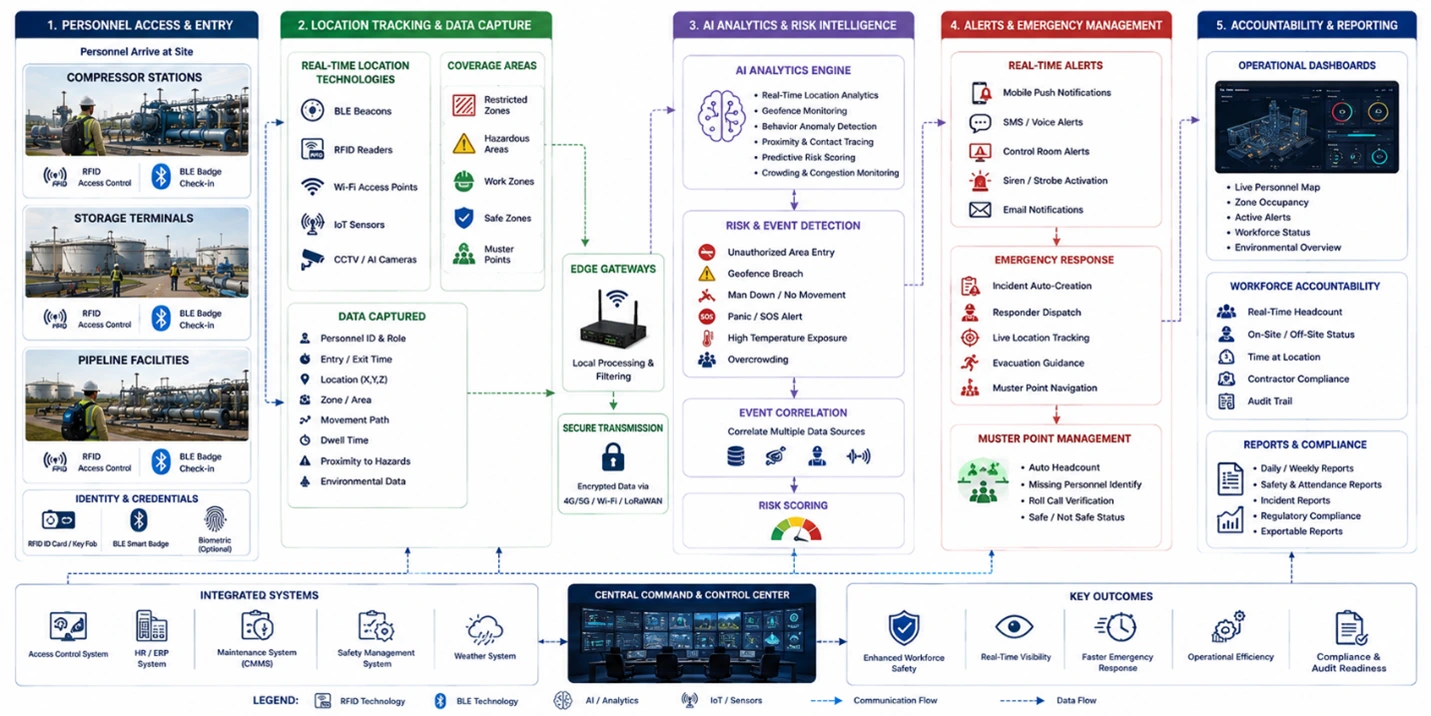
Workflow diagram showing BLE badges, RFID credentials, location sensors, AI analytics, geofencing, emergency dashboards, muster points, and workforce accountability reporting across midstream energy facilities.

Facility and Zone Access Intelligence

Pipeline transportation and storage infrastructure contains numerous restricted operational areas that require controlled access.

AI-powered access intelligence combines credential validation, access control technologies, location analytics, and behavioral monitoring to strengthen operational security.

01 Restricted Areas

Restricted Zone Access Intelligence

Certain operational areas require strict access management.

Examples include:
Compressor stations
Control facilities
Metering stations
SCADA equipment rooms
Pump stations
Tank farm control areas
Communications facilities
AI continuously evaluates:
  • Authorized access status
  • Credential validity
  • Access duration
  • Zone occupancy
  • Unauthorized entry attempts

This intelligence helps improve physical security while supporting compliance requirements.

02 Control Facilities

Control Facility Access Analytics

Control facilities serve as operational command centers for pipeline networks and storage operations.

AI analyzes access patterns to identify:
  • Unusual access behavior
  • After-hours activity
  • Unauthorized access attempts
  • Access anomalies
  • Operational security risks

Security teams receive actionable intelligence rather than relying solely on access logs.

03 Remote Security

Perimeter Security Intelligence

Remote operational facilities often have limited onsite staffing.

AI-enhanced perimeter security provides:
  • Geofenced perimeter monitoring
  • Intrusion detection analytics
  • Remote facility oversight
  • Security event correlation
  • Unauthorized activity detection

This capability improves situational awareness across geographically dispersed infrastructure.

04 Visitor Governance

Visitor Access Analytics

Visitor management systems generate valuable operational intelligence.

AI supports:
  • Visitor authorization verification
  • Temporary credential management
  • Movement monitoring
  • Safety compliance validation
  • Visit history reporting

These capabilities strengthen security while maintaining operational efficiency.

Critical Asset Tracking Intelligence

Midstream operations depend on thousands of fixed and mobile assets distributed across large geographic regions.

AI-powered asset intelligence helps operators understand asset locations, availability, utilization, and operational status.

01 Field Equipment

Pipeline Equipment Tracking Analytics

Field assets frequently move between projects, facilities, and maintenance operations.

Examples include:
Pipeline inspection equipment
Pigging tools
Welding equipment
Portable generators
Mobile compressors
Leak detection instruments
AI analyzes location and utilization data to provide:
  • Asset availability intelligence
  • Utilization reporting
  • Location visibility
  • Movement history analytics
  • Asset loss prevention
02 Measurement Assets

Metering Asset Visibility Intelligence

Custody transfer and measurement operations depend on accurate accountability for critical equipment.

AI provides visibility into:
  • Flow meters
  • Pressure instruments
  • Calibration equipment
  • Monitoring devices
  • Testing instruments

Operational teams gain better control over critical measurement infrastructure.

03 Fleet Visibility

Mobile Asset Intelligence

GPS and cellular technologies provide continuous visibility into:

  • Service vehicles
  • Maintenance fleets
  • Inspection units
  • Emergency response vehicles
  • Mobile support equipment

AI analyzes fleet activity to improve resource allocation and operational planning.

04 Predictive Intelligence

Predictive Asset Availability Analytics

Historical movement patterns, utilization trends, maintenance schedules, and operational requirements are analyzed to predict future asset availability.

Benefits include:
  • Improved maintenance planning
  • Reduced equipment shortages
  • Better resource allocation
  • Enhanced operational readiness

Spare Parts and Inventory Intelligence

Inventory availability directly affects operational reliability across pipeline and storage facilities.

AI transforms inventory data into actionable intelligence for maintenance and operations teams.

01 Demand Forecasting

Spare Parts Demand Forecasting

AI evaluates:

  • Maintenance history
  • Asset criticality
  • Failure patterns
  • Seasonal operational trends
  • Inspection schedules

Forecasting helps organizations maintain optimal inventory levels while reducing unnecessary stock accumulation.

02 MRO Optimization

MRO Inventory Optimization

Maintenance, Repair, and Operations inventory often spans multiple facilities and storage locations.

AI supports:
  • Inventory balancing
  • Reorder optimization
  • Multi-site inventory planning
  • Stock level forecasting
  • Procurement planning

This intelligence helps reduce inventory carrying costs while improving equipment availability.

03 Warehouse Visibility

Warehouse Stock Intelligence

RFID and IoT technologies provide real-time inventory visibility.

Capabilities include:
  • Inventory location tracking
  • Receiving verification
  • Stock movement monitoring
  • Asset issuance tracking
  • Inventory accuracy analytics

Warehouse personnel spend less time locating materials and more time supporting operations.

04 Operational Readiness

Critical Spares Availability Analytics

Critical equipment requires immediate access to replacement components.

AI continuously evaluates:
  • Spare parts availability
  • Stockout risks
  • Lead time exposure
  • Inventory readiness
  • Supply chain vulnerabilities

This helps prevent operational disruptions caused by missing components.

RFID Inventory Intelligence and AI Forecasting Architecture for Midstream Energy Spare Parts Management

This architecture diagram demonstrates how RFID-tagged spare parts are tracked across warehouses, storage yards, maintenance facilities, and supplier networks through an IoT-enabled inventory ecosystem. Data collected from RFID readers, gateways, environmental sensors, and edge devices flows into inventory management platforms where AI forecasting engines analyze demand patterns, inventory consumption, stock risks, and replenishment requirements. The architecture further illustrates integration with maintenance management, procurement, ERP, supplier portals, and operational dashboards to support optimized inventory planning, reduced downtime, and improved asset reliability.
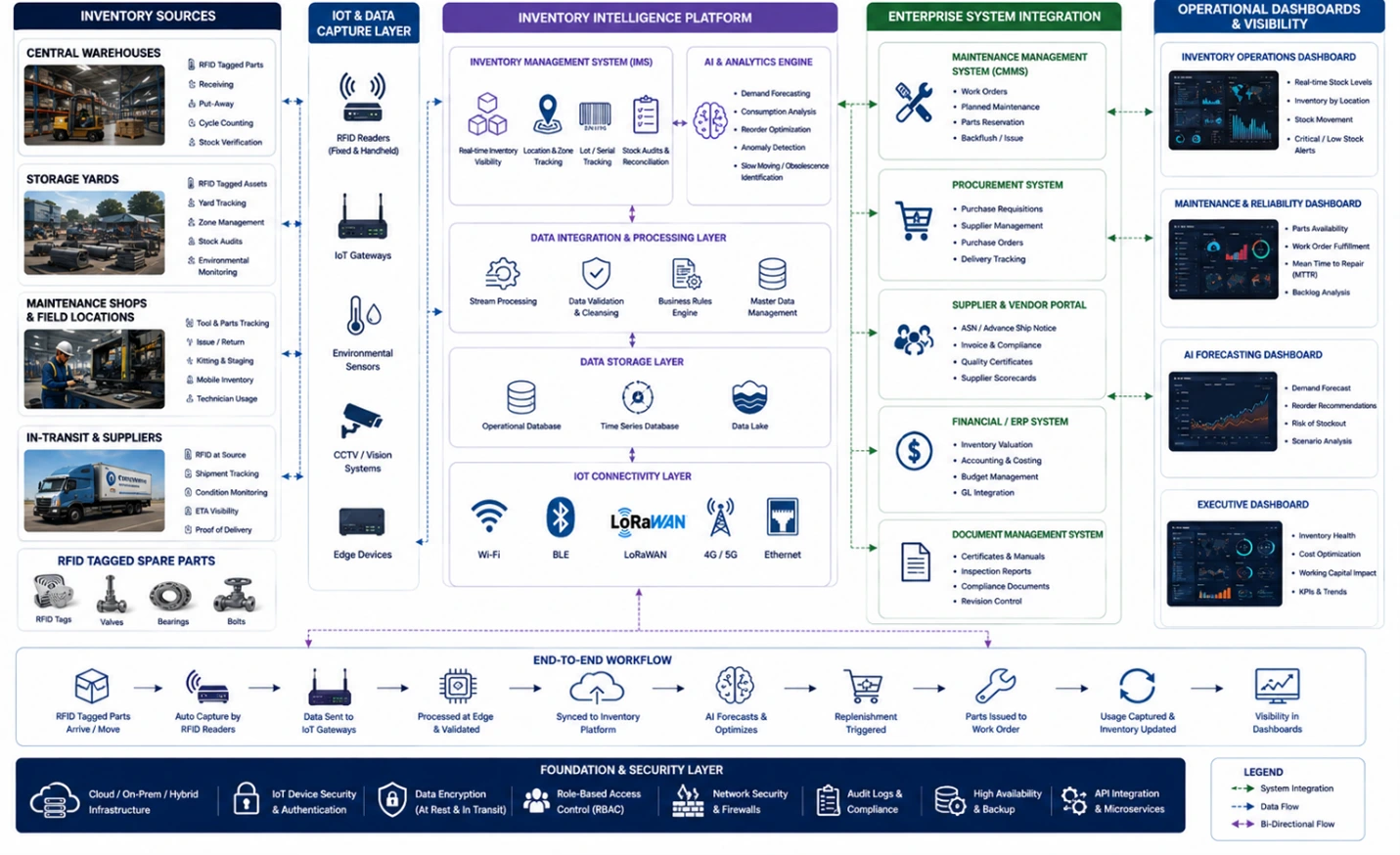
Architecture diagram showing RFID-tagged spare parts, warehouses, IoT gateways, inventory management software, AI forecasting engines, maintenance systems, procurement platforms, ERP systems, and operational dashboards connected through an integrated inventory intelligence infrastructure.

Maintenance Traceability Intelligence

Maintenance traceability helps operators maintain reliability, safety, compliance, and asset integrity throughout the equipment lifecycle.

AI converts maintenance records and operational data into actionable insights.

01 Work Progress

Maintenance Progress Tracking

AI provides visibility into:

  • Active work orders
  • Inspection activities
  • Maintenance schedules
  • Crew assignments
  • Completion status

Managers gain a real-time understanding of maintenance progress across facilities.

02 Lifecycle Records

Component Traceability Analytics

Component traceability enables organizations to track:

  • Installation history
  • Inspection records
  • Service activities
  • Maintenance events
  • Equipment lifecycle information

These records support operational reliability and regulatory reporting.

03 Workflow Analytics

Workflow Intelligence

AI analyzes maintenance workflows to identify:

  • Operational bottlenecks
  • Resource constraints
  • Delayed activities
  • Productivity opportunities
  • Process improvement areas

This intelligence helps organizations continuously improve maintenance efficiency.

04 Compliance Reporting

Compliance Traceability Reporting

Regulatory oversight requires accurate operational documentation.

AI-powered reporting supports:
  • Asset integrity programs
  • Inspection documentation
  • Maintenance records
  • Safety compliance reporting
  • Audit preparation

Digital traceability improves reporting accuracy while reducing administrative effort.

AI Architecture for Distributed Midstream Operations

Midstream infrastructure requires AI systems capable of operating across geographically distributed assets.

PipeNex AI supports:

  • Edge AI processing
  • Cloud analytics platforms
  • Hybrid deployment architectures
  • Multi-site operational visibility
  • Real-time event processing
  • Historical trend analysis

The architecture is designed to support remote operational facilities where connectivity conditions may vary.

Business Outcomes Delivered by AI Functions

Organizations deploying AI-enabled operational intelligence commonly pursue objectives such as:

01

Improved workforce safety

02

Enhanced facility security

03

Better asset utilization

04

Increased inventory accuracy

05

Reduced operational risk

06

Faster incident response

07

Improved maintenance efficiency

08

Stronger regulatory compliance

09

Better operational visibility

10

Increased infrastructure reliability

Applications Across Midstream Infrastructure

PipeNex AI functions support a wide range of operational environments including:

01

Natural gas transmission systems

02

Crude oil pipeline networks

03

Refined product transportation systems

04

LNG storage facilities

05

NGL transportation infrastructure

06

Compressor stations

07

Pump stations

08

Tank farms

09

Storage terminals

10

Metering and custody transfer facilities

11

Maintenance depots

12

Emergency response operations