
Hardware Technologies for AIoT-Enabled Midstream Pipeline and Storage Operations

Modern midstream infrastructure depends on accurate, real-time operational data. Artificial Intelligence delivers valuable insights, but AI can only be as effective as the quality of the data collected from field operations.

Industrial Hardware Architecture for Midstream Infrastructure

Pipeline networks often extend hundreds or thousands of miles through remote environments. Storage terminals, compressor stations, and metering facilities frequently operate in locations where connectivity, environmental conditions, and operational risks create unique deployment challenges.

The PipeNex AI hardware ecosystem is designed to support:

01

Remote pipeline corridors

02

Compressor stations

03

Pump stations

04

Tank farms

05

Storage terminals

06

Metering facilities

07

Valve stations

08

Maintenance depots

09

Fleet operations

10

Emergency response units

The hardware infrastructure combines identification technologies, wireless communications, sensing systems, and edge intelligence to create a continuous flow of operational data.

Industrial IoT Hardware System for Midstream Energy Infrastructure and Enterprise Operations

Shows how RFID tags, BLE beacons, GPS trackers, LoRaWAN sensors, and access control devices communicate through industrial gateways, edge computing platforms, and cellular or wireless networks to support distributed midstream operations. The architecture demonstrates how operational data flows into cloud platforms, AI analytics engines, maintenance systems, GIS applications, integrity management platforms, ERP systems, and operational dashboards, enabling real-time asset visibility, predictive maintenance, infrastructure monitoring, and enterprise-wide operational intelligence.
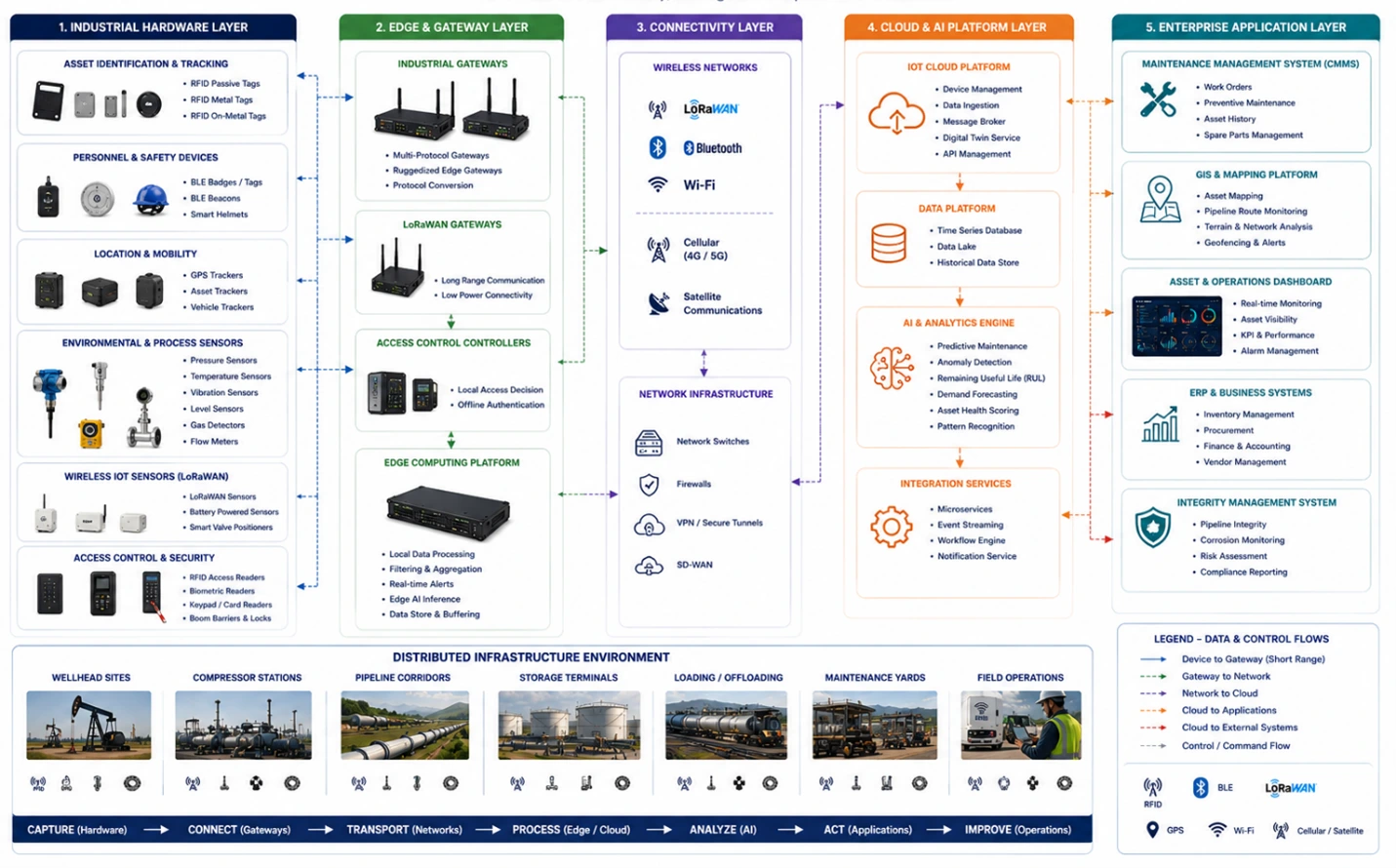
Industrial block diagram showing RFID tags, BLE beacons, GPS trackers, LoRaWAN sensors, edge gateways, wireless networks, cloud AI platforms, GIS systems, maintenance applications, ERP systems, and operational dashboards across pipeline and storage terminal infrastructure.

Physical Devices for Operational Intelligence

Physical devices form the foundation of every AIoT deployment.

These devices collect operational data from personnel, equipment, inventory, facilities, and infrastructure assets.

01 Identification

RFID Tags and Readers

Radio Frequency Identification (RFID) technology provides automated identification and tracking capabilities for equipment, inventory, tools, spare parts, and operational assets.

Common Midstream Applications
  • Spare parts tracking
  • Warehouse inventory management
  • Tool accountability
  • Equipment identification
  • Asset lifecycle tracking
  • Maintenance traceability
RFID Hardware Components
Passive UHF RFID tags
Active RFID tags
Fixed RFID readers
Handheld RFID readers
RFID antennas
Rugged industrial RFID devices
Benefits
  • Rapid inventory counting
  • Reduced manual data entry
  • Improved inventory accuracy
  • Enhanced asset accountability
  • Automated operational visibility

RFID technology is particularly effective in maintenance warehouses, storage yards, spare parts facilities, and equipment staging areas.

02 Location Intelligence

BLE Beacons and Tags

Bluetooth Low Energy (BLE) technology enables real-time location awareness for personnel and mobile assets.

BLE deployments are widely used where workforce visibility and operational accountability are critical.

Typical Applications
  • Workforce tracking
  • Contractor monitoring
  • Visitor management
  • Emergency accountability
  • Mobile equipment tracking
  • Restricted area monitoring
BLE Hardware Components
BLE personnel badges
BLE asset tags
Industrial BLE beacons
BLE gateways
BLE receivers
Location anchors
Operational Advantages
  • Low power consumption
  • Scalable deployments
  • Real-time visibility
  • Indoor location awareness
  • Workforce accountability

BLE technology is particularly valuable in compressor stations, control facilities, storage terminals, and maintenance buildings where GPS signals may be limited.

03 Wide-Area Tracking

GPS Asset Trackers

Global Positioning System (GPS) technologies provide real-time visibility into mobile assets operating across large geographic regions.

Assets Commonly Tracked
  • Maintenance vehicles
  • Inspection vehicles
  • Mobile generators
  • Portable equipment
  • Service trailers
  • Emergency response units
GPS Hardware Features
Location reporting
Route tracking
Geofencing support
Motion detection
Tamper alerts
Asset utilization monitoring
Benefits
  • Fleet visibility
  • Resource optimization
  • Equipment recovery
  • Operational planning support
  • Reduced asset loss

GPS technology plays a major role in managing mobile resources across pipeline transportation systems.

04 Facility Security

Access Control Readers

Physical security remains essential for critical energy infrastructure.

Access control hardware validates personnel authorization before granting access to restricted facilities.

Common Deployments
  • Control buildings
  • SCADA facilities
  • Compressor stations
  • Metering stations
  • Tank farms
  • Operations centers
Reader Technologies
RFID card readers
Smart card readers
BLE-enabled readers
Biometric readers
Mobile credential readers
Multi-factor authentication devices
Security Benefits
  • Controlled facility access
  • Audit trail creation
  • Access event monitoring
  • Enhanced compliance
  • Improved operational security

AI and RFID Technologies

RFID technologies generate large volumes of operational data. Artificial Intelligence transforms this information into actionable insights.

01 Asset Intelligence

AI and RFID Asset Tracking

AI continuously analyzes RFID-generated asset movement data.

AI Functions
  • Asset utilization analysis
  • Location intelligence
  • Asset availability forecasting
  • Equipment movement analytics
  • Asset loss detection
Applications
Pipeline maintenance equipment
Calibration tools
Inspection devices
Safety equipment
Mobile operational assets

Organizations gain visibility beyond simple location tracking.

02 Access Intelligence

AI and RFID Access Intelligence

RFID-based access systems generate valuable operational information.

AI evaluates:
  • Access behavior
  • Credential usage patterns
  • Security anomalies
  • Workforce movement trends
  • Access compliance metrics

This intelligence supports both security operations and workforce management.

AI and BLE Technologies

BLE technologies create highly accurate location intelligence for personnel and mobile assets.

01 Workforce Tracking

AI and BLE Workforce Tracking

BLE location data enables advanced workforce analytics.

AI Insights
  • Workforce density analysis
  • Site occupancy trends
  • Movement pattern recognition
  • Workforce utilization reporting
  • Safety compliance monitoring
Midstream Applications
Contractor management
Workforce accountability
Maintenance crew visibility
Operational staffing analysis

Organizations gain real-time visibility into workforce activity across facilities.

02 Zone Monitoring

AI and BLE Zone Monitoring

Restricted areas require continuous monitoring.

AI evaluates BLE location data to identify:

  • Unauthorized entry
  • Restricted zone violations
  • Occupancy anomalies
  • Access policy deviations
  • Emergency evacuation status

Zone intelligence helps strengthen operational safety and facility security.

BLE-Powered Workforce Location Intelligence System for Real-Time Personnel Visibility

Shows how BLE badges, wearable tags, location anchors, IoT gateways, and edge controllers work together across compressor stations, storage terminals, pipeline corridors, and maintenance yards to deliver real-time workforce location intelligence. The architecture shows how location data flows through analytics engines, geofencing systems, emergency response platforms, and operational dashboards to support personnel tracking, zone monitoring, workforce accountability, safety compliance, incident response, and situational awareness across distributed midstream energy facilities.
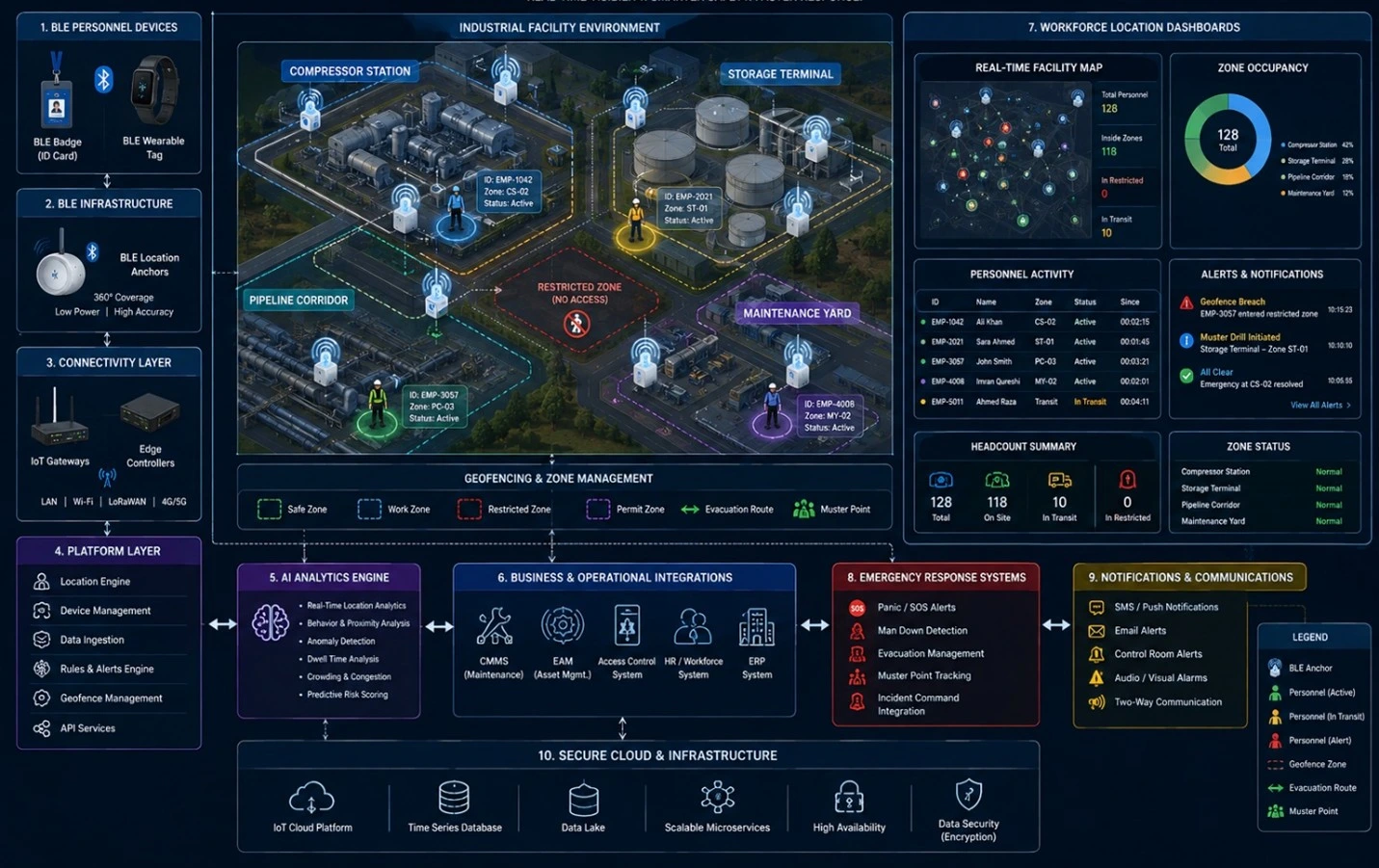
Interactive BLE workforce location intelligence diagram showing BLE badges, location anchors, geofenced zones, AI analytics, emergency response systems, and real-time personnel dashboards across compressor stations, storage terminals, pipeline corridors, and maintenance yards.

AI and LoRaWAN Technologies

LoRaWAN provides long-range wireless connectivity for geographically dispersed infrastructure.

This technology is particularly useful in remote operational environments where traditional communication methods may be expensive or difficult to deploy.

01 Asset Monitoring

AI and LoRaWAN Asset Monitoring

LoRaWAN-connected devices provide continuous operational data from field assets.

Applications include:
  • Remote equipment monitoring
  • Asset condition tracking
  • Valve station monitoring
  • Tank farm monitoring
  • Environmental sensing
AI Capabilities
  • Condition trend analysis
  • Anomaly detection
  • Asset health assessment
  • Operational performance monitoring
02 Sensor Networks

AI and LoRaWAN Sensor Networks

LoRaWAN sensor networks support:

  • Environmental monitoring
  • Equipment status monitoring
  • Facility condition awareness
  • Operational event detection
Sensor Examples
Temperature sensors
Pressure sensors
Vibration sensors
Humidity sensors
Position sensors
Environmental sensors

Long-range connectivity makes LoRaWAN particularly effective across remote pipeline infrastructure.

AI and GPS & Cellular Technologies

GPS and cellular networks provide continuous visibility into mobile assets operating across large territories.

01 Fleet Intelligence

AI and GPS Fleet Tracking

Fleet operations generate large amounts of location and operational data.

AI evaluates:
  • Route efficiency
  • Asset utilization
  • Travel patterns
  • Operational productivity
  • Resource allocation
Typical Fleet Assets
Service vehicles
Inspection trucks
Emergency response units
Maintenance fleets
02 Remote Monitoring

AI and Cellular Remote Monitoring

Cellular connectivity supports real-time communications between remote assets and operational systems.

Applications
  • Remote equipment monitoring
  • Field sensor communications
  • Mobile workforce support
  • Emergency communications
  • Asset telemetry
AI Functions
  • Event detection
  • Remote asset analytics
  • Predictive operational monitoring
  • Exception management

Cellular technologies extend operational visibility far beyond facility boundaries.

Edge Gateways and Industrial Computing

Industrial IoT deployments require reliable local processing capabilities.

Edge gateways provide:
  • 01

    Local data collection

  • 02

    Protocol translation

  • 03

    Event processing

  • 04

    Data filtering

  • 05

    Connectivity management

Benefits
  • 01

    Reduced latency

  • 02

    Improved resiliency

  • 03

    Lower bandwidth requirements

  • 04

    Enhanced operational continuity

Edge computing is particularly important in remote pipeline operations where network connectivity may be intermittent.

Environmental and Industrial Sensors

Sensors provide the operational data required for AI-driven decision making.

Common industrial sensors include:

01

Pressure sensors

02

Flow sensors

03

Temperature sensors

04

Vibration sensors

05

Position sensors

06

Environmental monitoring devices

07

Occupancy sensors

08

Motion detectors

These sensors provide the real-time operational awareness necessary for intelligent infrastructure management.

Selecting Hardware Technologies for Midstream Operations

Hardware selection depends on operational requirements, environmental conditions, facility layouts, connectivity availability, and business objectives.

Many deployments combine multiple technologies, including:

01
RFID

for inventory and asset identification

02
BLE

for personnel visibility

03
GPS

for mobile asset tracking

04
LoRaWAN

for remote monitoring

05
Cellular communications

for wide-area connectivity

06
Access control systems

for facility security

A multi-technology architecture often delivers the most comprehensive operational intelligence.

Applications Across Midstream Infrastructure

PipeNex AI hardware technologies support:

01

Natural gas transmission systems

02

Crude oil pipeline networks

03

Refined product transportation systems

04

LNG infrastructure

05

NGL facilities

06

Compressor stations

07

Pump stations

08

Storage terminals

09

Tank farms

10

Metering stations

11

Maintenance facilities

12

Emergency response operations

Midstream Operations Standards, Regulations, and Compliance Frameworks

01 United States

United States Standards and Regulations

  • 01

    PHMSA 49 CFR Part 192

  • 02

    PHMSA 49 CFR Part 195

  • 03

    49 CFR Part 191

  • 04

    API RP 1164

  • 05

    API RP 1173

  • 06

    API 1165

  • 07

    API 1168

  • 08

    API 1175

  • 09

    API 2350

  • 10

    API RP 754

  • 11

    API RP 780

  • 12

    API RP 1162

  • 13

    OSHA 29 CFR 1910

  • 14

    OSHA Process Safety Management (29 CFR 1910.119)

  • 15

    OSHA Walking-Working Surfaces Standard

  • 16

    OSHA Permit Required Confined Spaces Standard

  • 17

    OSHA Control of Hazardous Energy (Lockout/Tagout)

  • 18

    NFPA 70

  • 19

    NFPA 70E

  • 20

    NFPA 72

  • 21

    NFPA 1225

  • 22

    NIST Cybersecurity Framework

  • 23

    NIST SP 800-82

  • 24

    ISA/IEC 62443

  • 25

    ANSI/ASIS PSC.1

  • 26

    ANSI/ASIS Physical Asset Protection Standards

  • 27

    FERC Critical Infrastructure Protection (where applicable)

  • 28

    EPA Spill Prevention, Control, and Countermeasure (SPCC) Rule

  • 29

    EPA Risk Management Program (RMP)

02 Canada

Canadian Standards and Regulations

  • 01

    CSA Z662 Oil and Gas Pipeline Systems

  • 02

    CSA Z246 Series

  • 03

    CSA Z246.1 Security Management for Petroleum and Natural Gas Industry Systems

  • 04

    CSA C22.1 Canadian Electrical Code

  • 05

    CSA Z1006 Management of Work in Confined Spaces

  • 06

    CSA Z1002 Occupational Health and Safety Hazard Identification and Elimination

  • 07

    CSA Z246.2 Emergency Preparedness and Response

  • 08

    National Energy Board Onshore Pipeline Regulations

  • 09

    Canada Energy Regulator Act

  • 10

    Canada Labour Code Part II

  • 11

    Transportation of Dangerous Goods Regulations

  • 12

    Canadian Centre for Cyber Security Operational Technology Guidance

  • 13

    ISA/IEC 62443

  • 14

    NIST SP 800-82

  • 15

    PIPES Act requirements where applicable to cross-border operations

03 Technology

Wireless, Identification, and Tracking Technology Standards

  • 01

    IEEE 802.15.4

  • 02

    Bluetooth Low Energy (BLE)

  • 03

    Bluetooth Core Specification

  • 04

    LoRaWAN Specification

  • 05

    EPCglobal Gen2 UHF RFID

  • 06

    ISO/IEC 18000 Series

  • 07

    ISO/IEC 14443

  • 08

    ISO/IEC 15693

  • 09

    Wi-Fi IEEE 802.11 Standards

  • 10

    LTE-M

  • 11

    NB-IoT

  • 12

    5G NR

  • 13

    GPS/GNSS Standards

  • 14

    ISA100.11a

  • 15

    WirelessHART IEC 62591

Leading Companies in AI-Enabled Midstream Operations

The following organizations are among the most recognized providers of technologies, platforms, infrastructure, automation systems, industrial software, IoT connectivity, worker safety solutions, asset visibility systems, RFID technologies, RTLS platforms, industrial cybersecurity, and AI-driven operational intelligence used across North American midstream operations.

01
Automation

Industrial Automation and OT Platforms

  • Honeywell
  • Emerson
  • Siemens
  • Schneider Electric
  • Rockwell Automation
  • Yokogawa
  • ABB
02
AI & IoT

Industrial IoT and AI Platforms

  • Cisco
  • IBM
  • Microsoft
  • AWS
  • Google Cloud
  • PTC
  • AVEVA
  • C3 AI
03
RFID & RTLS

Asset Tracking, RFID, and RTLS Providers

  • Zebra Technologies
  • Impinj
  • Samsara
  • Wiliot
  • Identiv
  • Litum
  • CenTrak
  • Ubisense
04
Safety & Security

Workforce Safety and Access Control Providers

  • Motorola Solutions
  • Hexagon
  • Johnson Controls
  • HID Global
  • LenelS2
  • Genetec
05
Midstream Technology

Pipeline and Midstream Operations Technology Providers

  • Energy Solutions International
  • Quorum Software
  • DCP Midstream Technology Partners
  • SLB
  • Baker Hughes
  • Halliburton

Case Studies

01
United States

Houston, Texas, USA

AI-Enabled Workforce Visibility and Access Control for Pipeline Operations

01 Challenge

Problem

A midstream operations organization managing transmission pipelines, compressor stations, valve sites, and maintenance yards across the Houston region faced challenges maintaining real-time visibility of employees and contractors working across geographically dispersed assets. Multiple field crews, third-party contractors, inspection teams, and maintenance personnel routinely accessed operational sites with varying authorization levels.

Manual sign-in procedures, badge verification processes, and spreadsheet-based workforce tracking created delays during shift changes and emergency response activities. Operations personnel lacked a unified view of workforce distribution across facilities, making it difficult to verify site occupancy, monitor contractor compliance, and support evacuation procedures.

Additional challenges included:
  • Limited visibility into personnel locations across compressor stations and pipeline corridors
  • Delayed verification of contractor access permissions
  • Manual audit preparation for compliance reporting
  • Difficulty identifying unauthorized site access attempts
  • Lack of automated workforce accountability during emergency events
  • Inconsistent access management across multiple operational facilities
02 Deployment

Solution

PipeNex AI implemented an AIoT workforce visibility and intelligent access control solution designed specifically for midstream operations environments.

Our team leveraged experience gained through GAO Tek Inc. and GAO RFID Inc. deployments involving AI and BLE, AI and RFID, personnel tracking systems, and industrial access control systems. The solution combined artificial intelligence, IoT connectivity, BLE technologies, RFID technologies, and edge computing resources.

Hardware components included:
01

BLE Gateways from the GAO RFID BLE product category

02

BLE Beacons assigned to workers, contractors, and visitors

03

RFID Readers deployed at entry and exit checkpoints

04

UHF RFID Tags integrated into personnel identification credentials

05

Edge Computing devices for local event processing

06

Cellular IoT Devices for remote site connectivity

07

Biometric Devices supporting identity verification

08

GPS IoT Trackers for mobile field teams

BLE beacons transmitted location data throughout compressor stations, storage facilities, and maintenance areas. BLE gateways collected telemetry and forwarded data to local edge computing resources where AI algorithms evaluated movement patterns, occupancy levels, and access events.

RFID readers installed at controlled access points validated worker credentials and synchronized access records with workforce management functions. AI software correlated RFID access events with BLE location information to create continuous workforce accountability.

Biometric verification was introduced at selected critical infrastructure locations where elevated security controls were required. Cellular IoT connectivity supported communication with remote valve stations and geographically isolated assets.

The AI engine analyzed:

  • Personnel movement patterns
  • Site occupancy levels
  • Access authorization status
  • Contractor compliance activities
  • Restricted area entry attempts
  • Emergency muster accountability
03 Outcome

Result

The organization achieved measurable operational improvements across its midstream operations network.

01

Reduced manual workforce accountability activities during shift transitions

02

Improved visibility of personnel working across distributed pipeline assets

03

Faster verification of contractor access permissions

04

Improved audit readiness through automated access records

05

Increased detection of unauthorized access attempts

The most significant result was the establishment of near real-time visibility of personnel across multiple operational facilities, improving workforce accountability and operational safety throughout the pipeline network.

04
Case Study Insight

Lesson Learned

Midstream organizations often focus initially on access control alone. Greater operational value was achieved when access events were combined with AI-enabled people tracking functions, allowing operations teams to understand not only who entered a facility but also where personnel were located during maintenance, inspection, and emergency activities.

02

Pittsburgh, Pennsylvania, USA

AI-Driven Asset Tracking and Inventory Visibility for Compressor Station Maintenance

01

Problem

A midstream operations organization responsible for natural gas transmission assets across western Pennsylvania experienced recurring challenges managing maintenance equipment, spare parts inventories, mobile tools, calibration instruments, and inspection assets distributed across compressor stations and maintenance facilities.

Critical maintenance resources frequently moved between locations, creating difficulties tracking asset availability and inventory levels. Maintenance planners often relied on manual verification processes to locate specialized equipment before scheduled work activities.

Operational issues included:
  • Difficulty locating maintenance tools and diagnostic equipment
  • Limited visibility into spare parts inventory across facilities
  • Delays during planned maintenance activities
  • Inconsistent inventory reconciliation processes
  • Manual asset audits requiring significant labor resources
  • Reduced visibility of mobile equipment utilization

Pipeline reliability programs depended on timely access to maintenance assets, making inventory accuracy and equipment visibility increasingly important.

02

Solution

PipeNex AI deployed an AI-enabled asset tracking and inventory management solution utilizing AI and RFID, AI and BLE, industrial IoT sensing, and edge analytics technologies.

Drawing on extensive implementation experience from GAO Tek Inc. and GAO RFID Inc., the deployment incorporated technologies specifically suited to industrial maintenance operations.

Hardware components included:
01

UHF RFID Readers

02

UHF RFID Tags

03

RFID Antennas

04

RFID Reader Modules

05

BLE Beacons

06

BLE Gateways

07

Industrial Asset Monitoring Sensors

08

Wi-Fi HaLow End Devices

09

Device Edge Computing resources

10

GPS IoT Tracking Devices

RFID tags were attached to maintenance tools, calibration equipment, inspection devices, portable analyzers, safety equipment, and high-value spare parts.

RFID readers installed at maintenance facilities, tool cribs, warehouses, and compressor stations automatically captured asset movement events. BLE beacons supplemented tracking capabilities for mobile equipment requiring continuous location visibility.

AI software continuously evaluated:

  • Asset movement history
  • Equipment utilization trends
  • Inventory consumption patterns
  • Maintenance demand forecasts
  • Asset dwell times
  • Inventory replenishment requirements

Edge computing resources processed data locally at compressor stations, reducing communication latency and supporting operations during temporary network interruptions.

Inventory management functions integrated RFID transaction data with maintenance workflows, enabling automated inventory updates whenever tagged assets moved through controlled checkpoints.

GPS IoT devices provided additional visibility for trailers, portable equipment, and field-deployed assets operating across broad geographic regions.

03

Result

Operational improvements were realized across maintenance operations, inventory management activities, and asset utilization processes.

01

Improved visibility of maintenance equipment locations

02

Faster identification of required tools and spare parts

03

Reduced time spent conducting manual asset searches

04

Improved inventory accuracy across maintenance facilities

05

Better utilization of mobile equipment resources

06

Enhanced maintenance planning efficiency

The most important outcome was a substantial reduction in time required to locate critical maintenance assets before scheduled work activities, improving maintenance execution and reducing operational delays.

04

Lesson Learned

Asset tracking initiatives produce greater value when inventory management functions are implemented simultaneously. Asset visibility alone identifies equipment locations, while inventory intelligence provides operational context regarding availability, utilization, and replenishment requirements. Combining both functions delivered stronger operational outcomes for compressor station maintenance activities.